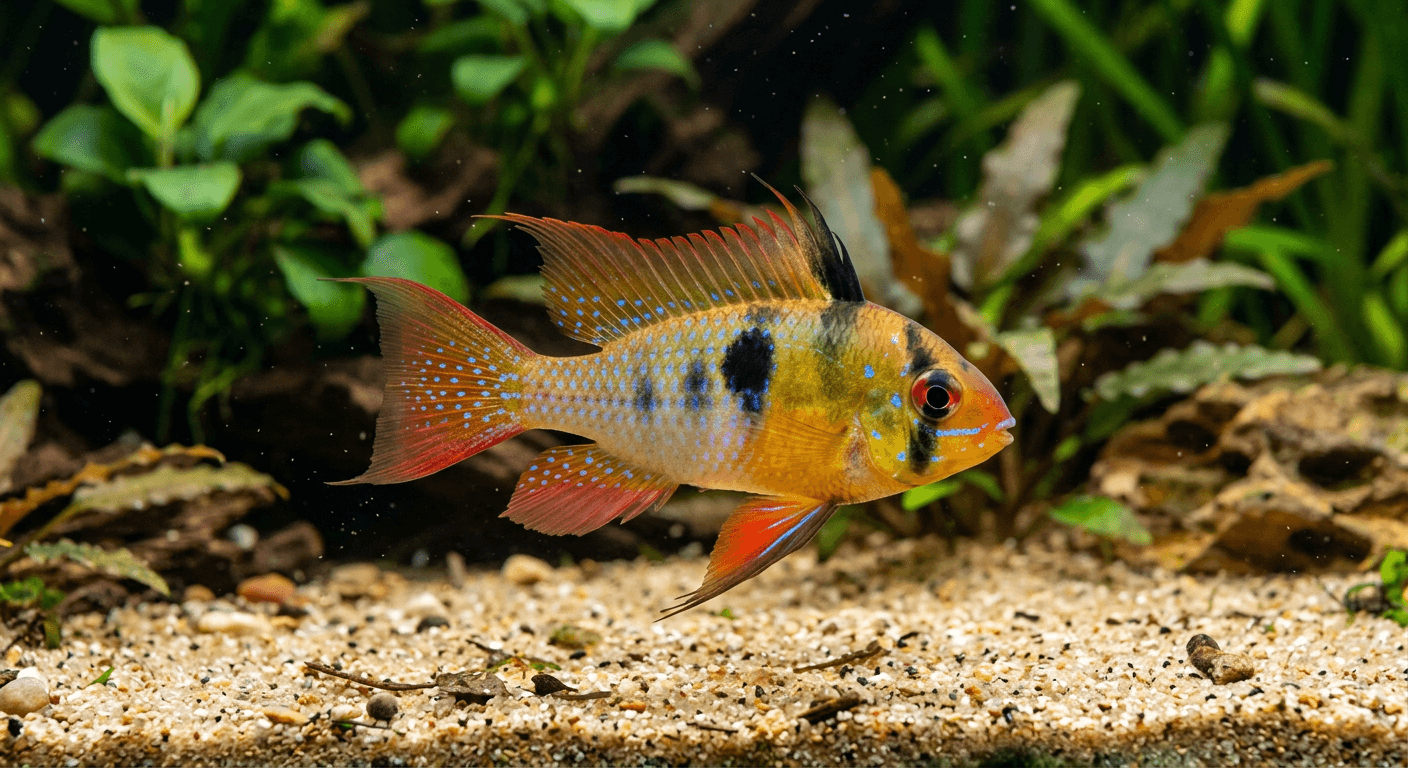
Bolivian Ram
Mikrogeophagus altispinosus
Overview
If the German blue ram is the flashy sports car, the Bolivian ram is the daily driver that actually starts every morning. Same genus (Mikrogeophagus), same pair-bonding intelligence, same entertaining personality, but with a tolerance for real-world water conditions that makes it a genuinely practical community fish. Bolivians handle temperatures from 72 to 79 degrees, accept a pH range of 6.5-7.5, and shrug off the minor parameter swings that would flatten a German blue. They are also bigger, reaching 3-3.5 inches, and live roughly twice as long at 4-6 years. None of that means they are boring. Bolivian rams have a gold-to-olive body with orange-red highlights on the dorsal and tail fins, a dark lateral spot, and vertical barring that intensifies with mood. Watch a pair sift through sand together, flaring at each other over a flat rock they have chosen as a spawning site, and you will understand why dwarf cichlid keepers love this fish. They reward attention. They just do not punish small mistakes the way their German cousins do.
Tank Setup
A 30-gallon tank is the starting point for a single Bolivian or a pair. Bump to 40 gallons for a community that includes a school of tetras and a group of corydoras. Sand substrate is non-negotiable. Bolivians are earth-eaters in miniature, constantly picking up mouthfuls of sand, sifting it through their gills, and spitting it out. Gravel blocks this behavior and can injure their gill rakers. Fine-grain pool filter sand or CaribSea Super Naturals both work well. Decorate with driftwood, rocks, and live plants. Java fern, Anubias, and Vallisneria all tolerate the moderate lighting Bolivians prefer. Create at least two distinct territories with line-of-sight breaks if you keep a pair, since they will claim separate zones outside of spawning. Flat rocks or broad leaves give them potential spawning sites. Moderate filtration with gentle flow is ideal. These are not river fish, and a strong current stresses them.
Water Parameters
This is where Bolivian rams outshine their German blue relatives. They thrive at 72-79 degrees Fahrenheit, with 76 being the sweet spot. That temperature range overlaps with nearly every common community fish, which opens up tankmate options that the 82-degree-demanding German blue ram simply cannot have. pH can sit anywhere between 6.5 and 7.5. Most municipal tap water falls in this window without any adjustment. General hardness between 5-12 dGH is fine. Bolivians still appreciate clean water and low nitrates, but they are not the nitrate-sensor that German blues are. Keep nitrates below 20 ppm with weekly 25% water changes. Use a quality liquid test kit (not strips) and test weekly. If your tap water runs above 7.5 pH or is very hard (over 15 dGH), consider cutting it with RO water, but many keepers run Bolivians successfully in moderately hard tap water straight out of the faucet.
Diet & Feeding
Bolivians are true omnivores and not picky about food. A high-quality sinking micro pellet works as a daily staple. Hikari Micro Pellets or similar small sinking pellets are the right size for their mouths. Supplement 2-3 times per week with frozen bloodworms, brine shrimp, or daphnia. They also enjoy blanched zucchini and cucumber slices, which they will peck at over hours. Feed twice daily in small amounts. Bolivians are methodical eaters. They pick up food, chew on it, spit it out, and pick it up again. In a community with faster fish like tetras, make sure some food reaches the bottom where the rams actually eat. Sinking pellets solve this problem neatly. Live foods like blackworms or baby brine shrimp are excellent for conditioning a pair before breeding.
Behavior & Temperament
Bolivian rams are dwarf cichlids, and they act like it. Each fish will establish a small territory around a piece of driftwood, a rock, or a plant cluster. Within that territory, they are the boss. Outside of it, they are peaceable and ignore most tankmates. Aggression is limited to posturing: flared fins, darkened colors, and lateral displays. Actual fighting with injuries is rare unless two males are crammed into a tank with no room to establish separate zones. Pair bonding is one of the most interesting behaviors you will see in a home aquarium. A bonded pair stays in close proximity, communicates with body language and color changes, and works together to clean spawning sites and guard eggs. During spawning, territorial behavior intensifies and the pair may chase tankmates away from their nest, but this calms down within a couple of weeks. Bolivians are also surprisingly curious. They will follow your finger along the glass and learn to associate your presence with feeding within days.
Compatible Tankmates
The forgiving temperature range of the Bolivian ram makes community planning straightforward. Schools of neon tetras, cardinal tetras, rummy-nose tetras, or harlequin rasboras all work perfectly in the 74-78 degree overlap zone. Cherry barbs and ember tetras add mid-level movement without bothering the rams. For the bottom level, bronze corydoras, sterbai corydoras, or panda corydoras are ideal. They occupy the same sand-level space but corydoras groups are too busy scavenging to trigger territorial responses from the rams. Otocinclus and bristlenose plecos handle algae duty without causing conflict. Amano shrimp are safe with adult Bolivians (though baby shrimp may get eaten). Mystery snails are completely ignored. Avoid oscars, silver dollars, and clown loaches, which are all too large and active. Tiger barbs are fin nippers that will harass the rams' flowing fins. Electric blue acaras overlap in territory and outmuscle Bolivians. Do not mix Bolivians with German blue rams. They can hybridize, and even when they do not, the differing temperature needs create a setup where one species is always compromised.
Common Health Issues
Bolivian rams are hardy by dwarf cichlid standards, but they are still cichlids. Ich is the most common issue, usually triggered by a temperature drop during water changes or after introduction to a new tank. Treat by raising temperature to 82-84 degrees and adding aquarium salt at 1 tablespoon per 5 gallons, or use a malachite green/formalin medication for stubborn cases. Hexamita (hole-in-the-head) shows up as small pits or erosion on the head and lateral line, typically caused by poor water quality or vitamin deficiency. Metronidazole in food is the standard treatment, combined with improving water conditions and adding varied nutrition. Bloating from overfeeding is common since Bolivians will eat anything offered. Fast them one day per week and avoid feeding more than they can consume in 2-3 minutes per session. Internal parasites can arrive with wild-caught specimens. Quarantine new fish for 2-3 weeks and consider a prophylactic round of Praziquantel if they were imported rather than tank-bred.
Breeding
Bolivian rams are substrate spawners that breed more reliably than German blues, making them a good first dwarf cichlid breeding project. A bonded pair will select a flat rock, a broad leaf, or even a cleared patch of sand as their spawning site. The female lays 100-200 eggs in neat rows while the male follows behind to fertilize them. Both parents guard the eggs aggressively, fanning them and removing any that develop fungus. Eggs hatch in about 60 hours at 78 degrees. The fry become free-swimming 4-5 days after hatching. Both parents actively herd the fry cloud around the tank, which is one of the most rewarding things to watch in the hobby. Feed fry with freshly hatched baby brine shrimp starting on day one of free swimming, then transition to crushed flake after a week. First-time pairs sometimes eat the eggs. Give them 3-4 attempts before worrying. A separate 20-gallon breeding tank with a sponge filter gives the best survival rate, but established pairs in a community tank can successfully raise fry if tankmates do not overwhelm the parents' ability to defend them.
Frequently Asked Questions
Quick Stats
What You Need for Bolivian Ram
Gear that works well for this species, based on what experienced keepers actually use.
Rated for 20-50 gallons, which covers the 30-40 gallon range Bolivians need. The adjustable flow control lets you dial back the current since these fish prefer gentle water movement. The large media basket holds biological, chemical, and mechanical filtration without cramming.
Fine, smooth grain that is safe for the ram's sand-sifting behavior. Will not scratch gill rakers or damage barbels on bottom-dwelling tankmates like corydoras. pH neutral, so it will not push your water outside the 6.5-7.5 range Bolivians prefer.
Small enough for Bolivian ram mouths and they sink slowly, giving the rams time to grab them before they hit the substrate. High protein content (over 40%) supports color and condition without the mess of flake food.
100W is properly sized for 30-40 gallon tanks. The Jager holds temperature within 0.5 degrees, and since Bolivians do best at a steady 76 degrees, that precision matters. Fully submersible with an easy-to-read adjustment dial.