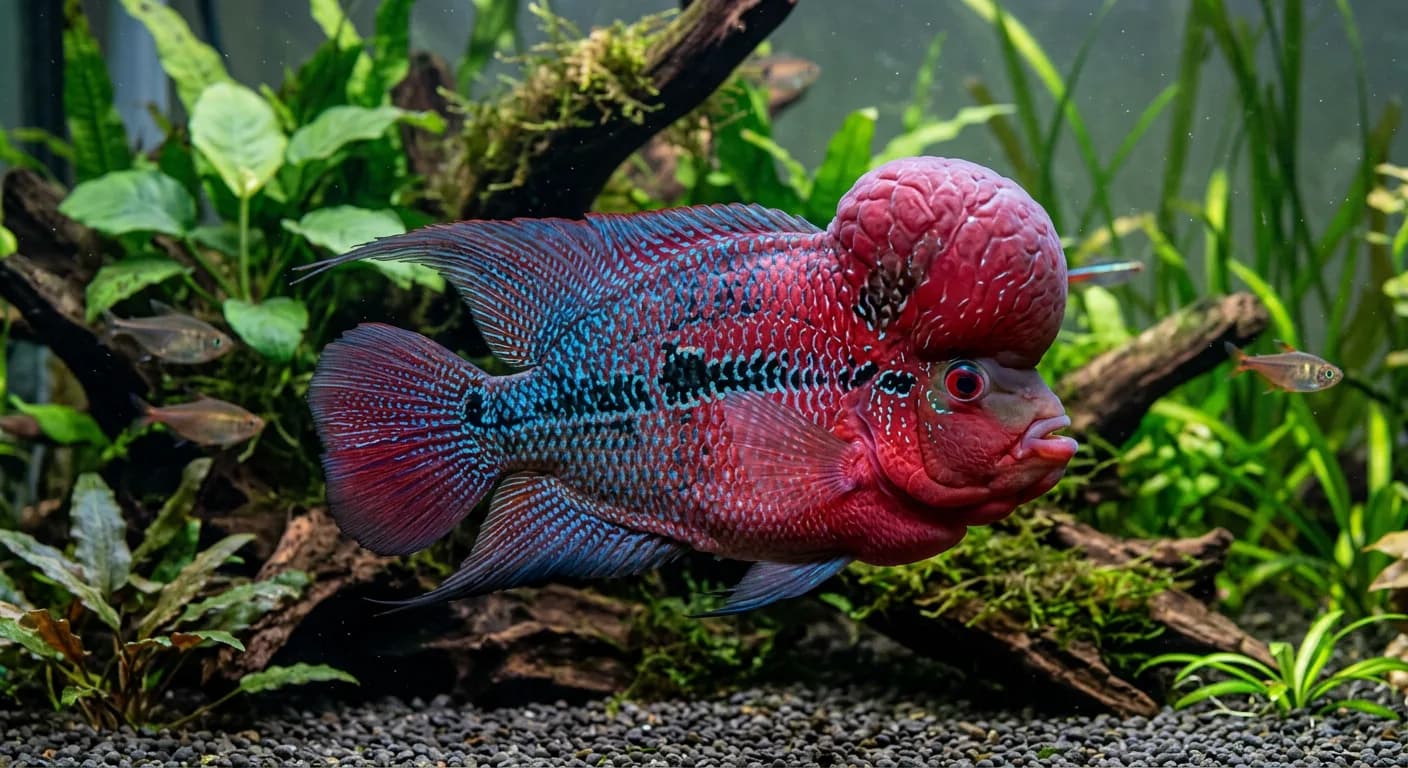
Flowerhorn Cichlid
Flowerhorn (hybrid)
Overview
Flowerhorn cichlids are man-made hybrids created by crossing various Central and South American cichlids. The most distinctive feature is the nuchal hump (kok) that develops on the forehead of mature specimens, especially males. These fish were developed in Malaysia and Thailand in the 1990s and quickly became popular throughout Asia. Flowerhorns are extremely aggressive and territorial, making them unsuitable for community tanks. They must be kept alone or with very carefully selected tankmates in massive systems. The appeal is their interactive personality and striking appearance. Many flowerhorns recognize their owners, beg for food, and even allow petting. Colors range from red and orange to blue and purple with intricate patterns. The nuchal hump can grow quite large, sometimes making up a quarter of the fish's total length. Males typically develop larger humps and more intense colors than females. Quality specimens with good hump development and color can be expensive, often costing hundreds of dollars.
Tank Setup
A 75-gallon tank is the absolute minimum for a flowerhorn, with 125+ gallons strongly preferred. They are active swimmers that need horizontal space and produce heavy waste requiring excellent filtration. Use a strong canister filter rated for at least 1.5-2 times the tank volume. Additional powerheads help with circulation since they prefer strong water flow. Substrate should be sand or fine gravel since flowerhorns are diggers that constantly rearrange their environment. Secure all decorations and equipment because they will move anything not firmly anchored. Live plants are usually not successful due to their digging and aggressive behavior. Artificial plants, rocks, and caves work better. Provide at least one large cave or shelter where they can retreat. Lighting should be moderate to strong to showcase their colors. Cover the tank securely as flowerhorns can jump when excited or territorial. Temperature stability is important so use a quality heater with backup if possible.
Water Parameters
Flowerhorns prefer warmer water than most community fish, with 80-86 degrees being ideal. They can handle slightly cooler temperatures but growth and color development suffer. pH should be neutral to slightly alkaline, between 7.0 and 8.5. They tolerate moderately hard water well. Water quality must be excellent due to their heavy bioload and sensitivity to poor conditions. Ammonia and nitrite must stay at zero. Keep nitrates under 20 ppm with frequent large water changes. Many flowerhorn keepers do 50% water changes weekly or even twice weekly. The combination of large size, heavy feeding, and high temperatures means waste accumulates quickly. Good surface agitation is essential since warm water holds less oxygen. Monitor water parameters frequently, especially during growth spurts when waste production increases rapidly.
Diet & Feeding
Flowerhorns are omnivores with big appetites and specific nutritional needs for color and hump development. Use high-quality cichlid pellets as the staple diet. Look for foods specifically designed for flowerhorns that contain color enhancers and proteins for hump growth. Feed 2-3 times daily, only what they consume in 2-3 minutes. Supplement with frozen foods like bloodworms, brine shrimp, and krill. Live foods like feeder fish, crickets, or earthworms can be offered occasionally but should not be the primary diet. Some flowerhorn foods contain hormones or enhancers to promote hump development, though natural diet and genetics play the biggest role. Avoid overfeeding as it leads to poor water quality and health problems. Young flowerhorns need more frequent feeding (3-4 times daily) while adults can be fed twice daily. Color-enhancing foods with astaxanthin, spirulina, and carotenoids help maintain their vibrant appearance.
Behavior & Temperament
Flowerhorns are highly aggressive and territorial cichlids that view the entire tank as their territory. They will attack any tankmate, including fish much larger than themselves. This aggression extends to their own species, making breeding challenging and housing multiple specimens nearly impossible in home aquariums. Despite their aggression toward other fish, flowerhorns often bond with their human caretakers. They typically rush to the front of the tank when their owner approaches, may follow hands along the glass, and some even tolerate being petted. They are intelligent fish that learn routines and can be trained to perform simple tricks. Flowerhorns are active swimmers that constantly patrol their territory. They dig in substrate, move decorations, and establish definite territories within their tank. Males are generally more aggressive and develop larger nuchal humps than females. Their territorial displays include flaring fins, intense color, and ramming behavior against perceived threats.
Compatible Tankmates
Flowerhorns are best kept alone due to their extreme aggression. In very large systems (200+ gallons), some experienced keepers have successfully housed them with other large, aggressive cichlids like large oscars, jaguar cichlids, or red devils, but this requires careful monitoring and multiple backup plans. Even then, compatibility is never guaranteed and violence can erupt suddenly. Large, fast-moving catfish like common plecos are occasionally tolerated since they occupy different space and are heavily armored, but this is still risky. The safest and most practical approach is to keep flowerhorns as single specimens. Their interactive personality makes them engaging pets even without tankmates. Any attempt at community housing should be done by experienced cichlid keepers with large tanks, multiple territories, and the ability to immediately separate fish if aggression occurs. Most experts recommend against tankmates entirely.
Common Health Issues
Flowerhorns can be susceptible to several health issues, often related to their hybrid nature and intensive breeding. Hole-in-the-head disease is common, appearing as pitted lesions on the head and lateral line. This is usually caused by poor water quality, nutritional deficiencies, or stress. Treatment involves improving water quality and medicated food. Swim bladder problems can occur, especially in specimens with very large nuchal humps that affect their balance. This often improves with varied diet and stable water conditions. Ich and other external parasites are treatable with standard medications, though flowerhorns can be sensitive to some treatments. Internal parasites are occasionally seen, requiring medicated food or stronger medications. Aggressive behavior toward tankmates can result in injuries to both the flowerhorn and other fish. The best prevention is excellent water quality, proper nutrition, and appropriate tank setup. Quarantine new additions and maintain stable conditions to prevent stress-related illnesses.
Breeding
Breeding flowerhorns is extremely challenging in home aquariums due to their aggressive nature and hybrid genetics. Pairs must be carefully introduced in large tanks (150+ gallons minimum) with multiple territories and dividers. Even compatible pairs can turn violent suddenly. Females may be killed by aggressive males, so constant supervision is required. When breeding does occur, flowerhorns are substrate spawners that lay eggs on flat surfaces like rocks or tank bottoms. The female guards eggs while the male patrols territory. Eggs hatch in 3-4 days, and fry become free-swimming within a week. Fry require live foods like baby brine shrimp and frequent feedings. Growth is rapid but uneven, with stronger fry often cannibalizing weaker siblings. Separating fry by size becomes necessary. Since flowerhorns are hybrids, offspring may vary dramatically in appearance and quality. Many commercial breeders use hormone treatments and selective breeding to produce desired traits. Home breeding is better left to experienced cichlid breeders with appropriate facilities.
Frequently Asked Questions
Quick Stats
What You Need for Flowerhorn Cichlid
Gear that works well for this species, based on what experienced keepers actually use.
Strong biological filtration capacity for high bioload cichlids. The 400 model provides adequate flow for waste management in large flowerhorn tanks.
Reliable heating for the warmer water flowerhorns require. Adjustable temperature control and safety features. Durable construction that can handle aggressive fish.
Specially formulated for large cichlids with color enhancers and nutrition for healthy growth. Floating pellets allow for interactive feeding and portion control.
Essential for monitoring water quality with high bioload, aggressive fish. Regular testing prevents the water quality issues that stress flowerhorns.