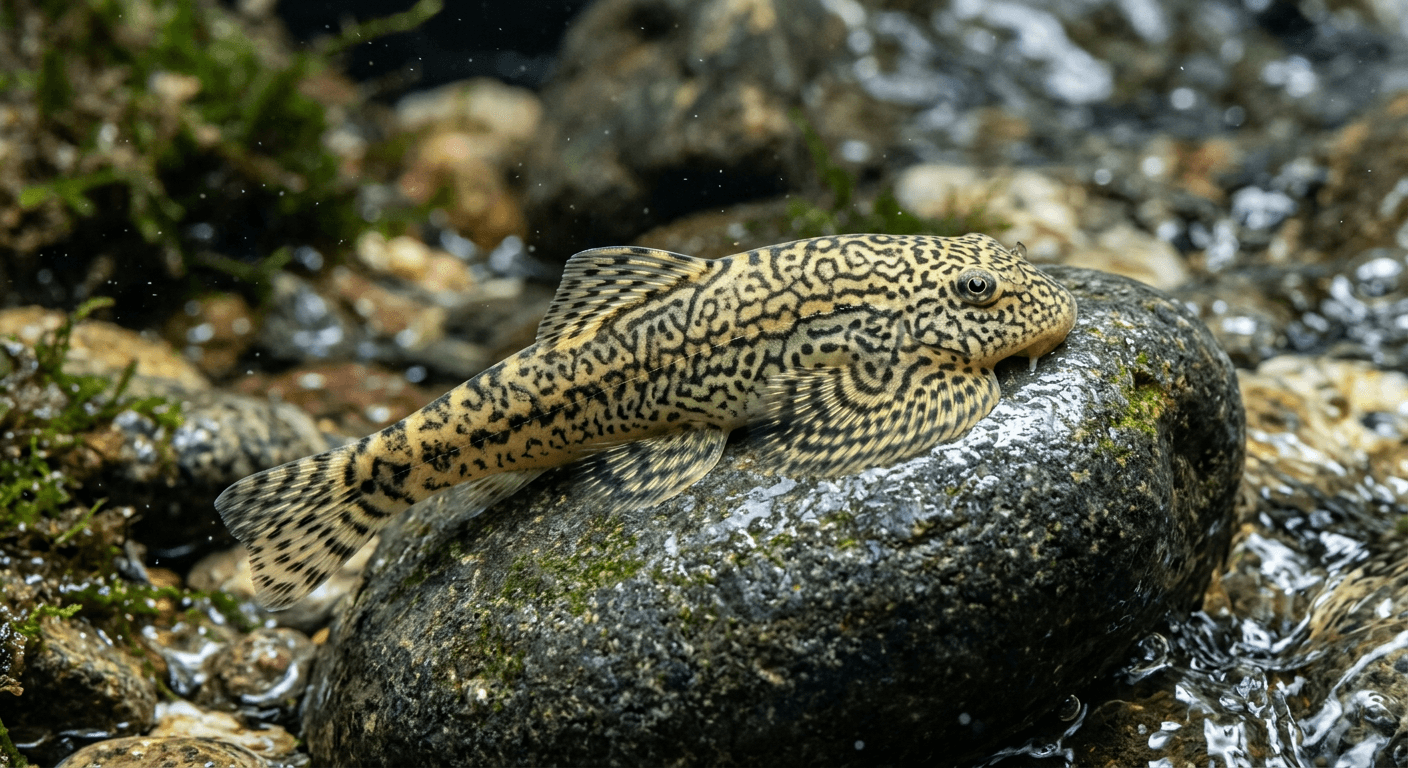
Hillstream Loach
Sewellia lineolata
Overview
Hillstream loaches look like someone crossed a stingray with a gecko and shrunk it down to fit in your aquarium. Their flattened bodies and wide, wing-like pectoral fins are built for one thing: clinging to rocks in fast-moving, oxygen-rich rivers across Southeast Asia. This is not your typical bottom dweller that hides under driftwood. Hillstream loaches actively suction onto hard surfaces in strong current, grazing biofilm as water rushes over them. They need cooler water and higher flow than most tropical community fish, which makes them a poor fit for the average heated tank. Get those two things right and they are fascinating to watch. Get them wrong and they will slowly decline. Most failures come down to warm, stagnant water. If you are willing to set up a river-style tank with a powerhead and keep temps below 75 degrees Fahrenheit, these fish will reward you with years of weird, wonderful behavior.
Tank Setup
The tank setup is where hillstream loaches either thrive or fail, and it comes down to flow. These fish evolved in shallow, fast-moving streams with rocky bottoms, and your aquarium needs to replicate that. A powerhead or wavemaker is not optional. Point it along the length of the tank to create a strong, directional current. The loaches will park themselves right in the flow and graze happily. A 20-gallon long is the minimum, but 40 gallons gives you room to create proper current patterns without dead spots. Substrate should be smooth river rocks and pebbles, not sharp gravel. Flat rocks stacked to create surfaces at different heights give them grazing territory. Driftwood works too, but rocks are the priority. Smooth cobblestones and river stones in varying sizes create the most natural look and the most grazing area. Live plants can work if they tolerate current. Anubias attached to rocks, java fern, and java moss all handle flow well. Avoid fine-leaved plants that get shredded by strong water movement. Lighting should be moderate to encourage some algae and biofilm growth on rock surfaces. A spotless tank with no biofilm is a tank with no food for your hillstream loach. Cooler water means you probably do not need a heater unless your house drops below 65 degrees Fahrenheit. In fact, keeping a heater in a hillstream tank is risky since a stuck thermostat in summer can cook them. If you use one, set it to 68 as a safety floor and nothing higher.
Water Parameters
This is where most people go wrong with hillstream loaches. They need cool water: 65 to 75 degrees Fahrenheit, with 70 being the sweet spot. That is 6-10 degrees cooler than a standard tropical tank. At temperatures above 78, hillstream loaches become stressed, stop eating, and are significantly more prone to disease. Sustained temps above 80 will kill them. In summer, this can be a real problem. If your house gets warm, you may need a fan blowing across the water surface or a clip-on aquarium cooling fan to keep temps down through evaporative cooling. pH should sit between 6.5 and 7.5. They are flexible on hardness but prefer moderate levels. The other non-negotiable is dissolved oxygen. High flow from a powerhead naturally increases oxygen exchange at the surface, which is part of why the flow requirement exists. If your water surface is dead still, oxygen levels drop and hillstreams suffer. Good surface agitation, strong filtration, and weekly 25-30% water changes with dechlorinated water keep conditions right. Ammonia and nitrite must be at zero, and nitrates under 20 ppm. These fish come from pristine mountain streams and have no tolerance for dirty water.
Diet & Feeding
In the wild, hillstream loaches are biofilm grazers. They use their sucker-like mouths to rasp algae, diatoms, microorganisms, and organic film off rocks. In your tank, they will do the same thing if you give them the surfaces and light to support biofilm growth. A tank with some natural algae growth on rocks is ideal. The problem is that most aquariums do not produce enough biofilm to sustain them. You need to supplement. Sinking algae wafers are the easiest option. Drop one in near their favorite rock after lights out. Blanched zucchini, cucumber, and spinach work well too. Weight the veggie down with a fork or veggie clip and remove uneaten portions after 12 hours. Repashy gel foods (Soilent Green or Community Plus) smeared on rocks are excellent because they mimic natural grazing. Hillstream loaches will also accept frozen foods like bloodworms and daphnia occasionally, making them technically omnivorous, but the bulk of their diet should be plant-based. Feed supplemental food every day or every other day. A hillstream loach with a rounded belly is eating well. A skinny one with a sunken gut is starving and needs immediate intervention.
Behavior & Temperament
Hillstream loaches are not shy fish, but they are not exactly social butterflies either. They spend most of their time suctioned to rocks, glass, or any hard surface in the current, slowly moving across it as they graze. Watching one methodically work its way across a flat stone is oddly relaxing. They are not aggressive toward other species, but males can be territorial with each other over prime grazing spots, especially flat rocks in high-flow areas. This usually amounts to one loach chasing another off a rock, nothing that causes injury. Providing plenty of flat surfaces and rocks spread across the tank reduces these squabbles. Despite not being a schooling species, they do well in small groups of 3-5. A single hillstream loach will be fine, but groups show more natural behavior and are more active. They are mostly diurnal, which is a nice change from many bottom dwellers that only come out at night. You will see them grazing throughout the day, occasionally repositioning with a quick dart to a new surface. One of their most distinctive behaviors is the way they move: instead of swimming, they hop from surface to surface, gripping with their modified pelvic fins like a tiny aquatic lizard.
Compatible Tankmates
The key constraint for hillstream loach tankmates is temperature. Any fish that needs water above 78 degrees Fahrenheit is a bad match. That rules out discus, German blue rams, and most warm-water species. The best companions are other cool-water or subtropical fish. Zebra danios are a top pick since they are active, hardy, and thrive in the same temperature range with high flow. Cherry barbs and ember tetras both tolerate the cooler end of their range and add color to the mid-water. Celestial pearl danios are another excellent match, though they prefer slightly calmer areas of the tank. For the bottom, bronze corydoras and panda corydoras overlap well on temperature and appreciate the clean, oxygenated water. Otocinclus share similar grazing habits and temp preferences, just make sure there is enough biofilm for everyone. Invertebrates work great too. Amano shrimp, cherry shrimp, ghost shrimp, and nerite snails all do well in cooler, high-flow setups. Avoid large or aggressive fish. Oscars, bala sharks, and silver dollar fish will eat or harass hillstream loaches. Clown loaches compete for bottom territory and need warmer water. Tiger barbs are too nippy. Stick with peaceful, cool-tolerant species and everyone will coexist.
Common Health Issues
Overheating is the number one killer of hillstream loaches in home aquariums. It is not dramatic. They just slowly decline as temperatures creep above 78 degrees Fahrenheit, eating less, becoming lethargic, and eventually dying. Summer heat waves are particularly dangerous. Monitor tank temperature daily during warm months and have a cooling plan ready. A simple clip-on fan aimed at the water surface can drop temperatures 3-5 degrees through evaporation. Low oxygen is the second biggest threat. Hillstreams evolved in turbulent, highly oxygenated water. A stagnant tank with poor surface agitation will stress them even if the temperature is fine. Run a powerhead and make sure the surface is always moving. Bacterial infections can occur when water quality slips. White patches, frayed fins, or red streaks on the body warrant immediate water testing and a large water change. These fish are sensitive to medications, so try to solve problems with pristine water conditions first. If you must medicate, avoid copper-based treatments. Starvation is the other silent killer. Hillstream loaches do not compete well for food, and in a mixed community they may not get enough to eat. Watch their belly profile regularly. A rounded belly means they are feeding. A concave, pinched belly means they are starving and need targeted feeding immediately.
Breeding
Hillstream loaches are rarely bred in home aquariums, though it has been reported with Sewellia lineolata more than other species. Successful breeders typically keep groups of 4-6 in species-only tanks with very high flow, cool water around 68-72 degrees Fahrenheit, and an abundance of flat rocks. Males tend to be slightly smaller with more pronounced pectoral fin texture. Spawning behavior involves the male trapping the female against a rock surface. Eggs are deposited in small batches on the underside of flat stones in high-current areas. Fry are tiny and need established biofilm to survive. Most successful spawnings happen in mature tanks that have been running for over a year with well-established biofilm colonies on every surface. If breeding hillstream loaches is your goal, focus on water quality, flow, cool temps, and patience. It is not something you can force.
Frequently Asked Questions
Quick Stats
What You Need for Hillstream Loach
Gear that works well for this species, based on what experienced keepers actually use.
Adjustable flow up to 850 GPH with a magnetic mount. Creates the strong, directional current hillstream loaches need to feel at home. Fits 20-80 gallon tanks and the flow can be dialed down if needed.
Dense sinking wafers designed for algae-eating bottom feeders. They hold together in strong current without dissolving immediately, so hillstream loaches can graze on them over time.
Smooth, rounded river stones that mimic the natural streambed habitat. No sharp edges to damage the loach's flat underside. The varied sizes create grazing surfaces and natural-looking terrain.
Tests pH, ammonia, nitrite, and nitrate. Hillstream loaches need pristine water quality and zero tolerance for ammonia spikes. Liquid tests are far more accurate than test strips for the precision these fish demand.