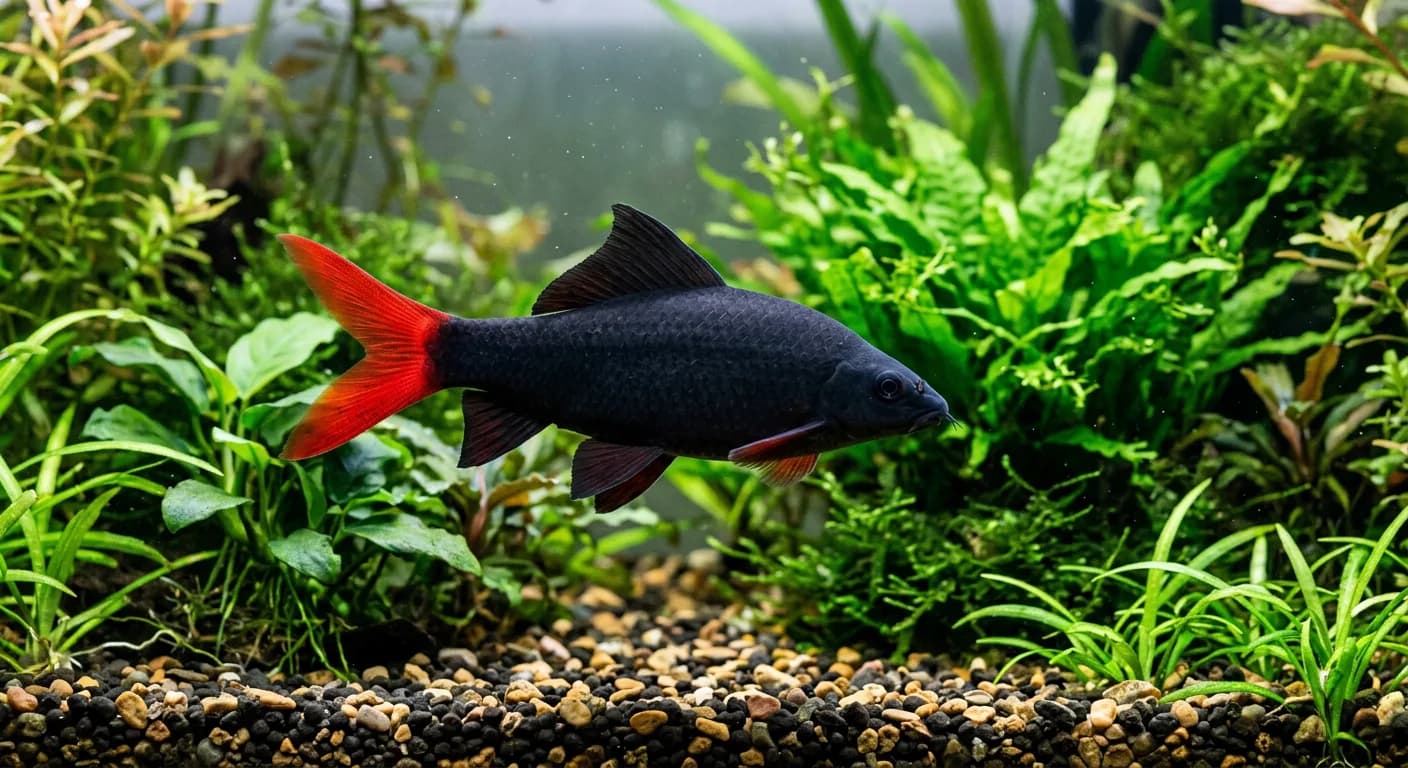
Red-Tailed Shark
Epalzeorhynchos bicolor
Overview
Red-Tailed Sharks are not actually sharks but members of the carp family that earned their name from their upright dorsal fin and territorial behavior. The contrast between their jet-black body and bright red tail makes them one of the most striking freshwater fish available. However, their beauty comes with responsibility. These fish are semi-aggressive and territorial, especially toward other bottom-dwelling fish or anything that resembles them. You can only keep one Red-Tailed Shark per tank, as two will fight constantly. They need plenty of space to establish territory and enough tankmates to spread their attention around. When kept properly in a large tank with appropriate companions, they become the centerpiece fish that draws everyone's eye. They are active swimmers that patrol the bottom third of the tank, constantly searching for food and defending their chosen spots. Red-Tailed Sharks are hardy once established but require careful planning when it comes to tankmate selection.
Tank Setup
Start with a 55-gallon minimum, though a 75-gallon provides better territory distribution and more stable water conditions. Red-Tailed Sharks need a well-decorated tank with plenty of hiding spots and territorial boundaries. Use caves, driftwood, large rocks, and dense plant groups to create separate zones. They appreciate a sandy or fine gravel substrate since they spend time foraging along the bottom. Filtration should be robust since these fish produce more waste than smaller species. A canister filter rated for your tank size plus 20-30% extra capacity works well. They prefer moderate to strong water flow, which helps oxygenate the water and mimics their natural river habitat. Good lighting supports plant growth, and live plants help break up sight lines to reduce territorial disputes. Java fern, anubias, and cryptocoryne species work well and can handle the occasional rough treatment from an investigating Red-Tailed Shark.
Water Parameters
Red-Tailed Sharks prefer slightly acidic to neutral water with a pH between 6.5 and 7.5. They do well in soft to moderately hard water and need stable conditions once established. Temperature should stay between 72-79 degrees Fahrenheit, with 76 degrees being ideal. Water quality must be excellent since these active fish are sensitive to ammonia and nitrite. Keep ammonia and nitrite at zero, nitrates under 20 ppm. Their bioload and territorial behavior can stress other fish, so consistent water changes of 25-30% weekly help maintain good conditions. They need well-oxygenated water due to their high activity level and preference for river-like conditions. Test water parameters regularly, especially during the first few months as they establish their territory and settle into the tank.
Diet & Feeding
Red-Tailed Sharks are omnivores with hearty appetites. A high-quality sinking pellet should form the base of their diet since they are primarily bottom feeders. Supplement with algae wafers, blanched vegetables like zucchini and spinach, and protein foods like bloodworms and brine shrimp. They are natural algae grazers and will help control algae growth in the tank, though they should never be relied upon as the sole algae control method. Feed once or twice daily, offering only what they can consume in 3-4 minutes. These fish are competitive eaters and will often chase other fish away from food, so spread food around the tank or use multiple feeding spots to ensure all tankmates get their share. They also appreciate sinking foods that reach the substrate where they spend most of their time foraging.
Behavior & Temperament
Red-Tailed Sharks are territorial and semi-aggressive, particularly toward other bottom-dwelling fish and anything with similar body shape or coloration. They establish territories in the lower third of the tank and will chase away intruders with aggressive displays and physical confrontation. However, their aggression is usually directed downward toward smaller fish rather than upward toward larger tankmates swimming in the middle and upper water column. They are most aggressive during feeding time and when establishing new territory. Once settled, many Red-Tailed Sharks become less aggressive but still maintain their territorial nature. They are active swimmers that constantly patrol their territory, investigating every corner and crevice. The key to success is providing enough space and appropriate tankmates so their territorial behavior does not become problematic for other fish in the community.
Compatible Tankmates
Red-Tailed Sharks do best with medium to large, semi-aggressive to moderately peaceful fish that swim in the middle and upper water column. Tiger barbs, cherry barbs, and larger tetras like rummy-nose work well since they school in the middle water and can handle some chasing. Angelfish and medium-sized cichlids like electric blue acaras make good upper-level companions. Avoid other bottom-dwelling territorial fish like other sharks, large plecos, or cichlids that claim bottom territory. Small, peaceful fish like neon tetras, corydoras, and dwarf gouramis often get stressed by constant harassment. Fast-swimming fish that can escape to upper water levels work better than slow, bottom-dwelling species. Never keep two Red-Tailed Sharks together unless you have a massive tank (150+ gallons) with extensive territorial boundaries.
Common Health Issues
Red-Tailed Sharks are relatively hardy but can suffer from stress-related illnesses if kept in improper conditions. Ich is common when they are first introduced to new tanks or during periods of poor water quality. Their territorial stress can also make them susceptible to bacterial infections if they injure themselves during aggressive displays. White spot disease and fin rot occur occasionally, usually related to water quality issues. Internal parasites can be a problem with wild-caught specimens, though most available fish are now tank-bred. The biggest health issue is often stress-related, caused by inadequate tank size, poor tankmate choices, or lack of territorial boundaries. Stressed Red-Tailed Sharks lose their bright colors, hide constantly, and become more susceptible to disease. Maintaining excellent water quality, proper tank size, and appropriate tankmates prevents most health problems.
Breeding
Breeding Red-Tailed Sharks in home aquariums is extremely rare and difficult. Most breeding occurs in commercial farms using large outdoor ponds and hormone injections to trigger spawning. They are egg scatterers that require specific seasonal temperature and water condition changes to breed naturally. Males become more territorial during breeding season and develop slightly more intense coloration. Females grow rounder when carrying eggs. Even if spawning occurs, the parents will eat their own eggs and fry aggressively. The fry are tiny and difficult to feed, requiring live foods like infusoria and baby brine shrimp. Most Red-Tailed Sharks in the aquarium trade are farm-raised in Southeast Asia rather than bred by hobbyists. If you are interested in breeding projects, focus on easier species first and gain experience before attempting Red-Tailed Sharks. Their territorial nature and specific requirements make them unsuitable for novice breeding attempts.
Frequently Asked Questions
Quick Stats
What You Need for Red-Tailed Shark
Gear that works well for this species, based on what experienced keepers actually use.
Powerful filtration system rated for 30-70 gallon tanks. Bio-wheel provides excellent biological filtration needed for the higher bioload of semi-aggressive fish like Red-Tailed Sharks.
Reliable heater that maintains the 72-79°F range Red-Tailed Sharks prefer. External temperature controller allows precise adjustment without disturbing the fish.
High-protein sinking pellets that reach the bottom where Red-Tailed Sharks feed. Natural insect protein supports their omnivorous diet and maintains good coloration.
Fine, smooth sand substrate perfect for bottom-dwelling fish that like to forage. Will not injure barbels or fins during their constant bottom exploration and territorial displays.