How to Acclimate New Fish (Stop Killing Fish on Day One)
You just drove home from the fish store with a bag of new fish. What you do in the next 30-60 minutes determines whether those fish live or die. Fish that go from store water into your tank without proper acclimation can experience pH shock, temperature shock, and osmotic stress that kills them within hours to days. The fish looks fine when you drop it in. Then it's dead on the bottom by morning. Proper acclimation takes 20-45 minutes and costs nothing. Here's how to do it right.
01
Why Acclimation Matters
Fish store water and your tank water are different. Often very different. The store might run pH 7.8 on hard well water while your tank sits at pH 6.5 on soft tap water. Their temperature might be 74 while yours is 78. Ammonia in a store bag that's been sealed for an hour is climbing by the minute.
Fish are cold-blooded and permeable. Their bodies constantly exchange water and dissolved substances with their environment through gills and skin. A sudden change in pH, temperature, or mineral content forces their body to adapt instantly instead of gradually. That's physiological shock.
pH shock is the most dangerous. A difference of 0.5 pH units, experienced suddenly, can damage gill tissue and disrupt blood chemistry. A full point difference (say, 7.5 to 6.5) experienced instantly is often lethal. Temperature shock triggers ich outbreaks, suppresses the immune system, and can cause organ failure in extreme cases.
Osmotic stress happens when the dissolved mineral content (TDS) of the new water is very different from bag water. Fish in hard water suddenly placed in soft water have to rapidly adjust how much water their cells absorb or expel. This is invisible but exhausting and sometimes fatal, especially for invertebrates like shrimp.
02
The Float Method
The float method is the bare minimum and handles temperature only. It doesn't acclimate fish to differences in pH, hardness, or chemistry. For hardy species going into similar parameters, it works fine.
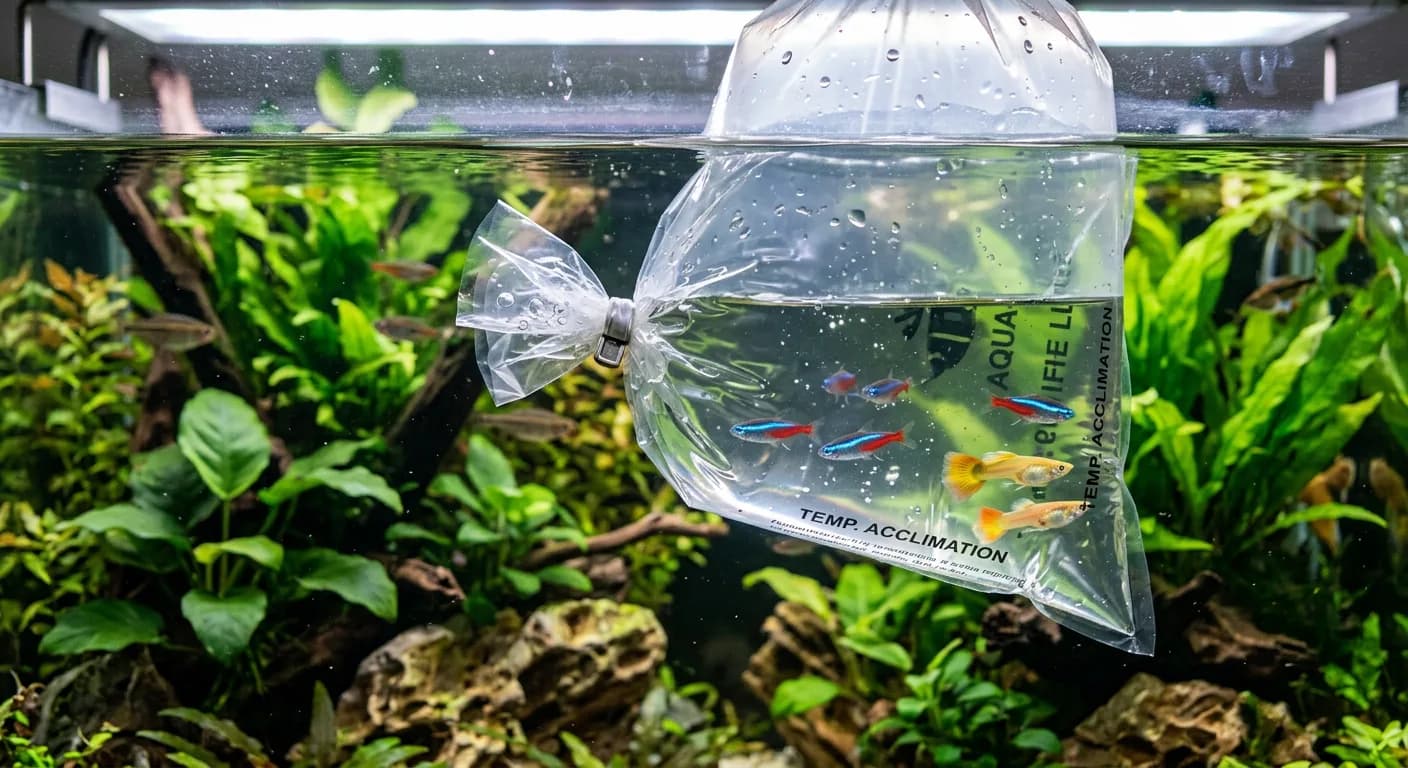
Float the sealed bag in your tank for 15-20 minutes. The water in the bag gradually reaches tank temperature. That's it for temperature.
After floating, open the bag and roll down the edges to create a floating bowl. Add about half a cup of tank water to the bag every 5 minutes for 20-30 minutes. This gradually shifts bag water toward your tank's chemistry. After 4-5 additions, net the fish out and place them in the tank. Discard the bag water and do not pour it into your tank.
Works well for hardy community fish like guppies, platies, danios, most tetras when your parameters are reasonably close to the store's. Takes about 30-40 minutes total.
Don't float the bag more than 45 minutes. Ammonia builds up in the sealed bag from waste and respiration. The longer the bag stays sealed, the worse the water quality gets. If you're acclimating for chemistry (not just temperature), switch to the drip method.
03
The Drip Method
The drip method is the gold standard. It gradually replaces bag water with tank water over 45-90 minutes, giving fish time to adjust to every parameter difference simultaneously. Use it for sensitive species like cardinal tetras, otocinclus, discus, ram cichlids, and all invertebrates (shrimp are extremely sensitive to parameter swings).
You need: a clean bucket, airline tubing (3-4 feet), and something to control flow (a loose knot or airline valve).
Pour the fish and all bag water into the bucket. Position the bucket below the tank. Run airline tubing from the tank into the bucket. Start a siphon by sucking briefly on the bucket end. Tie a loose knot to slow flow to 2-4 drips per second.
Let it drip until water volume in the bucket roughly doubles. For most fish, that's 30-45 minutes. For shrimp, let it triple over 60-90 minutes. Shrimp are more sensitive to TDS and pH changes than fish.
Once volume has doubled (or tripled for shrimp), net the fish out and place them in the tank. Dump the bucket water. Never pour acclimation water into your tank because it contains concentrated waste plus any parasites or pathogens from store fish.
Keep lights off for a few hours after adding new fish. Dim conditions reduce stress and give them time to find hiding spots and settle in.
04
Plop and Drop: When It Works
Plop-and-drop means netting the fish out of the bag and putting them straight into the tank with zero acclimation. Sounds reckless, and for most situations it is. Experienced fishkeepers sometimes use it deliberately.
Why use plop-and-drop? Bag water quality drops fast. Ammonia builds up, CO2 increases, pH drops. The longer you acclimate, the longer the fish sits in deteriorating water. If the fish has been in the bag for a long time, the bag water may be so toxic that getting the fish out quickly is the priority.
Key detail: ammonia toxicity depends on pH. In acidic water (low pH), ammonia exists mostly as ammonium (NH4+), much less toxic. As you add tank water during acclimation, you raise the pH, converting that relatively safe ammonium back into toxic ammonia (NH3). You can actually make things worse by slowly acclimating a fish in a bag with high ammonia.
When plop-and-drop makes sense: the fish has been in the bag more than 3-4 hours, you know the bag water has high ammonia (it smells), and the temperature difference is small (under 3-4 degrees).
When to avoid it: your parameters are significantly different from the store's, you're acclimating shrimp or invertebrates, or adding sensitive species. For most hobbyists buying fish at a local store 20 minutes away, the drip method is safer.
05
Quarantine Tanks
A quarantine tank is a separate, bare-bones tank where new fish spend 2-4 weeks before joining your main display. It's the single best practice that most hobbyists skip and later regret.
Why quarantine works: fish stores house hundreds of fish from dozens of suppliers in interconnected systems. Ich, velvet, bacterial infections, and parasites spread easily between tanks. A fish can carry parasites without showing symptoms and introduce them to your healthy tank. One sick fish from the store can wipe out a community you spent months building.
A quarantine setup doesn't need to be fancy. A 10 gallon tank, sponge filter, heater, and a hiding spot (PVC pipe, terracotta pot) is the whole setup. No substrate needed. Bare bottom is easier to medicate and clean.
During 2-4 weeks, observe fish for signs of disease: white spots (ich), gold dust (velvet), clamped fins, rapid breathing, loss of appetite, white stringy poop (internal parasites), fuzzy patches (fungal infection). Many experienced keepers prophylactically treat all new fish with the 'med trio': Ich-X, Fritz ParaCleanse, and Fritz Maracyn simultaneously.
If the fish stays healthy through quarantine with no symptoms, it's safe to move to your display tank. Acclimate it the same way as a new fish from the store.
06
What NOT to Do
Don't dump the bag water into your tank. Store water contains elevated ammonia, possibly parasites, medications, or disease organisms from shared systems. Net the fish out and discard the water. This single habit prevents most disease introductions.
Don't skip acclimation entirely. Even a 15-minute float is better than nothing. Tossing a fish from 72 degree store water into your 80 degree tank is a recipe for ich and shock.
Don't acclimate with lights on at full blast. New fish are already stressed from being netted, bagged, transported, and dumped into unfamiliar water. Bright lights add stress. Turn lights off or dim them for at least 2-3 hours after adding new fish.
Don't add too many fish at once. Even in a fully cycled tank, the beneficial bacteria population is sized to the current bioload. Adding 15 fish to a tank that had 6 can temporarily overwhelm filtration and spike ammonia. Add 3-4 fish at a time with at least a week between additions.
Don't feed new fish on day one. They're stressed and unlikely to eat much. Uneaten food just fouls the water. Wait 24 hours, then offer a small amount.
Don't rearrange decorations right after adding fish. Some guides suggest this to reset territories for aggressive species. It works for cichlids being added to a cichlid tank, but for most community fish, rearranging just adds chaos. Let them settle for a few days first.
07
Species-Specific Tips
Shrimp (cherry, amano, crystal red): always drip acclimate for 60-90 minutes minimum. Shrimp are extremely sensitive to TDS changes. A sudden shift can cause molting problems that kill them within days. Crystal red shrimp and other Caridina species need even longer, up to 2 hours. Failed molts are the number one killer of newly added shrimp.
Otocinclus: drip acclimate for 45-60 minutes. Otos are wild-caught more often than not and are extremely fragile during transport. Many arrive already stressed and malnourished. Drip acclimation plus a quarantine period where you fatten them up on blanched zucchini and algae wafers significantly improves survival rates. Expect some losses even with perfect acclimation. Otos are just difficult to transition.
Cardinal tetras: drip acclimate for 45-60 minutes. Wild-caught cardinals come from extremely soft, acidic water (pH 4.5-5.5). If your tank is pH 7.5 and hard, the transition needs to be very gradual. Tank-raised cardinals are more adaptable but still benefit from a slow drip.
Bettas: float-and-add works fine. They're hardy and adaptable. Float for 15-20 minutes, add tank water to the bag over 15-20 minutes, then net and release. Bettas tend to explore their new space immediately. That's normal, not stress.
Corydoras: drip for 30-45 minutes. Cories are fairly hardy but they produce a mild toxin when severely stressed that can poison other fish in a small, enclosed space like a shipping bag. Get them out of the bag water and don't add that water to your tank.
Table of Contents
Related Content
Popular Fish Species
Essential Gear
Best Filter for a 20 Gallon Tank
Aquaneat 3-Pack Biosponge Filter