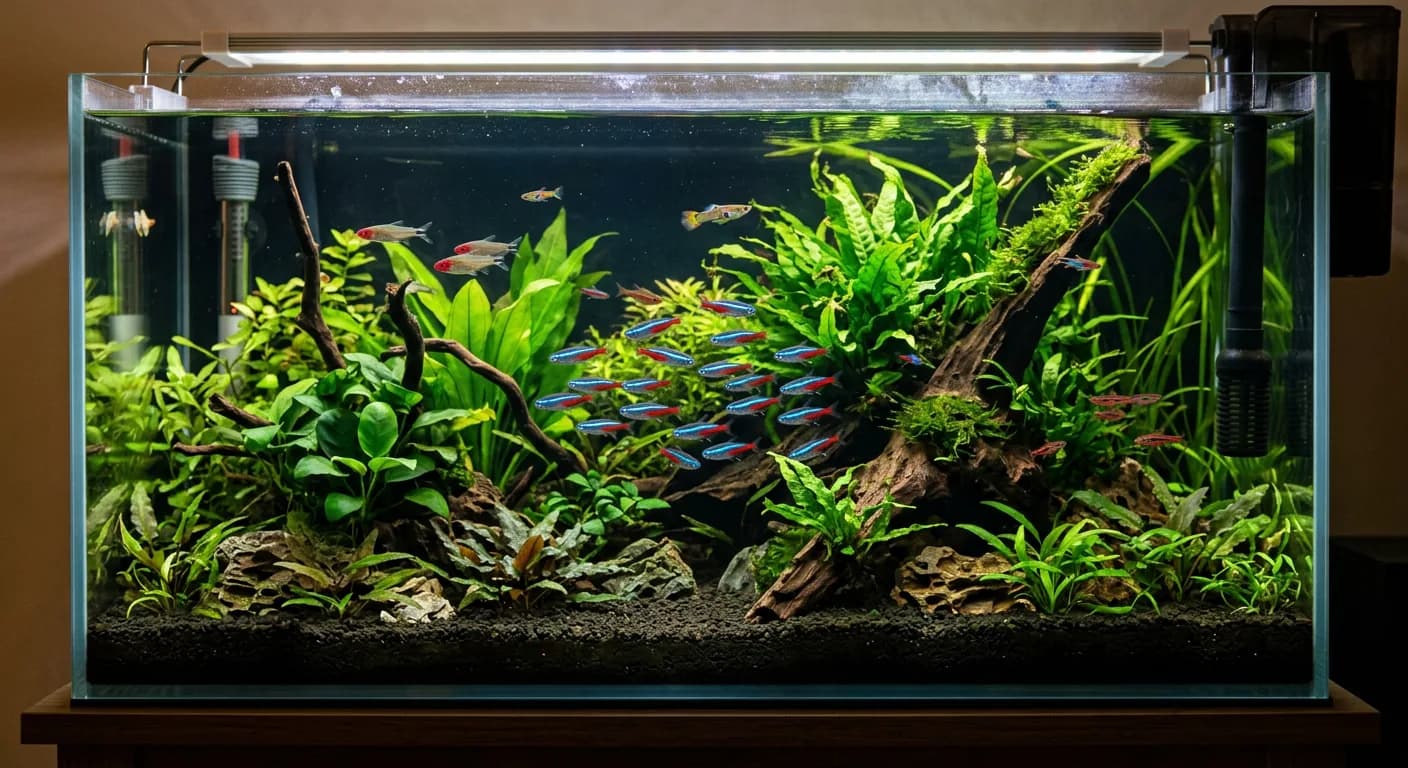
Best Fish for a 10 Gallon Tank (With Stocking Combos)
A 10 gallon tank is where most people start, and honestly, it's a solid size. You've got real options here compared to a 5 gallon, but it's still a small tank, and the wrong fish will outgrow it or trash the water quality in weeks. This guide covers the fish that genuinely do well in 10 gallons, community combos that are tested and proven, and the species you should skip no matter what the pet store employee tells you.
01
What a 10 Gallon Can Handle
You've probably heard the "one inch of fish per gallon" rule. Ignore it. A 10-inch oscar would not survive in a 10 gallon tank, and 10 one-inch fish might overload the filtration in a bare tank with a basic kit filter.
What actually determines stocking capacity in a 10 gallon:
Filtration is the biggest variable. A sponge filter rated for 10 gallons handles a moderate bioload. An AquaClear 20 or similar hang-on-back filter gives you more room because it processes waste faster. Upgraded filtration buys you extra stocking room.
Live plants absorb nitrates between water changes and add oxygen. A 10 gallon with java fern, anubias, and some stem plants can handle a heavier fish load than the same tank with plastic decorations. Plants don't replace water changes, but they provide a real buffer.
Swimming space matters as much as water quality. Some fish need horizontal room to school. Others stick to one spot. A group of 8 ember tetras takes up less functional space than 4 harlequin rasboras because embers are smaller and tighter schoolers.
Species temperament dictates how many fish can share the space without stress. Territorial fish need more room per individual than peaceful community species. A single betta with a small school of nano fish works because the betta mostly patrols and the school stays together.
A realistic 10 gallon tank with decent filtration and some live plants can comfortably house 8-12 nano fish (under 1.5 inches each) or a single centerpiece fish with 6-8 small tankmates. That's the honest range. Push past it and you'll be fighting water quality problems constantly.
02
Best Solo Fish: Betta
The betta is still the best single fish for a 10 gallon, and the extra space over a 5 gallon opens up community possibilities that most people don't realize exist.
A male betta in a 10 gallon has enough territory to feel secure without becoming hyper-aggressive toward tankmates. The key is choosing the right companions and having enough plant cover to break sight lines.
The classic 10 gallon betta community: 1 male betta + 6 ember tetras + 3 nerite snails. This combination works because ember tetras are small enough to avoid triggering the betta's predator instinct, fast enough to dodge if he flares, and dull-colored enough that he doesn't see them as rival males. Nerite snails are too slow and armored for the betta to bother with.
Other betta-compatible tankmates in a 10 gallon: - 6-8 pygmy corydoras (they stay at the bottom, away from betta territory) - 3-5 amano shrimp (big enough that most bettas leave them alone, though some bettas hunt anything) - 4-5 otocinclus (only in tanks running 3+ months with established algae) - 6-8 chili rasboras (even smaller than embers, same principle applies)
What doesn't work with bettas in a 10 gallon: - Other bettas, male or female. Period. A 10 gallon is not big enough for a sorority. - Guppies. Males have colorful flowing tails that bettas mistake for rival males. - Dwarf gouramis. Same family, territorial conflicts guaranteed. - Neon tetras. They can work, but their bright coloring sometimes triggers aggression in bettas, and the 10 gallon doesn't leave enough escape room.
The betta's temperament varies wildly between individuals. Some bettas coexist peacefully with anything. Others attack snails. Always have a backup plan if your betta turns out to be a serial harasser. A spare 5 gallon or a tank divider solves most problems.
Feed your betta high-quality pellets like Hikari Betta Bio-Gold, 3-4 pellets twice daily. Supplement with frozen bloodworms or brine shrimp 2-3 times per week. Bettas are carnivores and need protein-rich food, not generic tropical flakes.
03
Best Schooling Fish
Schooling fish bring movement and life to a 10 gallon, but the tank size limits which species actually have enough room. These four are the best options, ranked by how well they fit.
Ember Tetras (8-10 fish) are the top pick for a 10 gallon. They max out at 0.8 inches, school tightly, and produce almost no bioload. Their warm orange coloring pops against green plants. They tolerate pH from 5.5 to 7.5 and temperatures from 73-84F. Embers are peaceful to the point of being timid, so avoid housing them with anything large or aggressive. A group of 10 in a planted 10 gallon leaves room for a small cleanup crew.
Celestial Pearl Danios (6-8 fish) are a close second. These tiny fish (about 1 inch) have striking spotted patterns that look hand-painted. They prefer cooler temperatures (73-79F) and slightly acidic to neutral water (6.5-7.5 pH). Males spar with each other but don't cause real damage. Keep at least 6 to spread aggression and include 2 females for every male if possible. They appreciate dense plant cover and will display their best colors in a well-planted tank.
Harlequin Rasboras (6-8 fish) are a reliable community fish, but they're pushing the size limit for a 10 gallon at about 2 inches each. A group of 6 works if they're your only mid-level fish. They school beautifully, tolerate a wide pH range (6.0-7.8), and handle temperatures from 72-80F. Hardy and forgiving of beginner mistakes, but they'll look and act better in a 20 gallon where they have more swimming room.
Neon Tetras (6-8 fish) are probably the most popular aquarium fish alive, and a 10 gallon is technically their minimum tank size. Here's the honest take: neons are not as easy as people think. They need stable temperatures (72-78F), established tanks with a completed nitrogen cycle, and consistent water parameters. Wild-caught neons and poorly bred farm stock carry diseases at alarming rates. If you buy neons, source them from a store that quarantines their stock, and don't add them to a tank that's less than 6 weeks old. When healthy, they're gorgeous and school well. But they're a worse choice for beginners than ember tetras or celestial pearl danios.
For any schooling fish in a 10 gallon, feed small amounts 2-3 times daily rather than one large feeding. Their mouths are tiny and they process food quickly. Fluval Bug Bites are a solid staple because the granules are small enough for nano fish and the insect-based protein matches their natural diet.
Fluval Bug Bites Tropical Fish Food
Insect-based granules sized perfectly for nano fish. High protein without clouding the water.
04
Best Bottom Dwellers
The bottom of a 10 gallon tank is valuable real estate, and stocking it with the right cleanup crew keeps your substrate cleaner and adds activity to an area that would otherwise sit empty.
Pygmy Corydoras (6-8 fish) are the best bottom dweller for a 10 gallon, hands down. At just under 1 inch, they're small enough that a group of 6-8 barely registers on the bioload meter. They school together along the bottom, occasionally darting to the surface for a gulp of air (completely normal behavior). They prefer sandy substrate that won't scratch their barbels, temperatures of 72-79F, and soft to moderately hard water.
Pygmy cories differ from their larger relatives in an important way: they don't just sit on the bottom. They hover in the lower third of the water column and actively swim as a group, which makes them more interesting to watch than most catfish. Feed them sinking pellets or wafers after lights-out, supplemented with frozen foods like baby brine shrimp.
Why regular corydoras don't fit a 10 gallon: Bronze cories, sterbai cories, and panda cories all grow to 2-2.5 inches. They need groups of 6 minimum, and 6 two-inch catfish in a 10 gallon eats up most of your stocking capacity while leaving limited room for mid-level fish. These species do much better in a 20 gallon long where they have floor space to forage naturally. Putting 4 bronze cories in a 10 gallon "because it's a small group" still doesn't work since 4 is below their minimum school size and they'll be visibly stressed.
Otocinclus (4-5 fish) are excellent algae eaters at about 1.5 inches each, but they come with a major caveat: only add them to a tank that's been running for 3+ months with visible algae growth. Otos are wild-caught, ship poorly, and often arrive malnourished. They need established biofilm and soft algae to survive. In a new tank with clean glass, they starve. Once established, they're peaceful, efficient, and fascinating to watch as they graze methodically across every surface.
Nerite Snails (2-3) are the lowest-maintenance cleanup crew. They eat algae constantly, can't breed in freshwater (so no population explosions), and their shells come in attractive zebra or tiger patterns. They do occasionally climb out of uncovered tanks, so keep a lid on. Two to 3 nerite snails in a 10 gallon handle most algae on glass and hardscape without producing meaningful waste.
Amano Shrimp (3-5) are another option for algae control. At about 2 inches, they're large enough that most fish leave them alone (though bettas and larger fish sometimes hunt them). Amanos eat soft algae, leftover food, and decaying plant matter. Like nerites, they won't breed in freshwater. They're sensitive to copper, so avoid medications containing copper sulfate if you keep shrimp.
05
Community Combos That Work
Instead of vague advice about "compatible species," here are 4 specific stocking lists that are proven in real 10 gallon tanks. Pick one and stock it exactly as written.
Combo 1: The Nano School - 8 ember tetras - 6 pygmy corydoras - 2 nerite snails
This is the safest, most balanced 10 gallon community. Low bioload, all species are peaceful, and you get activity at every water level. The embers school in the middle, pygmy cories work the bottom and lower third, and nerites clean surfaces. Works with a basic sponge filter and weekly 25% water changes. Temperature: 74-78F.
Combo 2: Betta Community - 1 male betta - 6 ember tetras - 3 amano shrimp
The betta owns the upper level, embers school in the middle, and amanos patrol the bottom. This combo requires more plant cover than Combo 1 because the betta needs sight line breaks to avoid fixating on the tetras. Java fern, anubias, and floating plants like salvinia work well. Temperature: 76-80F. Monitor the betta's behavior for the first 2 weeks and remove the tetras if he won't stop chasing them.
Combo 3: Danio Display - 6 celestial pearl danios - 6 pygmy corydoras - 3 nerite snails
A slightly more colorful option. Celestial pearl danios have better coloring than embers and their spotted pattern stands out in a planted tank. Males will display to each other, which adds behavior you won't get from embers. The pygmy cories and nerites round out the bottom. Temperature: 73-78F.
Combo 4: The Rasbora Tank - 6 harlequin rasboras - 4 pygmy corydoras - 2 nerite snails
This one pushes the stocking limit more than the others because harlequin rasboras are larger fish. You get a tighter community, and the rasboras' copper-orange bodies with black wedge markings create a striking school. Only run this combo with upgraded filtration (hang-on-back filter, not just a sponge). Temperature: 74-78F.
What all 4 combos have in common: planted tank, heater set to the overlap temperature, weekly water changes of 25-30%, and a cycled tank before adding fish. Don't try to combine elements from multiple combos. Each one is balanced as-is. Adding "just 2 more tetras" or "one more cory" is how beginners slowly overshoot their tank's capacity.
06
What Doesn't Belong in a 10 Gallon
Pet stores sell all of these fish to 10 gallon tank owners. Every single one is a bad fit.
Goldfish are the worst offender. Even "fancy" goldfish grow to 6-8 inches, produce enormous waste, and need 20+ gallons per fish with powerful filtration. Common goldfish (the feeder fish) grow to 12 inches and belong in ponds. The ammonia output of a single goldfish in 10 gallons will spike within days regardless of your filter. If you want goldfish, start with a 40 gallon.
Angelfish grow to 6 inches tall and 8 inches long. They need a minimum 20 gallon tall tank for a single fish, and they eat anything small enough to swallow, including neon tetras. A 10 gallon angelfish is a stressed, stunted fish that will never display normal behavior.
Common Plecos get sold at 2 inches and grow to 12-18 inches over several years. They produce massive waste and need 75+ gallon tanks as adults. Stores keep selling them because customers keep buying them, and the store won't have to deal with the 15-inch problem fish 2 years later. If you want a pleco for a 10 gallon, a bristlenose is your only reasonable option, and even that's a tight fit.
Dwarf Gouramis are technically small enough for a 10 gallon at about 3.5 inches. The real problem is the dwarf gourami iridovirus (DGIV), which has decimated commercially bred stock to the point where a large percentage of pet store fish carry it. Healthy dwarf gouramis also prefer 15-20 gallons of swimming room and can be territorial with tankmates. Honey gouramis are a better choice if you want a gourami in a 10, but even they'd appreciate a 15-20 gallon.
Most Cichlids need more space, more territory, and handle aggression dynamics that don't work in 10 gallons. German blue rams, apistogrammas, and shell dwellers sometimes get recommended for 10 gallon tanks, and while some experienced keepers make it work, beginners should not attempt it. Cichlids are demanding fish that punish mistakes.
Tiger Barbs, Serpae Tetras, and Other Fin Nippers are active, nippy schooling fish that need 20+ gallons and groups of 8+ to spread aggression. In a 10 gallon, they terrorize anything with flowing fins and stress the entire tank.
Why pet stores keep selling these fish for small tanks: margin. A $4 common pleco sold to every 10 gallon buyer is reliable revenue. The store won't see the consequence when the fish outgrows the tank in a year. Do your own research before buying, and don't take stocking advice from someone whose job is to sell you fish.
07
Setting Up for Success
The right equipment turns a 10 gallon from a maintenance headache into a stable, easy-to-manage tank. These are the essentials.
Filtration: A sponge filter works fine for light stocking (8-10 nano fish). For heavier communities or betta setups, a small hang-on-back filter like the AquaClear 20 gives you mechanical and biological filtration with adjustable flow. If your filter pushes too much current for bettas or small fish, baffle the output with a pre-filter sponge or aim it at the back glass.
Heater: Non-negotiable for tropical fish. Most species on this list need 74-80F, and room temperature fluctuates too much in most homes. Get an adjustable heater rated for 10 gallons (50 watts is standard). The Hitop and HiTauing adjustable heaters are budget-friendly and reliable. Place it near the filter output for even heat distribution.
Live Plants: Even 3-4 easy plants transform a 10 gallon. Java fern and anubias attach to rocks or driftwood and need zero substrate nutrients. Water sprite and hornwort float or plant in gravel and grow fast, pulling nitrates from the water. Floating plants like salvinia provide shade and cover that reduces fish stress. You don't need CO2 injection or plant-specific substrate for these species. Just decent light for 8-10 hours daily.
Substrate: Sand is preferred if you're keeping corydoras (protects their barbels). Inert pool filter sand costs under $10 for enough to fill a 10 gallon. If you want planted substrate, Fluval Stratum works but costs more.
Lighting: The stock light on most 10 gallon kits grows low-light plants fine. If you're buying separately, any basic LED rated for a 10 gallon works for java fern and anubias. You only need upgraded lighting if you're growing medium to high-light plants with CO2.
Water testing: Get the API Freshwater Master Test Kit. Strips are less accurate and cost more per test over time. Test ammonia, nitrite, nitrate, and pH weekly for the first 2 months. After that, test biweekly or whenever something looks off. A cycled, stable 10 gallon should read 0 ammonia, 0 nitrite, and under 20 ppm nitrate between water changes.
Maintenance schedule: 25-30% water change weekly. Vacuum the substrate during water changes to remove debris. Clean filter media in old tank water (never tap water, the chlorine kills beneficial bacteria). Top off evaporation between changes with dechlorinated water. This takes about 15-20 minutes per week.
Aqueon 10 Gallon LED Aquarium Starter Kit
Includes tank, hood, LED light, filter, and heater. Everything you need to start for under $50.
Table of Contents
Related Content
Essential Gear
Best Filter for 10-Gallon Fish Tanks
AquaClear 20 Power Filter