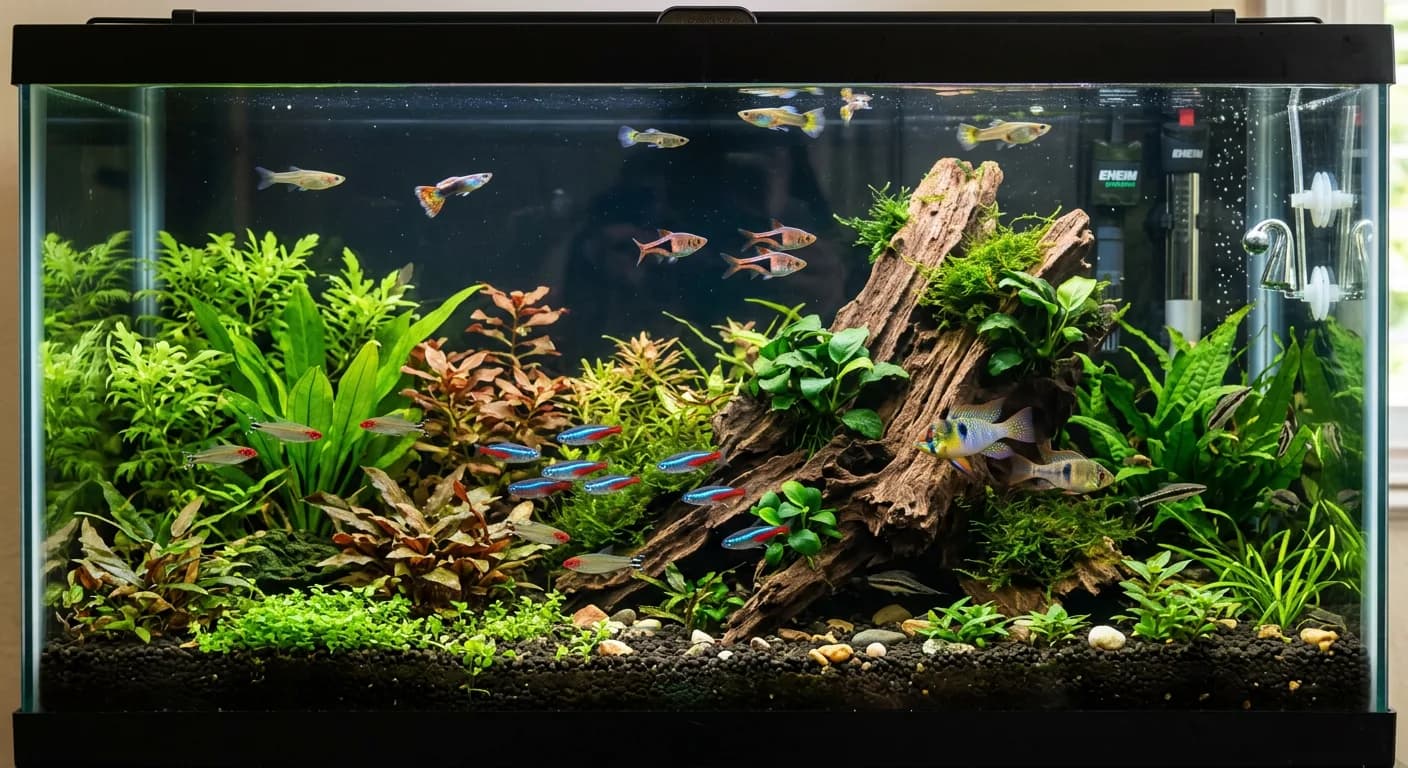
Best Fish for a 20 Gallon Tank (Complete Community Builds)
A 20 gallon tank is the sweet spot for freshwater fishkeeping. It's big enough to run a real community tank with proper schools and bottom dwellers, but small enough to sit on a sturdy dresser or bookshelf. If you've been stuck with a 10 gallon and feeling limited, this is where the hobby opens up. Your fish options roughly double, water parameters stay more stable because of the extra volume, and you can finally keep the combinations that actually look good together. Everything in this guide comes from stocking 20 gallon tanks over the years and watching what works long-term, not just what survives the first month.
01
Why 20 Gallons Is the Sweet Spot
Twenty gallons hits a balance that smaller and larger tanks can't match. You get enough water volume that temperature and pH hold steady between maintenance days. A 10 gallon can swing 2-3 degrees overnight if your room gets cold. A 20 barely moves. That stability keeps fish healthy without constant babysitting.
The real advantage is stocking flexibility. In a 10 gallon, you pick one small school and maybe a bottom dweller. In a 20, you can run a school of 10 tetras, 6 corydoras on the bottom, and a centerpiece fish on top. Three layers of activity instead of one. That's a proper community tank.
20 Long vs. 20 High: Pick the Long
Two standard tank shapes share the "20 gallon" label, but they're very different for fishkeeping.
The 20 long measures 30 inches wide by 12 inches deep by 12 inches tall. The 20 high measures 24 inches wide by 12 inches deep by 16 inches tall. Same water volume, completely different footprint.
For most freshwater fish, the 20 long wins. More floor space means more territory for bottom dwellers like corydoras and loaches. More horizontal swimming room means schooling fish actually school instead of pacing back and forth. Better surface area to volume ratio means better gas exchange and oxygenation.
The 20 high only makes sense if you're keeping tall-bodied fish like angelfish (and even then, 20 gallons is tight for angels) or if your physical space only fits a narrower footprint. For community tanks, planted tanks, and the stocking ideas in this guide, go with the 20 long every time.
02
Best Community Fish
Community fish are the backbone of a 20 gallon tank. These are the mid-water schooling species that fill the middle of your aquarium with color and movement. The key with all of them: buy real schools, not the minimum. Six is survival. Ten or twelve is where schooling behavior actually looks natural.
Neon Tetras (10-12)
The most popular aquarium fish for a reason. Their electric blue stripe and red tail section pop against green plants and dark substrates. Neons stay small at about 1.5 inches, so a 20 gallon comfortably holds 10-12 of them with room for other species. They're peaceful, stay in the mid-water column, and school tightly when they feel safe. In a planted tank with dim lighting, a school of 12 neons is genuinely stunning.
The catch: neons need established tanks with stable parameters. Don't add them to a brand-new setup. Wait until your tank has been running for at least 3-4 weeks with stable ammonia and nitrite readings at zero. They prefer soft, slightly acidic water (pH 6.0-7.0, temperature 72-78F) but adapt to moderate hardness.
Cardinal Tetras (8-10)
Cardinals look like neons with the color turned up. The red stripe runs the full length of their body instead of just the back half. They're slightly larger (up to 2 inches) and a bit more sensitive than neons, which is why I recommend 8-10 instead of 12. They prefer warmer water (75-82F) and do best in mature, well-planted tanks.
If you can keep neons alive for 6 months, you can keep cardinals. They're worth the slight step up in difficulty because a school of 8 cardinals in a planted 20 long is one of the best-looking freshwater setups you can build.
Harlequin Rasboras (8-10)
Underrated and overlooked. Harlequins have a copper-orange body with a distinctive black triangular patch. They school more reliably than most tetras, staying in tight formations that drift around the tank like a single organism. A group of 10 harlequin rasboras moving together through a planted tank is mesmerizing.
They tolerate a wider range of water conditions than tetras (pH 6.0-7.8, temperature 72-80F) and rarely bother other fish. Harlequins also tend to be hardier in transit, so you're less likely to lose fish in the first week after purchase.
Rummy-Nose Tetras (8-10)
The "canary in the coal mine" of community fish. Rummy-noses have a bright red face, silver body, and black-and-white striped tail. When water quality is good, their red nose is intense. When something's off, the red fades to pink. They're a living water quality indicator.
They school tighter than almost any other tetra species, making them the best choice if schooling behavior is what you're after. Eight rummy-noses in a 20 long will form a precise formation and patrol the tank together. They need clean, warm water (76-82F) and zero tolerance for ammonia, so they're better for keepers with a few months of experience.
Cherry Barbs (6-8)
Cherry barbs bring a different energy than tetras. Males turn deep crimson red during breeding season and display to each other constantly without actual fighting. Females stay more muted with a brown-gold coloring. A group of 6-8 with a mix of males and females gives you color and activity without aggression.
They're tougher than tetras, handling temperatures from 68-79F and pH from 6.0-8.0. Cherry barbs occupy the lower-middle water column and spend time foraging through plants and substrate, so they add activity to a zone that tetras ignore. They also eat pest snails when small enough, which is a nice bonus.
Fluval Bug Bites Tropical Fish Food
Black soldier fly larvae as the first ingredient. Small granules that tetras, rasboras, and barbs all go after without the cloud of uneaten flakes.
03
Best Centerpiece Fish
A centerpiece fish is the single standout species that draws your eye when you look at the tank. While schools provide movement, the centerpiece provides personality. In a 20 gallon, you have room for exactly one centerpiece species alongside your community fish.
Honey Gourami (1-2)
My top pick for a 20 gallon centerpiece. Honey gouramis are gentle, curious, and develop a warm golden-orange color that intensifies as they settle in. Males build bubble nests at the surface and patrol their territory without bothering tankmates. They grow to about 2 inches and occupy the upper-middle water column, filling the space above your tetra school.
Keep 1 male or a male-female pair. Two males will squabble in a 20 gallon. Honeys are slow eaters, so make sure food reaches them before faster tetras grab everything. Temperature 72-82F, pH 6.0-7.5.
The best part about honey gouramis: they're actually hardy. Unlike their dwarf gourami cousins (more on that next), honeys rarely get sick and handle typical beginner fluctuations without issues.
Dwarf Gourami (1) - With a Warning
Dwarf gouramis are gorgeous. The males come in flame red, powder blue, and neon blue varieties with iridescent scales that shift color depending on the light. They're the most visually striking centerpiece option at this tank size.
Here's the honest truth though: dwarf gouramis have a serious iridovirus problem. This virus is widespread in commercially bred stock, especially from Southeast Asian farms. Infected fish can appear healthy for months before developing bloating, lesions, and lethargy. Estimates vary, but a significant percentage of pet store dwarf gouramis carry this virus with no visible symptoms at purchase.
If you buy a dwarf gourami, accept the risk. Look for locally bred specimens when possible, quarantine for 2-4 weeks, and don't be surprised if the fish develops problems 6-12 months later despite good care. Some keepers swear off dwarf gouramis entirely because of this. I still think they're worth trying if you understand what you're getting into, but honey gouramis are the safer bet.
German Blue Ram (1 Pair) - Not for Beginners
Rams are small cichlids with electric blue and yellow coloring that photographs beautifully. A bonded pair in a planted 20 gallon is one of the most photogenic setups in freshwater fishkeeping.
But they're demanding. Rams need warm water, 82-84F, which limits your other species options (cardinal tetras and sterbai corydoras handle this range, most others don't). They require soft, acidic water (pH 5.5-7.0) and zero ammonia or nitrite tolerance. Tank-raised specimens from quality breeders handle aquarium life better than wild-caught, but they're still not forgiving of mistakes.
If you've kept a successful community tank for 6+ months and want a challenge, rams reward good husbandry. If you're setting up your first 20 gallon, skip them for now.
Apistogramma (1 Pair)
Apistos are the "advanced beginner" centerpiece option. They're small dwarf cichlids (2-3 inches) with personality that punches well above their size. Apistogramma cacatuoides (cockatoo dwarf cichlid) is the hardiest species for community tanks. Males have elaborate fin extensions and flashy colors, while females turn bright yellow when breeding.
They claim a small territory near the bottom of the tank but coexist with tetras and rasboras that swim above them. Keep one pair in a 20 gallon with plenty of caves and hiding spots. Temperature 75-82F, pH 6.0-7.5 for tank-raised specimens.
04
Best Bottom Dwellers
The bottom third of a 20 gallon tank is prime real estate that too many fishkeepers leave empty. Bottom dwellers add activity where you'd otherwise just see substrate, and most of them help keep things tidy by eating leftover food that sinks past your mid-water fish.
Bronze Corydoras (6-8)
The gold standard of beginner bottom dwellers. Bronze cories grow to about 2.5 inches, live 5-7 years, and spend their entire day shuffling through substrate with their barbels looking for food. They're social fish that need groups of at least 6 to feel secure. At 6-8, you'll see them form little foraging parties that sweep across the tank floor together.
They handle temperatures from 68-78F and pH from 6.0-8.0, making them compatible with almost any community setup. Bronze cories are also one of the few fish that "talk." They make clicking sounds during feeding and when they're content. Once you notice it, you can't stop listening for it.
Sterbai Corydoras (6)
Sterbai cories are the warm-water specialists. If you're keeping German blue rams or cardinal tetras at 80-84F, most corydoras species get uncomfortable. Sterbais thrive at those temperatures (75-84F), making them the only common cory that works in warm community setups. They have attractive spotted patterns on a dark body with orange pectoral fins.
They're slightly more expensive than bronze cories ($8-12 each vs $3-5) but behave the same way. Keep 6 in a 20 gallon.
Panda Corydoras (6-8)
Named for their black-and-white markings that resemble a panda's face. Panda cories stay smaller than bronze cories (around 2 inches) and prefer cooler water (68-77F). They're slightly more delicate than bronze cories, particularly sensitive to high nitrates, so stay on top of water changes.
Their smaller size makes them a good choice when you want a larger school in a 20 gallon. Eight panda cories take up less bioload than 8 bronze cories and still provide that satisfying bottom-level activity.
Kuhli Loaches (6)
Kuhli loaches look like tiny striped eels and behave like nothing else in the hobby. They're nocturnal, spending the day wedged into crevices, under rocks, and buried in substrate. At night they come out and slither across the tank floor, weaving through plants and decorations. A group of 6 will sometimes pile into a single hiding spot in a squirming mass.
They need fine sand substrate (they burrow), plenty of hiding spots, and patient owners. You won't see much of them during the day, especially in the first few weeks. Once they settle in after a month or two, they get braver and you'll catch them out during feeding time. Temperature 74-82F, pH 6.0-7.0.
Bristlenose Pleco (1)
A single bristlenose pleco handles algae duty for a 20 gallon tank. They grow to 4-5 inches and develop the signature forked bristles on their face as adults. Unlike common plecos that reach 12-18 inches and need 75+ gallon tanks, bristlenose stay manageable.
They need driftwood in the tank (they rasp on it for fiber), hiding caves for daytime rest, and supplemental feeding with sinking algae wafers and blanched vegetables. Don't expect one bristlenose to eliminate all your algae, but they'll keep glass and hardscape noticeably cleaner.
One note: a bristlenose pleco plus a full school of corydoras in a 20 gallon gets tight on bioload. Pick one or the other for bottom-dwelling duty, not both, unless you're running strong filtration and doing weekly water changes religiously.
Substrate Matters for Bottom Dwellers
Corydoras and kuhli loaches need sand substrate, not gravel. Their barbels (the whisker-like sensory organs on their faces) get damaged and infected on sharp gravel. Pool filter sand, play sand, or aquarium sand all work. If you already have gravel and want cories, consider at least covering one section of the tank floor with sand to give them a safe foraging area.
05
Best Cleanup Crew
"Cleanup crew" is a misleading term because no fish or invertebrate replaces water changes and tank maintenance. But the right combination of invertebrates targets specific types of waste and algae that fish leave behind. Here's what each one actually does and what it won't do.
Nerite Snails (3-4)
Nerites are the best algae-eating snail for freshwater tanks and it's not close. They eat green spot algae, green dust algae, diatoms (brown algae), and soft film algae off glass, rocks, driftwood, and plant leaves. A single nerite can keep 5-6 gallons of glass visibly cleaner. Three or four handle a 20 gallon.
They come in several patterns: zebra, tiger, horned, and olive. All perform the same, so pick whatever looks good to you. The big selling point: nerite eggs don't hatch in freshwater. You might see small white eggs scattered on hardscape (they're annoying to remove), but you'll never end up with 200 baby snails like you would with mystery snails or ramshorns.
What nerites won't do: eat hair algae, black beard algae, or leftover fish food. They're surface grazers only.
Amano Shrimp (5-6)
Amano shrimp are the heavy lifters of the cleanup crew. They eat hair algae that snails ignore, leftover fish food, decaying plant matter, and biofilm. A group of 5-6 amano shrimp in a 20 gallon will visibly reduce debris in planted tanks. They're large for shrimp (up to 2 inches) so most community fish leave them alone.
Amanos are transparent with a line of dots along their sides. They're not colorful, but watching them methodically pick through moss and plants is oddly satisfying. They're most active at night, so you'll often find them out grazing if you check the tank after lights-out.
What amano shrimp won't do: eat black beard algae (they'll pick at it but won't eliminate it), replace water changes, or clean up large amounts of uneaten food. They supplement good maintenance, they don't replace it.
They won't breed in freshwater. Larvae need brackish water to develop, so your population stays stable at whatever number you buy.
Otocinclus (5-6, Mature Tanks Only)
Otos are tiny catfish (1.5-2 inches) that spend all day grazing on diatoms and soft algae. A group of 5-6 will keep plants, glass, and hardscape polished. They work as a team and you'll often see them lined up on a piece of driftwood, all grazing in the same direction.
The problem with otos: they starve easily. They need a constant supply of biofilm and soft algae, which means your tank needs to be running for at least 2-3 months before adding them. New tanks don't produce enough natural food. Even in mature tanks, supplement with blanched zucchini or algae wafers if you notice them looking thin (sunken belly).
Otos are also sensitive to water quality. Zero ammonia, zero nitrite, low nitrates. They're not a beginner species despite their small size and peaceful nature. Add them after your tank is established and running smoothly, not during initial stocking.
06
Complete Stocking Ideas
Here are 5 ready-to-go stocking plans for a 20 gallon long tank. Each one has been balanced for bioload, swimming level distribution, and temperament compatibility. Pick one as a starting template and adjust to your preferences.
Classic Community 10 neon tetras + 6 bronze corydoras + 1 honey gourami + 3 nerite snails
This is the "if you're not sure, start here" build. Neons fill the middle with color and movement, cories keep the bottom active, the honey gourami gives you a personality-driven focal point at the top, and nerites handle algae. Everyone gets along. Temperature 74-78F covers all four species comfortably. This build leaves a little room on bioload, so you could add 4-5 amano shrimp later if you want.
Planted Tank 8 cardinal tetras + 6 panda corydoras + 6 amano shrimp + 1 honey gourami
Built for a tank with moderate to heavy planting. Cardinals look their best against dark substrate and green plants. Panda cories forage without disturbing plant roots. Amano shrimp keep plant leaves clean and eat decaying vegetation before it rots. The honey gourami adds a warm accent color. Run this at 76-78F with slightly acidic water (pH 6.5-7.0) for the best color from everyone.
Livebearer Tank 6 endler's livebearers + 4 platies + 6 pygmy corydoras
Bright, active, and constantly producing babies. Endlers are tiny but males are neon-colored with patterns unique to each fish. Platies add larger body shapes and come in red, orange, yellow, and mixed colors. Pygmy cories (Corydoras pygmaeus) stay under an inch and swim in the mid-water column as well as the bottom, adding movement to the whole tank. If you don't want babies, keep only males of each species.
Betta Community 1 male betta + 8 ember tetras + 6 pygmy corydoras + 3 nerite snails
A betta community tank works in a 20 gallon when you pick the right tankmates. Ember tetras are small, peaceful, and fast enough to avoid a grumpy betta. Their orange-red color complements most betta colorations. Pygmy cories stay out of the betta's way at the bottom. Nerites are ignored completely.
This build depends on your betta's personality. Some bettas tolerate tankmates fine. Others flare at everything that moves. Have a backup plan (a spare 5 gallon) in case your betta turns out to be aggressive. Add the betta last so the other fish establish their territories first.
Shrimp Garden 20-30 cherry shrimp + 5 otocinclus + lots of plants
No fish as the centerpiece here. Cherry shrimp in red, orange, yellow, or blue grades become the main attraction. A colony of 20+ breeding cherry shrimp in a heavily planted tank is like watching a tiny ecosystem run itself. Otocinclus keep plant leaves clean without bothering shrimp. Java moss, flame moss, and anubias provide grazing surfaces and hiding spots for baby shrimp.
This build needs a mature tank (2+ months running) before adding otos, and dense plant cover for shrimp to feel safe and breed successfully. No fish that eat shrimp, which means no centerpiece fish here. The colony itself is the show.
07
What to Avoid in a 20 Gallon
Pet stores will sell you fish that don't belong anywhere near a 20 gallon tank. Here's what to skip and why.
Oscars grow to 12-14 inches and need 75 gallons minimum. A baby oscar in a 20 gallon will be miserable within months and produce enough waste to crash your water quality repeatedly. Don't believe anyone who says they'll "grow slowly" in a small tank.
Common Plecos are sold as 2-inch babies that will reach 12-18 inches as adults. They need 75-125 gallon tanks with strong filtration. Bristlenose plecos are the correct alternative for a 20 gallon (4-5 inches max).
Bala Sharks look like sleek little silver fish at the store. They grow to 14 inches and need schools of 5+ in 125+ gallon tanks. Completely inappropriate for a 20 gallon at any life stage.
Silver Dollars are schooling fish that reach 6 inches and need 55+ gallon tanks in groups of 5+. They'll also eat every plant in your tank overnight.
Goldfish produce significantly more waste than tropical fish their size. A single fancy goldfish needs 20 gallons on its own with no tankmates, and common/comet goldfish need 30+ gallons each, ideally ponds. They also need cooler water (65-72F) that's incompatible with tropical community fish. Don't mix goldfish with tropicals.
Angelfish are the controversial one. Some experienced keepers maintain a single angelfish in a 20 high successfully, but it's tight. Angels grow to 6 inches tall with long fins, reach 8-10 inches from fin tip to fin tip, and become territorial as adults. They'll also eat neon tetras once big enough. A 20 gallon can work short-term for a juvenile angel, but you'll likely need to upgrade within a year. A 29 or 30 gallon is much more appropriate.
The "Growth to Tank Size" Myth
You'll hear people claim fish "grow to the size of their tank." This is dangerously wrong. What actually happens: fish in undersized tanks get stressed, their growth stunts externally, but their internal organs keep developing. This leads to organ damage, shortened lifespans, weakened immune systems, and behavioral problems. A stunted oscar in a 20 gallon isn't "adapted" to the tank. It's suffering.
Always stock for adult size, not the juvenile you see at the store. Ask how big a fish gets before buying it, and verify independently because pet store staff get this wrong regularly.
08
Equipment Recommendations
A 20 gallon tank doesn't need expensive equipment, but getting the basics right avoids problems down the road. Here's what I recommend.
Filtration
An AquaClear 30 (or AquaClear 20 for lighter stocking) is the standard hang-on-back filter recommendation for 20 gallon tanks, and it deserves that reputation. The customizable media basket lets you run mechanical filtration (sponge), biological filtration (ceramic rings or biomax), and chemical filtration (activated carbon) in whatever ratio you want. Most keepers ditch the carbon after the first month and fill the space with more biological media.
For planted tanks or tanks with shrimp, a sponge filter works well. Sponge filters provide biological filtration and gentle water flow that won't suck up baby shrimp or create currents too strong for bettas. They're also nearly silent. You'll need an air pump to run one.
For heavily stocked community tanks, consider running both a HOB filter and a small sponge filter. The redundancy gives you a safety net if one fails, and the extra biological filtration handles the higher waste load.
Heating
A 100W adjustable heater handles a 20 gallon tank in most homes. Look for models with external temperature dials and indicator lights so you can monitor operation without reaching into the tank. Preset heaters (fixed at 78F) work fine if your target is 76-80F, but adjustable heaters let you bump temperature up to 82-84F for treating ich or keeping warm-water species like German blue rams.
Place the heater near the filter output for even heat distribution. Use a separate thermometer to verify the heater's accuracy. Don't trust the dial on the heater itself, they're often off by 2-3 degrees.
Lighting
If you're keeping live plants, invest in a proper aquarium light. Look for full-spectrum LEDs in the 6500-7000K color temperature range, which supports photosynthesis for low and medium-light plants. Timer functionality prevents inconsistent light schedules that promote algae.
For fish-only tanks, the light that comes with a starter kit works fine. Fish don't need intense lighting, and too much light without plants just grows algae.
Maintenance
Plan for weekly 25% water changes with dechlorinated water. A gravel vacuum or siphon makes this quick: 5-10 minutes once a week to remove debris from the substrate and replace 5 gallons of water. That single habit prevents more problems than any equipment purchase.
Test your water weekly for the first 2-3 months with a liquid test kit (API Freshwater Master Test Kit is the standard). Once your tank is established and stable, you can reduce testing to monthly or whenever something looks off.
AquaClear 20 Power Filter
Customizable media basket lets you swap carbon for extra bio media. Quiet, reliable, and the go-to HOB filter for 20 gallon setups.
Aqueon 20 Gallon LED Aquarium Starter Kit
Includes tank, filter, heater, light, and thermometer in one box. Good starting point if you're buying everything from scratch.
Table of Contents
Related Content
Popular Fish Species
Essential Gear
Best Filter for a 20 Gallon Tank
Aquaneat 3-Pack Biosponge Filter