Best Fish for a 5 Gallon Tank (And What Will Die in One)
Five gallons is not a lot of water. Most fish you see at the pet store have no business living in a tank that small, and the "inch per gallon" rule people love to cite falls apart at this volume. But that doesn't mean a 5 gallon is useless. You just need to be honest about what it can handle and pick species that genuinely thrive in tight quarters instead of ones that merely survive.
01
Why 5 Gallons Is Harder Than You Think
A 5 gallon tank holds roughly 19 liters of actual water after you account for substrate, decorations, and displacement. That's not much buffer against anything going wrong.
Water parameters swing fast in small volumes. A single missed water change can push ammonia from safe to dangerous in 48 hours. Temperature drops 3-4 degrees overnight if your heater cycles off, because there's just not enough thermal mass to hold steady. pH can shift a full point between water changes if your bioload is even slightly too high.
Pet stores market 5 gallon tanks as "starter" setups for beginners, but they're actually harder to maintain than a 20 gallon. More water means more stability, more room for error, and more time to notice problems before they become fatal. A 20 gallon gives you days to catch an ammonia spike. A 5 gallon gives you hours.
None of this means you shouldn't keep a 5 gallon. It means you should go in knowing that small tanks demand more attention per gallon, not less. Weekly testing, consistent water changes, and conservative stocking are non-negotiable at this size.
02
Betta Fish: The Obvious Choice
A single betta is the best thing you can put in a 5 gallon tank. Full stop.
Bettas are solitary fish that actually prefer living alone. They don't need tankmates, they don't school, and they're perfectly content being the only fish in the tank. That matches a 5 gallon setup perfectly. One fish, one territory, no conflicts over limited space.
They also breathe air from the surface using a labyrinth organ, which means they're less dependent on dissolved oxygen levels than most tropical fish. In a small tank where gas exchange is limited by surface area, that matters.
Bioload from a single betta is manageable in 5 gallons with a gentle filter and weekly water changes of 30-40%. They produce moderate waste compared to similarly-sized fish, and their feeding schedule is simple: 3-4 high-quality pellets twice a day.
What surprises most people is that bettas have real personalities. They recognize their owners, come to the front of the tank during feeding time, flare at their own reflection, and explore decorations with obvious curiosity. They're more interactive than fish three times their price. I've kept bettas that would follow my finger along the glass and ones that would sulk behind a plant if I rearranged their tank without warning.
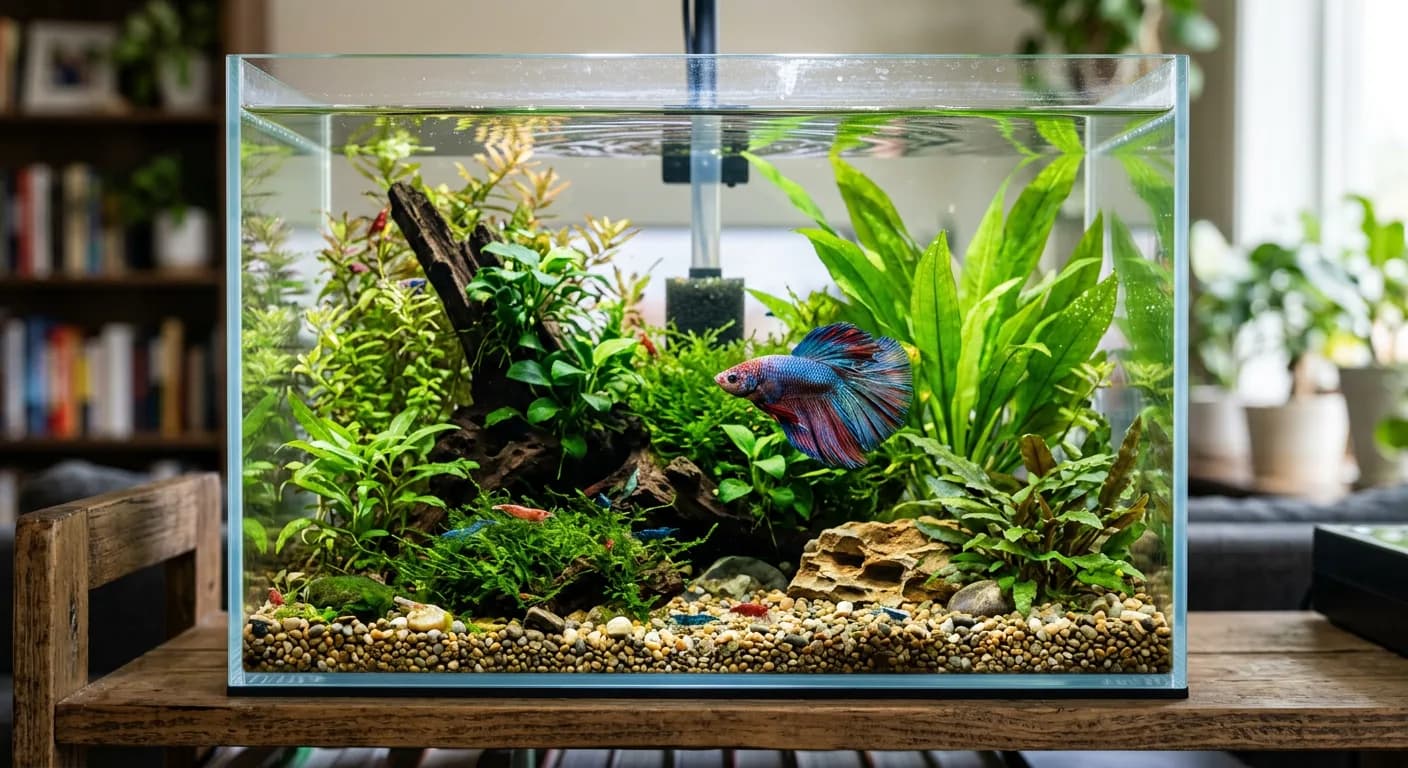
A heated, filtered 5 gallon with a few live or silk plants is genuinely a good life for a betta. Don't let anyone tell you they're fine in a cup on a shelf. But don't let anyone tell you they need 20 gallons, either. Five is the sweet spot for a single betta.
Hikari Betta Bio-Gold Pellets
Specifically formulated for bettas with color-enhancing ingredients. Small pellet size is right for betta mouths, and the protein content matches their carnivorous diet.
03
Shrimp Colonies
If you want activity and movement in a 5 gallon without the bioload of fish, shrimp are the answer.
Cherry shrimp (Neocaridina davidi) are the go-to. You can comfortably keep 10-15 in a 5 gallon, and they'll breed on their own if conditions are stable. They come in red, orange, yellow, blue, and black color varieties. They spend their entire day picking at surfaces, eating algae and biofilm, and generally keeping the tank cleaner than it would be without them.
A mature cherry shrimp colony in a planted 5 gallon is one of the most self-sustaining setups you can build. The shrimp graze constantly, the plants absorb waste, and new babies replace old adults every 12-18 months. You'll still need water changes, but the overall maintenance load is lighter than keeping fish.
Amano shrimp are larger (up to 2 inches) and better at eating hair algae, but they don't breed in freshwater. You can keep 3-5 amano shrimp in a 5 gallon as an algae cleanup crew, though they won't reproduce to sustain their population.
The catch with all shrimp: they're sensitive to copper and heavy metals. Many fish medications contain copper, which is lethal to invertebrates even in small doses. Tap water treated with copper pipes can also cause problems. Use a water conditioner that detoxifies heavy metals, and never medicate a shrimp tank without checking the ingredient list first.
Shrimp also need stable parameters more than perfect ones. A pH of 7.2 that stays at 7.2 is better than a pH that swings between 6.8 and 7.4 across a week. Temperature should hold between 68-78F. Consistency matters more than hitting an exact number.
04
Nano Fish That Work
Beyond bettas and shrimp, a handful of nano species can genuinely work in 5 gallons. The key word is "work," not "survive." These fish will display natural behaviors, stay healthy, and live full lifespans at proper stocking levels.
Endler's Livebearers (3-4 males): Endler's are smaller cousins of guppies, maxing out at about 1 inch for males. They're active, colorful, and hardy enough to handle the parameter swings of a small tank. Stick with all males unless you want babies constantly, because endler's breed faster than guppies. Three to 4 males give you a lively tank without overwhelming the filtration. They eat standard flake or micro pellet food and tolerate temperatures from 72-82F.
Celestial Pearl Danios (5-6): Also called galaxy rasboras, these tiny fish max out around 0.75 inches and display blue bodies covered in gold spots. They're shy at first but settle in after a week or two, especially with live plants for cover. A group of 5-6 works in a planted 5 gallon, and you'll see males display to each other with flared fins. They prefer cooler water (72-76F) and gentle flow. Feed them crushed flakes or micro foods, since their mouths are small.
Chili Rasboras (6-8): At barely half an inch fully grown, chili rasboras are among the smallest aquarium fish available. You can keep 6-8 in a 5 gallon with light filtration. They're bright red, active in groups, and surprisingly bold once established. They need soft, slightly acidic water (pH 6.0-7.0) and warm temperatures (75-82F). Not as forgiving as endler's on water parameters, so test regularly.
Sparkling Gouramis (a pair): These tiny gouramis grow to about 1.5 inches and make actual audible clicking sounds during courtship, which is where the name comes from. A male-female pair works in a planted 5 gallon with floating plants. They're surface dwellers like bettas, using a labyrinth organ to breathe air. They prefer still or very gentle water flow and appreciate dense plant cover. More sensitive to water quality than bettas, so stay on top of maintenance.
Pick one of these options per tank. Mixing nano species in 5 gallons doesn't work because the bioload and territorial pressure gets too high.
05
What NOT to Put in a 5 Gallon
Pet stores will happily sell you fish that have no place in a 5 gallon. They're moving inventory, not planning your ecosystem. Here's what to refuse no matter how small it looks in the display tank.
Goldfish: Not in 5 gallons. Not in 10. Not in 20. A single fancy goldfish needs 20 gallons minimum, and common goldfish need 40+. They grow to 6-12 inches, produce enormous amounts of waste, and need cool water with strong filtration. The "goldfish bowl" is animal cruelty with good marketing. If a pet store employee suggests a goldfish for your 5 gallon, find a different store.
Neon Tetras: This one surprises people because neons are small. But they need groups of 6+ to feel secure, and that group needs swimming room. Six neon tetras in a 5 gallon creates a cramped, stressed school in a tank that can't handle the combined bioload. They also need stable, mature tanks and are more fragile than their popularity suggests. Save neons for a 10 gallon minimum.
Corydoras Catfish: Even pygmy corydoras, the smallest species, need groups of 6+ and floor space to forage. A 5 gallon doesn't have enough bottom area for a proper cory school. They'll survive, but they won't behave naturally or stay healthy long-term. Regular bronze or pepper corydoras grow to 2.5 inches and belong in 20+ gallon setups.
Dwarf Gouramis: Despite the "dwarf" in the name, these fish reach 3.5 inches and are significantly larger than bettas. They need 10+ gallons and are prone to iridovirus, a disease that's widespread in commercially bred stock. A stressed dwarf gourami in an undersized tank is almost guaranteed to develop health problems.
African Dwarf Frogs: People pair these with bettas in 5 gallons all the time, and it rarely goes well. The frogs need to surface for air but are clumsy swimmers who struggle to compete with fish for food. Adding any tankmate to a betta's 5 gallon shrinks an already tight space.
The pattern across all of these: just because something fits physically doesn't mean the tank can support its biological needs. Swimming space, waste processing, schooling requirements, and territorial behavior all matter more than whether the fish can turn around.
06
Making a 5 Gallon Work
Running a successful 5 gallon comes down to equipment choices and maintenance discipline. Cut corners here and you'll lose fish.
Heater: mandatory. Small water volumes lose heat fast. A 5 gallon can drop 5-6 degrees overnight in a 68F room. Tropical fish need stable temperatures between 76-82F, and the only way to deliver that in 5 gallons is an adjustable heater rated for the tank size (25-50 watts). Preset heaters that claim to hold 78F often run hot or cold with no way to correct them. Get one with an adjustable dial and pair it with a separate thermometer to verify accuracy.
Filter: sponge filter recommended. Hang-on-back filters create too much flow for a 5 gallon, pushing small fish around and creating current they can't escape. A small sponge filter driven by an air pump provides gentle biological and mechanical filtration without turning the tank into a washing machine. Bettas, shrimp, and nano fish all prefer calm water. If you use a hang-on-back, baffle the output with a sponge or pre-filter to reduce flow.
Live plants help enormously. Java moss, anubias, java fern, and floating plants like water lettuce absorb nitrates directly from the water. In a 5 gallon, even a few clumps of easy plants make a measurable difference in water quality between changes. Plants also provide hiding spots that reduce stress for fish and shrimp. You don't need special substrate or CO2 injection for these species. Just decent light for 8-10 hours a day.
Water changes: 30-40% weekly, no exceptions. In a 5 gallon, waste concentrates fast and there's no margin for skipping a week. Use a small siphon or turkey baster to remove water and debris from the substrate. Match the temperature of replacement water before adding it. Sudden temperature shifts in 5 gallons can send fish into shock.
Test your water. Ammonia and nitrite should always read zero in an established tank. Nitrates should stay below 20 ppm. In a 5 gallon, these numbers can change quickly, so test weekly until you know your tank's rhythm. An API Master Test Kit pays for itself the first time it catches a problem early.
Hitop Adjustable Aquarium Heater
Adjustable dial lets you dial in the exact temperature for your species. Works reliably in 5-15 gallon tanks and holds steady without overshooting.