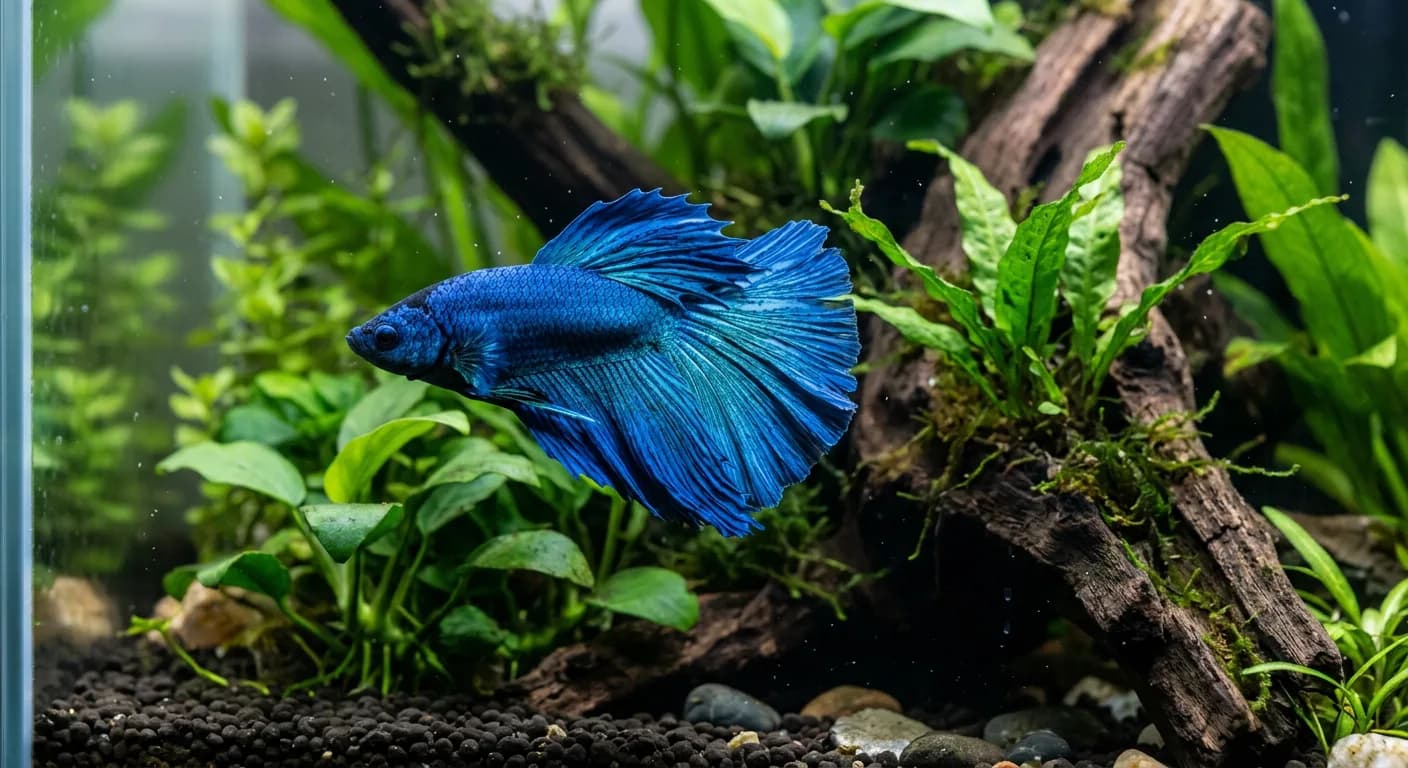
Betta Fish Tank Size Guide: Minimum, Ideal, and What to Avoid
Your betta does not belong in a bowl. That tiny cup at the pet store is just transport packaging. This guide covers the real minimum tank size for bettas, why going bigger pays off, and how to set up a tank that keeps your fish healthy for its full 3-5 year lifespan.
01
The 5-Gallon Minimum: Why It Exists
Five gallons is the accepted minimum for a single betta, and there are hard practical reasons behind that number. In anything smaller, ammonia builds up fast. A betta produces waste constantly, and in 1-2 gallons of water, ammonia can spike to toxic levels within 24-48 hours. You end up doing water changes every other day just to keep your fish alive.
Smaller volumes also can't hold a stable nitrogen cycle. Beneficial bacteria need surface area in filter media to colonize, and the water volume needs to be large enough to buffer the process. Below 5 gallons, the cycle crashes easily. One missed water change or a slight overfeeding and you're looking at an ammonia emergency.
Temperature is another problem. Small bodies of water swing with room temperature. A 2-gallon tank near a window can fluctuate 5-10°F in a single day. Bettas need a steady 76-82°F. Those swings stress their immune system and open the door to ich and fin rot. A 5-gallon tank with a small heater holds temperature far more reliably. It's the smallest volume where filtration, heating, and the nitrogen cycle can all function together without constant intervention from you.
02
Why Bigger Is Better: The 10-20 Gallon Sweet Spot
A 5-gallon tank keeps a betta alive. A 10-gallon tank lets it thrive. The cost difference is surprisingly small. A 10-gallon kit often runs $30-40 at chain pet stores.
More water volume means more stable parameters across the board. Ammonia dilutes further, temperature holds steadier, and pH swings are less likely. You can go a full week between water changes instead of twice a week. That alone makes a bigger tank easier to maintain, not harder.
Bettas are more active than people expect. In a 10 or 20-gallon tank, you'll see behaviors that never show up in a 5-gallon: full-speed laps across the tank, flaring at their reflection, hunting food from the surface with visible excitement. They use the space. A bored betta in a tiny tank often becomes a lethargic betta.
Bigger tanks also open up live plants, which bettas love. Java fern, anubias, and Amazon sword all need room to grow. Plants pull nitrates from the water and give your betta resting spots near the surface. In a 20-gallon long, you can build a planted setup that practically maintains itself between weekly water changes. The fish is happier, the tank is more stable, and your maintenance workload actually drops.
03
Tank Shape Matters: Long vs. Tall
Not all tanks of the same volume are equal for bettas. A 10-gallon long and a 10-gallon tall hold the same water, but they're very different habitats.
Bettas are labyrinth fish. They breathe atmospheric air by swimming to the surface and gulping. In a tall, narrow tank, that trip to the surface is longer and more tiring, especially for long-finned varieties like halfmoons and rosetails whose heavy fins already make swimming harder. A standard 20-gallon long (30" x 12" x 12") is far better than a 20-gallon tall (24" x 12" x 16").
Surface area also drives gas exchange. A wider tank surface lets CO2 escape and oxygen enter the water more efficiently. Tall, narrow tanks with small surface openings can develop low-oxygen zones near the bottom.
For a single betta, look for tanks where the length is at least twice the height. The standard 10-gallon (20" x 10" x 12") works well. Cube tanks like the Fluval Spec V (5 gallons) are fine at that size because the height is still reasonable at about 10 inches. But avoid tall hexagonal or column tanks above 5 gallons. Your betta will camp at the top and ignore the lower two-thirds entirely. You're paying for water volume your fish won't use.
04
Male vs. Female Bettas: Different Size Needs
A single male betta does well in 5-10 gallons. Males are territorial and solitary, so the tank is for one fish. Simple enough. Long-finned males like halfmoons and deltas are slower swimmers, so a calm tank with gentle flow matters more than raw volume. A 10-gallon with a baffled filter is ideal.
Females are a different situation. Individual females are slightly smaller and less aggressive, and they can sometimes be kept in groups called sorority tanks. If you want to try a sorority, 20 gallons is the bare minimum, and 40 gallons is strongly recommended. You need at least 5 females to spread aggression, heavy planting to break sight lines, and multiple hiding spots.
Sororities are not beginner setups. Even with proper space, aggression can escalate without warning. You need a backup plan for separating fish, and you should expect some fin nipping. Many experienced keepers have tried sororities and dismantled them after persistent bullying. It works sometimes, but it's a real gamble.
If you're keeping a single female betta, the same 5-10 gallon guidance applies. Females are actually more active swimmers than long-finned males, so they appreciate the extra horizontal space. A 10-gallon long is a great choice for a solo female.
05
The Betta Bowl Myth: Why "They Live in Puddles" Is Wrong
The most common defense for tiny betta containers is that wild bettas live in rice paddies and puddles. This is a half-truth that completely falls apart with any context.
Wild betta splendens live in rice paddies, shallow ponds, and slow-moving streams across Southeast Asia. These habitats are shallow, yes, but they're enormous in total area. A rice paddy can stretch across acres. The fish have access to hundreds or thousands of gallons of water spread over a wide, planted area. During dry season, some bettas do end up in small puddles, but this is a survival scenario. They don't choose it. They're stressed and vulnerable. Many don't make it.
Pet store cups are even worse than puddles. They have no filtration and no heating. The water chemistry degrades within hours. Stores do frequent water changes on their betta cups precisely because the fish would die otherwise. The cup is for shipping.
The labyrinth organ is another misunderstood adaptation. Yes, bettas can breathe air, which lets them survive in low-oxygen water. But surviving bad water isn't the same as being healthy. A fish that can tolerate poor conditions shouldn't be forced to live in them. Your betta's ability to gulp air is an emergency backup. It doesn't mean you can skip filtration.
06
Setting Up the Right Tank: Filter, Heater, and Lid
Once you've picked your tank size, three things matter most: gentle filtration, consistent heating, and a lid.
Bettas need a filter, but they hate strong current. Hang-on-back filters and internal power filters often push too much flow for long-finned bettas. A sponge filter powered by a small air pump is the best option for most setups. It provides biological and mechanical filtration with almost zero current. For hang-on-back filters, baffle the output with a pre-filter sponge or a water bottle cut to redirect flow along the glass.
A heater is non-negotiable. Bettas are tropical fish that need 76-82°F consistently. For a 5-gallon tank, a 25-watt adjustable heater works well. For 10 gallons, go with 50 watts. Avoid preset heaters that lock at 78°F because you can't adjust if your room runs warm or cool. Always pair your heater with a separate thermometer to verify the actual temperature.
Bettas jump. This is not occasional or rare. They will launch themselves out of open-top tanks, especially when startled or if water quality drops. A lid is essential. If your tank has an open top, buy or make a glass or acrylic cover with feeding holes. Every betta keeper who's gone lidless has a horror story. Don't learn this one the hard way. A small gap for airline tubing is fine, but the top needs to be mostly covered.
Table of Contents
Related Content
Popular Fish Species
Essential Gear
Best Filter for 10-Gallon Fish Tanks
AquaClear 20 Power Filter