Why Is My Fish Tank Cloudy? (And How to Fix It)
Your tank looked fine yesterday. Now the water looks like milk, pea soup, or weak tea. Before you panic and start dumping chemicals in, stop. Cloudy water has a specific cause, and the fix is usually patience or a simple correction. Here's how to figure out what's going on.
01
White or Milky: Bacterial Bloom
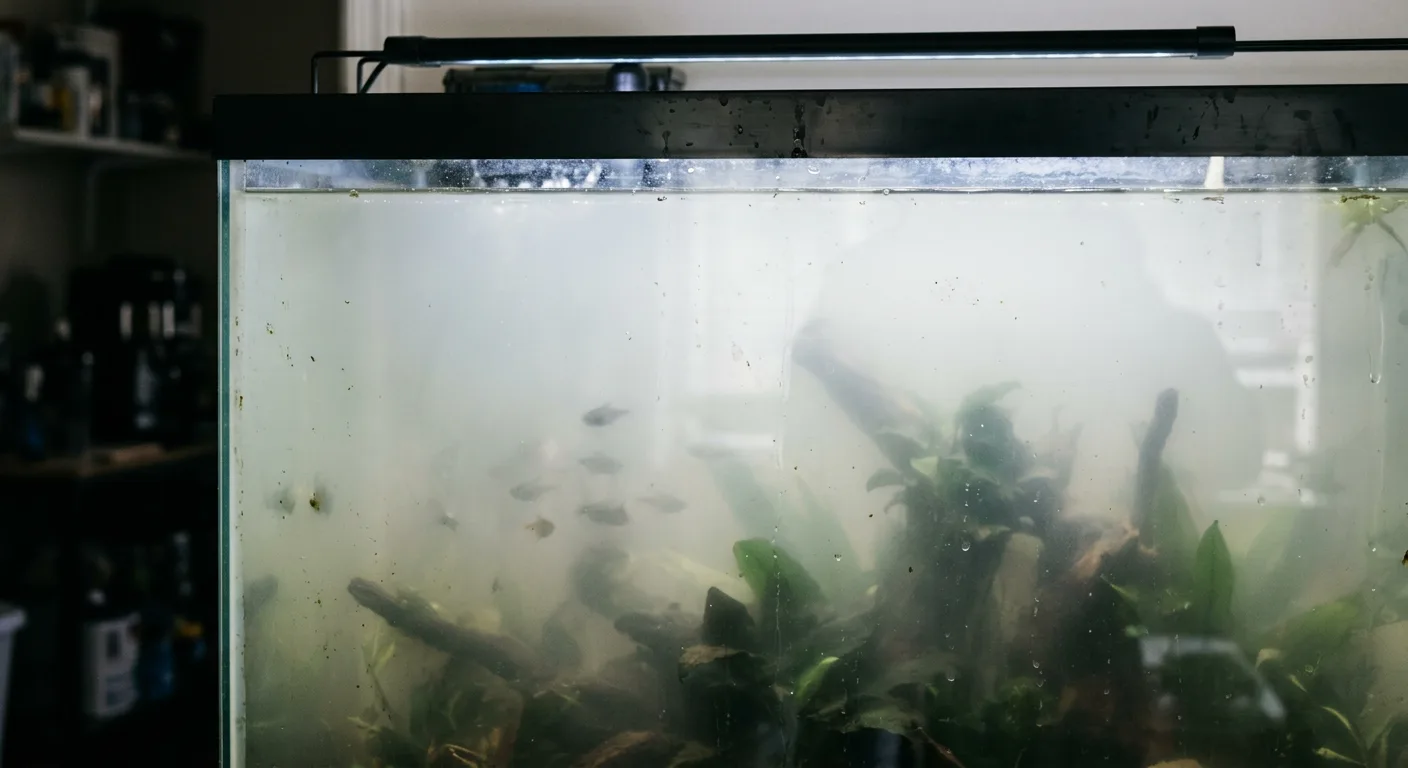
White or grayish milky water is almost always a bacterial bloom. Bacteria are reproducing like crazy in the water column, eating available nutrients. It looks like someone poured milk into the tank.
This shows up most often in new tanks during cycling. Your filter's beneficial bacteria haven't colonized yet, so free-floating bacteria fill the gap. They eat ammonia and organic matter, multiply rapidly, and cloud the water. Totally normal in tanks under 6 weeks old.
In established tanks, bacterial blooms happen after something disrupts the bioload: replacing all filter media at once, scrubbing the gravel too thoroughly, a dead fish rotting somewhere, or antibiotics that wiped out your filter bacteria.
For new tanks: wait it out. Do not do big water changes. Do not add clarifiers. The bloom clears on its own in 3-7 days as bacteria settle onto surfaces. Feed sparingly, keep the filter running.
For established tanks: find the cause (dead fish, rotting food), do a 25% water change, and wait. If you replaced filter media recently, seed it with media from another tank if possible.
02
Green Water: Algae
Green water means free-floating algae (phytoplankton) has taken over. Unlike algae growing on glass or driftwood, this floats in the water itself. Ranges from slightly tinted to opaque green smoothie.
The cause is always the same: too much light plus too many nutrients. Direct sunlight is the worst offender. A tank near a window with 2-3 hours of sun goes green within a week. Running lights more than 10-12 hours daily does the same thing.
High phosphate and nitrate feed the bloom. Overfeeding, overstocking, and skipping water changes all add nutrients that algae loves.
Fix it by blacking out the tank. Cover it with towels or garbage bags, turn off the light, leave it dark for 3-4 days. Fish handle this fine. Plants survive too. Algae cannot live without light and dies off.
After the blackout, reduce light to 6-8 hours on a timer. Move the tank away from windows or use a curtain. Do a 50% water change to remove dead algae and nutrients.
UV sterilizers work well for recurring green water. A small inline or hang-on unit clears it in 3-5 days and keeps it clear.
03
Brown or Yellow: Tannins
Brownish or yellowish tea-colored water comes from tannins. These leach from driftwood, Indian almond leaves, peat moss, and botanicals. Not harmful at all. Many fish actually prefer tannin-stained water.
Bettas, cardinal tetras, discus, and South American species thrive in blackwater. Tannins slightly lower pH, have mild antibacterial properties, and mimic natural habitats. Betta breeders add Indian almond leaves deliberately.
If you want to keep tannins, do nothing. Enjoy the natural look. Many aquascapers aim for this aesthetic.
If you want clear water: boil driftwood before adding it to the tank to leech out tannins. Soak it in hot water for a few days, changing when it turns brown, until the water stays clear.
Activated carbon removes tannins effectively. Seachem Purigen works better and recharges with bleach when exhausted. Pulls water from tea-colored to crystal clear in 48 hours.
Water changes dilute tannins, but they keep leaching from wood, so tint returns. Carbon or Purigen is the permanent fix.
04
New Tank Syndrome
Set up a new tank, fill it, and it goes cloudy within 48 hours? That's new tank syndrome. Expected. Here's what happens:
Day 1-2: Water looks hazy from substrate dust (especially if you didn't rinse gravel) or initial bacterial response.
Day 3-7: Bacterial bloom peaks. Water turns milky white as heterotrophic bacteria explode in population.
Week 2-4: Bloom starts clearing as nitrifying bacteria (the good ones) colonize the filter and outcompete free-floating bacteria.
Week 4-6: Tank clears. Nitrogen cycle establishes, beneficial bacteria settle onto surfaces.
The worst move during this process is panicking and "fixing" things. Big water changes remove establishing bacteria. Adding clarifiers treats symptoms, not causes. Replacing filter media removes colonizing surfaces.
Just let it run. Keep the filter on, feed lightly, test water parameters. Cloudiness resolves on its own.
05
When to Act vs. When to Wait
Not all cloudiness needs intervention. Knowing when to step back saves you from making things worse.
Wait when: tank is under 6 weeks old with white cloudiness (normal cycling bloom), you just added driftwood with slight yellow tint (tannins), or you stirred up substrate (settles in hours).
Act when: cloudiness smells foul (something rotting), fish gasp at surface or show stress (test ammonia/nitrite immediately), green water worsens despite 8 hours or less of light, or cloudiness persists over 2 weeks in a tank that was previously clear.
Test water before doing anything. Ammonia and nitrite should be 0 in a cycled tank. If not, you have a biological problem, not cosmetic. High ammonia with cloudiness means the cycle crashed or never established.
Nitrate over 40 ppm with cloudiness means overdue for water changes or overstocked.
06
Fixes by Type
White bacterial bloom in new tanks: do nothing. Run filter, feed minimally, wait 5-7 days. Seachem Clarity clumps bacteria for your filter to catch if you really can't stand looking at it, but you're treating symptoms.
White bacterial bloom in established tanks: 25% water change, find the cause (dead fish, rotting food), check filter media wasn't replaced. Used antibiotics recently? Add Seachem Stability daily for 7 days.
Green water: 3-4 day blackout, then reduce light to 6-8 hours on timer. Block window light. 50% water change after blackout. UV sterilizer prevents recurrence.
Tannins: Purigen clears it in 48 hours and is rechargeable. Activated carbon works but needs monthly replacement. Pre-soak and boil new driftwood.
Substrate dust (gray haze right after setup): fine filter floss catches particulate matter. Clear in 24-48 hours.
Water clarifiers are a last resort. They clump particles for the filter but don't fix root causes.
07
Prevention
Weekly 25% water changes prevent most cloudiness before it starts. Keeps nitrate low, removes dissolved organics, maintains stable chemistry.
Don't overfeed. Excess food decomposes and feeds bacteria and algae. Feed what fish eat in 2 minutes. Food hitting the substrate means too much.
Don't overstock. More fish means more waste, more nutrients for blooms. Follow reasonable stocking guidelines.
Use a timer for lights. 8 hours daily for fish-only tanks. Planted tanks can go 10 hours with good CO2 and fertilizer. Over 10 hours promotes algae.
Rinse substrate before adding to a new tank. Fill a bucket one-third with gravel, hose it down, stir, dump cloudy water, repeat until clear. Takes 5-10 minutes and prevents the initial dust cloud.
Maintain the filter without destroying it. Rinse mechanical media in old tank water monthly. Never replace all media at once. Stagger chemical media replacements by at least 2 weeks.
Table of Contents
Related Content
Popular Fish Species
Essential Gear
Best Filter for a 20 Gallon Tank
Aquaneat 3-Pack Biosponge Filter