How to Start a Fish Tank on a Tight Budget: A Realistic Guide for Beginners
Fish tanks are expensive. Nobody tells you that upfront. Between the tank, filter, heater, substrate, decorations, water conditioner, test kit, and the fish themselves, costs pile up fast. If you've been putting off starting an aquarium because of the price tag, you're not the only one. It's easy to feel broke before you even buy your first fish. You can build a functional, healthy tank for a lot less than the setups you see recommended online. This guide breaks down where to spend, where to save, and how to prioritize when your budget is tight.
01
What You Need vs. What You Don't
The biggest source of unnecessary spending is believing you need everything the pet store recommends. You don't. Knowing the difference between what's required and what's optional is the fastest way to cut costs without compromising fish health.
What you need (no getting around it): The tank itself, obviously, but size matters less than you'd think. A 10-gallon works for many setups and costs a fraction of larger tanks. A reliable filter is your second priority, and this isn't where you want to cut corners. A hang-on-back filter like the AquaClear 20 or Seachem Tidal 35 keeps water clean and houses the bacteria that keep your fish alive. A heater is required for tropical fish. Even room-temperature tanks fluctuate enough to stress fish. A basic adjustable 50-100W heater runs under $20 and lasts for years. And water conditioner: every drop of tap water needs treatment before it goes in the tank. Seachem Prime is the standard, and a small bottle lasts most beginners a year.
What can wait: CO2 systems for planted tanks run hundreds of dollars with ongoing costs. Skip it when starting out. Most beginner plants grow fine without CO2. Fancy LED setups with app controls and customizable spectrums look nice but aren't doing anything a $15 clip-on light can't do for fish health. Premium substrates, planted soils, and specialty hardscape can all wait. Gravel or play sand from a hardware store works perfectly well. Decorative items like resin ornaments and themed backgrounds are aesthetic choices, not biological ones.
Bottom line: put your money into a good filter and heater before worrying about tank size or how things look. Your fish won't notice the decor, but they'll absolutely notice the difference between clean water and dirty water.
02
The Bare-Bottom Tank Stigma
If you've spent any time in aquarium communities, you've seen the judgment people get for running a bare-bottom tank or a minimal setup. The assumption is that a tank isn't "real" without substrate, live plants, and carefully arranged hardscape. Here's the thing: that's social pressure, not biology.
Why some fish do fine without substrate: Many species don't care about substrate at all. Bettas are labyrinth fish that often live in shallow waters with minimal substrate in the wild. Guppies and platys do perfectly well in bare-bottom tanks, especially for breeding or simple display. Snails (nerite, mystery, assassin) are great tank cleaners that don't need substrate either. And bare-bottom tanks are easier to keep clean, which helps beginners who are still learning maintenance.
The judgment isn't justified: It's easy to feel self-conscious when your setup looks sparse compared to the lush aquascaped tanks on Reddit. But those tanks often take months or years to build and cost hundreds. A simple, clean tank with healthy fish is a real achievement. Fish care about water quality, stable temperature, and food. That's it. If you're providing those things, you're doing fine.
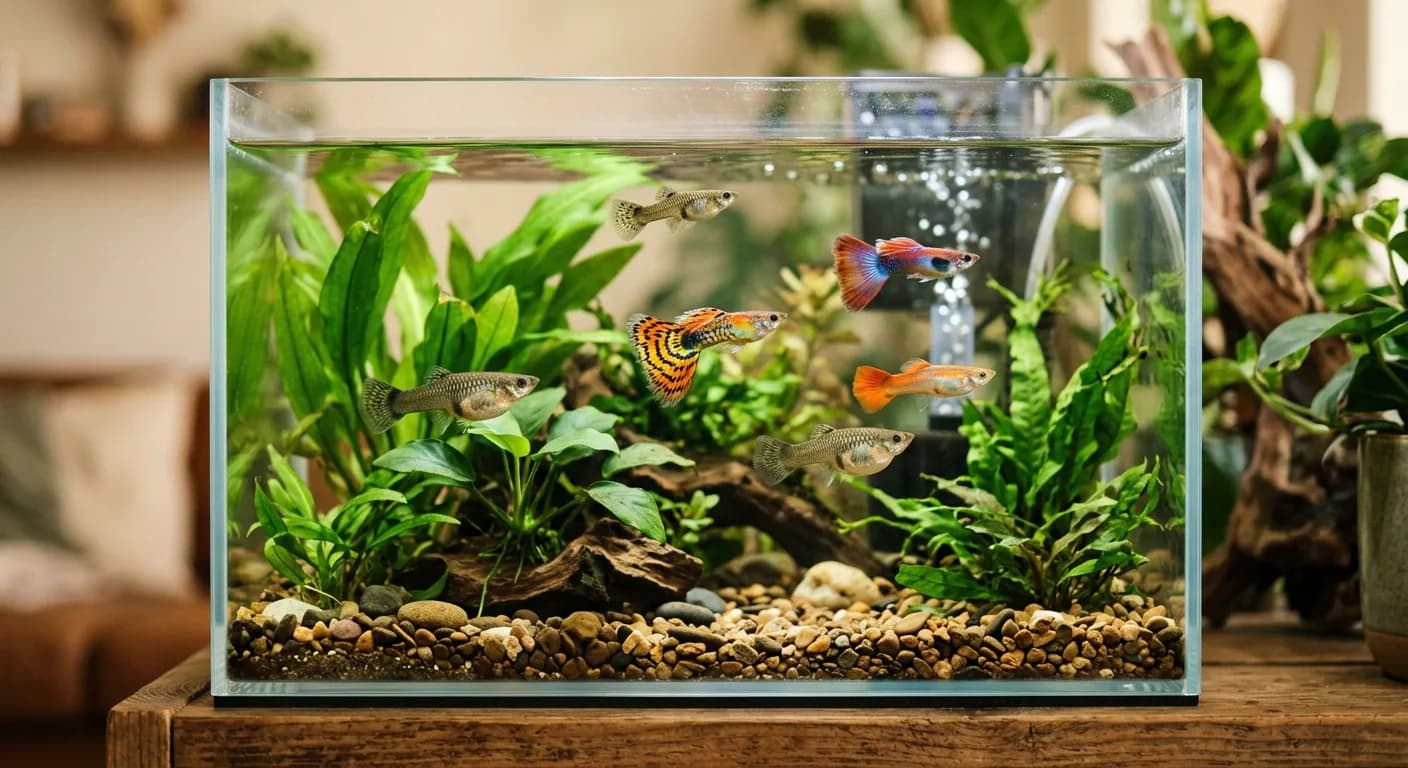
Good setups that happen to be cheap: A single betta in a 5-10 gallon bare-bottom tank is one of the most satisfying and affordable setups you can run. Guppies and platys are colorful, active, and cheap; a school of 6 guppies costs under $15 at most stores. Mystery snails come in several color varieties and do useful work. Even a basic tank with a betta and a snail is a legitimate setup that can cost under $50 total.
03
Cheap Substrate and Decor That Works
If you do want substrate, there are options beyond the expensive branded bags at the pet store. The trick is knowing what works and where to find it.
Affordable substrate: Pool filter sand is one of the hobby's best-kept secrets. Finely graded, pH-neutral, and dirt cheap. A 50-pound bag runs $10-15 and fills multiple tanks. Play sand from any hardware store is another option, though it needs thorough rinsing before use. Pet store gravel works in small quantities, but landscaping suppliers sell it in bulk for much less. Aquarium soil (Fluval Stratum, etc.) is great for serious planted tanks but unnecessary unless you're going high-tech. For most beginner setups, plain gravel or sand does the job.
Cheap hardscape: Pet store driftwood is wildly overpriced. Look for hardwood pieces at craft stores, or collect and prepare your own from safe sources. Research any wood before adding it. Some release tannins that stain water brown (harmless, and some fish actually benefit from it), while others can be toxic. Rocks from outside need thorough boiling or baking to sterilize. Avoid rocks with metal veins or unusual weight. Seashells and coral raise pH, so use them carefully if you keep soft-water fish.
You don't need to spend much here. A $5 bag of gravel and a $5 piece of craft-store driftwood can look just as good as $50 of branded products.
04
Fish That Won't Break the Bank
Fish themselves can get expensive, but they don't have to be. Picking hardy, affordable species that are easy to care for is the best approach when money is tight.
Best budget fish: Guppies are the classic beginner fish. Usually $2-5 each, colorful, active, and they breed easily. They handle a wide range of water conditions and don't need a heater if your room stays above 72°F. Platys are similarly forgiving, come in dozens of color varieties, and cost $3-7 each. Mollies are a bit bigger but just as tough, and they do well in both freshwater and brackish water. Bettas, despite their reputation, are actually excellent for small tanks and don't need companions. A single male betta in a 5-10 gallon is a complete, satisfying setup.
Fish to avoid when budgeting: Rare or exotic species come with high price tags and demanding care. Fancy goldfish need 30+ gallons and cold water, which isn't beginner-friendly or cheap. Plecos sold as "small" (like the common pleco) grow over a foot long and need 75+ gallons. Cichlids can be aggressive and typically need larger tanks with more complex setups. Stick with the basics until you've got experience and room in your budget.
Build stock slowly: One of the biggest mistakes new owners make is buying too many fish at once. It strains your wallet and overwhelms the tank's biological filtration. Add 2-3 fish at a time, wait a week, test your water, then add more. This spreads costs over weeks or months instead of one big hit.
05
Planning for Upgrades
Starting with a budget setup doesn't lock you in. Start small and upgrade as you learn and as your finances allow. This approach lowers risk, builds knowledge, and spreads costs over time.
Start small, upgrade intentionally: Begin with a 10-gallon tank, a basic filter and heater, and a handful of hardy fish. This teaches you the fundamentals (water testing, feeding schedules, maintenance routines) without much money on the line. Once you're comfortable and the tank is stable, you can start thinking about what comes next. Maybe a larger tank. Maybe live plants. Maybe a different species. Each upgrade becomes a deliberate choice rather than an overwhelming first purchase.
What to save for first: If upgrades are in your future, prioritize a better filter over a bigger tank. A quality hang-on-back filter (AquaClear, Seachem Tidal) works in whatever tank you eventually move to. Good heaters last for years. Test kits (the API Freshwater Master Test Kit) are an investment that pays off across every tank you'll ever own. These are the pieces that transfer from one setup to the next.
There's nothing wrong with a modest setup. A clean 10-gallon with guppies or a single betta is a real aquarium. It gives you all the enjoyment and learning of a high-end setup. You're not settling. You're starting somewhere reasonable.
06
Sample Budget Breakdown
Here's what a complete, functional 10-gallon setup costs if you buy strategically:
The essentials: 10-gallon tank (often under $20, especially during sales) AquaClear 20 filter ($25-30, lasts years) Basic 50W heater ($15-20) Gravel or play sand ($5-10) Seachem Prime water conditioner (~$15, lasts about a year) API Freshwater Master Test Kit ($35-40, lasts a long time) Basic LED clip-on light ($10-20) Thermometer ($5)
Total for essentials: roughly $130-155
Optional first-month additions: 3-5 guppies or platys ($10-20) A nerite or mystery snail ($5-8) Driftwood or decorations ($5-15) Java fern or anubias ($8-15)
Grand total: $160-200
That's a complete, healthy setup that will last years. Compare that to $300-500 starter kits packed with cheap equipment you'll replace within months. Buying individual quality pieces saves money in the long run.
API Freshwater Master Test Kit
The best money you'll spend on this hobby. Tests ammonia, nitrite, nitrate, and pH: all four parameters you need to keep fish alive. Cheaper per test than strips and far more accurate.
AquaClear 20 Power Filter
The filter that shows up on every budget build recommendation. Reliable, customizable, and lasts for years without needing replacement parts constantly.
Table of Contents
Related Content
Popular Fish Species
Essential Gear
Best Filter for 10-Gallon Fish Tanks
AquaClear 20 Power Filter