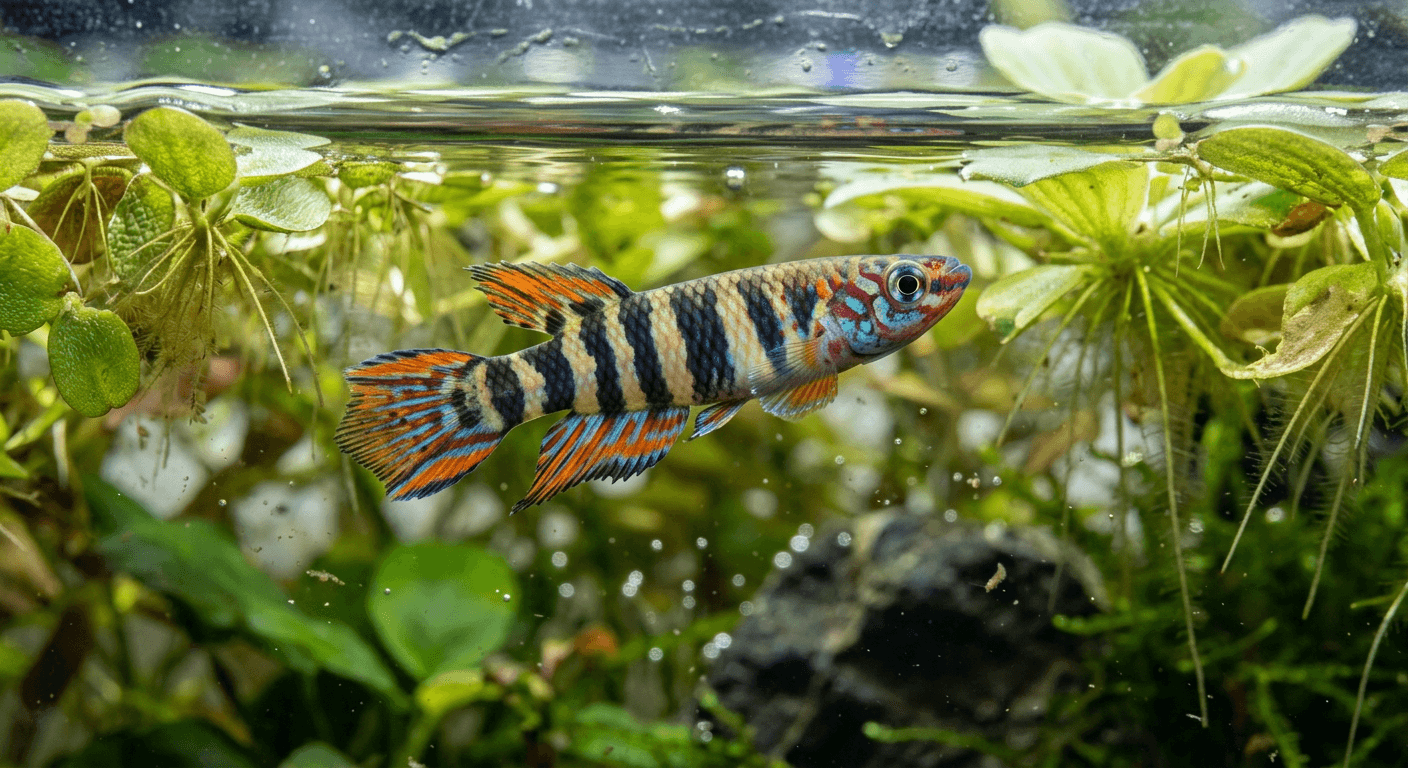
Clown Killifish
Epiplatys annulatus
Overview
Clown killifish are one of the most underrated nano fish in the hobby. They top out at around 1.2 inches, live at the water surface, and have a color pattern that looks hand-painted: vertical black bands on a golden-tan body, with a tail fin marked in blue, red, and orange like a tiny rocket flame. Males are more colorful than females, with brighter tails and deeper banding. Females are slightly duller and rounder through the belly. Despite the name, these are not the annual killifish that live fast and die in a few months. Epiplatys annulatus is a non-annual species with a solid 3-5 year lifespan when kept well. They come from shallow streams and swampy areas in West Africa (Guinea, Sierra Leone, Liberia), where they hunt tiny insects at the surface among floating vegetation. One thing you need to know upfront: they jump. Not occasionally, not maybe. They will find gaps in your tank lid and launch themselves through openings you did not think a fish could fit through. A tight-fitting lid or a layer of floating plants dense enough to discourage takeoff is non-negotiable.
Tank Setup
A 5-gallon tank is enough for a group of 4-6 clown killifish, though 10 gallons gives you more room for tankmates and better water stability. The single most important element is surface cover. Floating plants like Amazon frogbit, salvinia, or red root floaters give these fish a sense of security and reduce jumping. They spend nearly all their time in the top inch of water, so the mid and lower zones are free for other species. Dense planting throughout the tank helps, but the surface layer matters most. Use a gentle sponge filter. Clown killifish come from slow or still water and strong flow pushes them around. Hang-on-back filters work if you baffle the output with a sponge or pre-filter. Dark substrate is not required but it does bring out their colors. Lighting should be moderate since heavy floating plant coverage will filter it naturally. Keep a tight lid with no gaps wider than a pencil.
Water Parameters
Temperature between 72-79 degrees Fahrenheit with 75 as the sweet spot. They prefer the cooler side of tropical, which pairs well with species like celestial pearl danios and ember tetras. pH of 6.0 to 7.5, with slightly acidic being preferred. Most dechlorinated tap water works fine. Soft to moderately hard water is ideal. Weekly 20-25% water changes keep things stable. These fish produce almost no waste individually, and a group of 6 in a planted 10-gallon is about the lightest bioload you can have. Ammonia and nitrite at zero, nitrates under 20 ppm. Avoid sudden swings in any parameter. Stability matters more than hitting exact numbers.
Diet & Feeding
This is where clown killifish differ from most nano fish. They are true carnivores, not omnivores. In the wild, they eat tiny insects, insect larvae, and invertebrates that fall on the water surface. In captivity, they strongly prefer live and frozen foods over dry food. Frozen baby brine shrimp, frozen daphnia, and frozen cyclops are staples. Live foods like vinegar eels, microworms, and fruit flies (wingless or flightless) are excellent and trigger the most enthusiastic feeding response. Some individuals will accept crushed flakes or micro pellets after acclimation, but do not count on it. Hikari Micro Pellets are worth trying since they semi-float, which puts food in the right zone. Feed small amounts twice daily. They eat at the surface, so sinking food is wasted on them. If you keep them in a community with bottom-feeders, the bottom fish will clean up anything that drops.
Behavior & Temperament
Clown killifish are calm, deliberate fish. They hover at the water surface, often motionless, waiting for food to appear. When something catches their attention, they dart forward with surprising speed. Males display to each other by spreading their flame-patterned tails and posturing, but actual fights are rare and never cause injury. In a group with multiple males, you get a constant low-key display competition that shows off their best colors. They are not schooling fish that swim in tight formation. They shoal loosely, hanging out in the same area but keeping individual space. Four is the minimum to see social behavior, but six or more is better. They ignore fish that occupy the middle and lower water column. Tankmates that stay near the surface or are large enough to be intimidating will stress them. They are not skittish exactly, but they are watchful. Quick movements outside the tank can spook them, which is another reason floating plant cover helps.
Compatible Tankmates
Small, peaceful species that stay out of the surface zone are the best companions. Ember tetras and celestial pearl danios are top picks because they occupy the mid-water and share similar water parameter preferences. Pygmy corydoras work the bottom and are too small to bother anyone. Otocinclus stick to glass and plant surfaces. Cherry shrimp and amano shrimp are completely safe with clown killifish and add cleanup value. Mystery snails and nerite snails are fine. Avoid bettas entirely. Both species occupy the surface, bettas are territorial, and the size difference creates stress even if the betta is not aggressive. Dwarf puffers will hunt and kill clown killifish. Oscar, tiger barbs, clown loaches, silver dollars, and angelfish are all too large, too fast, or too aggressive. The general rule: if the tankmate's mouth is bigger than the killifish's body, skip it.
Common Health Issues
Clown killifish are reasonably hardy once settled into a stable tank. The biggest killer is jumping. More clown killifish die on the floor than from disease. After that, the main risks are standard tropical fish issues. Ich can appear during shipping stress or after sudden temperature drops, showing as white spots on the body and fins. Treat with temperature increase to 80 degrees and half-dose ich medication since small fish are more sensitive to chemicals. Velvet (Oodinium) is less common but more dangerous, appearing as a gold dust coating. It needs prompt treatment with a copper-based medication. Internal parasites occasionally show up in wild-caught fish, causing weight loss despite normal eating. Medicated food with levamisole or praziquantel handles most internal parasites. Keep water quality high and stable, and most health problems never appear.
Breeding
Clown killifish are among the easiest killifish to breed, and breeding can happen without any intervention in a well-planted tank. Males court females near the water surface, displaying their tail patterns. The female deposits one or two adhesive eggs at a time on the underside of floating plant leaves or in fine-leaved plants near the surface. This happens over several days rather than in one spawning event. Adults will eat eggs and fry they find, but in a tank with dense floating plants, some always survive. For intentional breeding, set up a separate 2.5-5 gallon tank with floating plants (Amazon frogbit works well), a sponge filter, and water matching the main tank parameters. Move a pair or trio (1 male, 2 females) and feed heavily with live foods. Check floating plant roots daily for tiny adhesive eggs. You can leave the eggs in place or move the plants to a hatching container. Eggs hatch in 10-14 days depending on temperature. Fry are small but larger than most egg-layer fry, and they can often eat baby brine shrimp and microworms right away. Growth is steady, and young fish start showing adult coloring at about 6-8 weeks.
Frequently Asked Questions
Quick Stats
What You Need for Clown Killifish
Gear that works well for this species, based on what experienced keepers actually use.
Gentle output that will not push surface dwellers around. Safe for tiny fish and fry, with no intake slots to trap them.
Semi-floating pellets stay near the surface where clown killifish feed. Small enough for 1-inch mouths. Not all individuals accept dry food, but this is the best option to try.
25W is the right size for 5-10 gallon tanks without overheating. Adjustable dial lets you set the 72-75 degree range these fish prefer.
Floating plants are essential for clown killifish. Frogbit provides surface cover that reduces jumping, creates shade, and gives females a place to deposit eggs on the dangling roots.