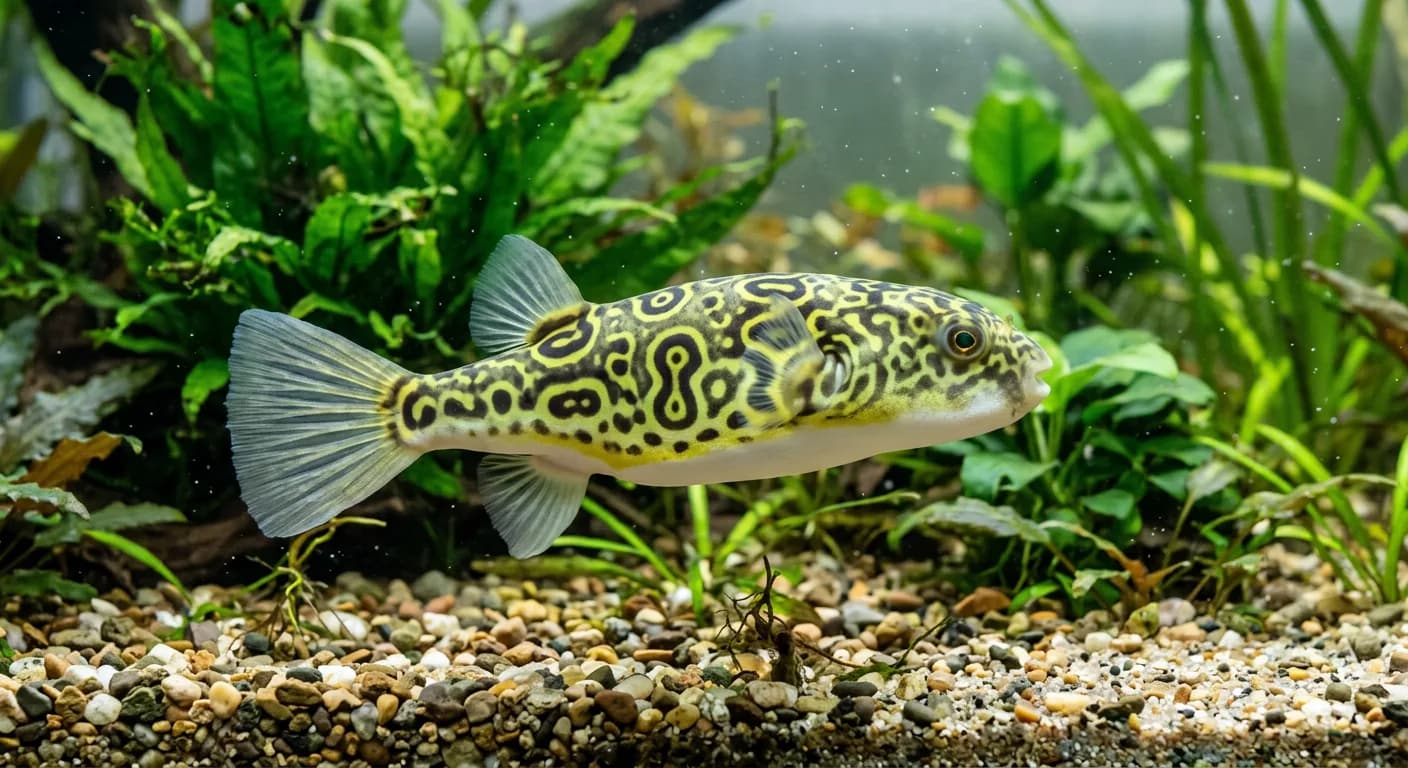
Figure Eight Puffer
Tetraodon biocellatus
Overview
Figure eight puffers are small, intelligent brackish water puffers named for the distinctive figure-8 pattern on their backs. They have huge personalities in tiny packages, often recognizing their owners and begging for food like underwater puppies. However, they are aggressive fin nippers that cannot be kept with most community fish. Their constantly growing teeth require regular hard foods to wear down, or they will need manual beak trimming every few months. These are brackish water fish that need salinity between marine and freshwater levels to thrive. While young puffers may tolerate pure freshwater temporarily, adults require brackish conditions for long-term health. A 15-gallon tank can house a single adult, though 30+ gallons provides more stable water parameters and room for enrichment. They are messy eaters with high bioloads, requiring excellent filtration and frequent water changes. Figure eight puffers are definitely not beginner fish, needing specialized diets, brackish water setup, and species-appropriate tankmates.
Tank Setup
Figure eight puffers need brackish water with specific gravity between 1.005-1.015, requiring marine salt and a hydrometer to maintain proper salinity. A 15-gallon tank works for a single adult, but 30+ gallons provides better stability and water quality. Use strong filtration rated for at least 1.5x the tank volume due to their messy eating habits and high bioload. Canister filters work best, though quality hang-on-back filters can handle smaller setups. Substrate should be sand or fine gravel that can be easily cleaned, as leftover food and waste accumulate quickly. Provide plenty of visual barriers and hiding spots using PVC pipes, caves, and driftwood. Live plants like java fern and anubias tolerate brackish conditions and provide enrichment. Tank lids are essential as puffers are curious and may jump when excited or startled. Lighting should be moderate as bright lights can stress them and promote excessive algae growth in the nutrient-rich water.
Water Parameters
Figure eight puffers require brackish water with specific gravity between 1.005-1.015 (roughly 8-24 ppt salinity). Young fish tolerate lower salinity, while adults prefer the higher end of this range. pH should be between 7.0-8.5 with 7.5-8.0 being ideal. Temperature needs to stay between 75-82 degrees, with 78-80 being optimal. Ammonia and nitrite must be zero, though they produce significant bioload requiring vigilant monitoring. Nitrates should stay under 20 ppm through frequent water changes. Plan on 30-40% weekly water changes due to their messy eating and high waste production. Always premix replacement water to match tank salinity and temperature. Test salinity regularly as evaporation concentrates salt, requiring freshwater top-offs between water changes. They are sensitive to rapid parameter changes, so acclimation must be done slowly over several hours when introducing new fish.
Diet & Feeding
Figure eight puffers are carnivores requiring a varied diet of hard-shelled foods to maintain dental health. Their teeth grow continuously and must be worn down through crushing shells and hard foods. Frozen bloodworms, brine shrimp, and krill form the base diet, supplemented with live or frozen snails, small crabs, and mussels. Offer hard foods like pond snails or small hermit crabs weekly to prevent beak overgrowth. Many puffers learn to take prepared foods like New Life Spectrum pellets or frozen carnivore cubes, but variety is essential. Feed adult fish once daily, juveniles twice daily. Remove uneaten food within 30 minutes to prevent water quality issues. They are intelligent and can become fixated on preferred foods, refusing alternatives if not offered variety from the start. Live foods provide mental stimulation as they hunt and capture prey. Watch for signs of beak overgrowth like difficulty eating or visible tooth extension.
Behavior & Temperament
Figure eight puffers are highly intelligent, curious fish with distinct personalities. They often recognize their owners and may beg for food or follow movement outside the tank. However, they are aggressive fin nippers that will attack most other fish species. Their aggression extends to their own kind - multiple puffers usually require very large tanks with plenty of territories. They explore every inch of their environment and benefit from enrichment like caves to investigate and live foods to hunt. Puffers inflate when severely stressed or threatened, but this should be rare in a proper setup and never encouraged as it can cause injury. They have excellent eyesight and hand-eye coordination, able to spot food from across the tank and precisely capture small prey. Most are active during daylight hours, though some individuals develop different activity patterns. They communicate through body language and color changes, with stressed individuals often showing darker coloration.
Compatible Tankmates
Figure eight puffers have very limited compatible tankmates due to their aggressive nature and brackish water requirements. Fast-swimming, hardy fish like some mollies may work in large tanks, though success is not guaranteed and depends on individual puffer temperament. Peaceful mollies that can handle brackish conditions are sometimes successful, but the puffer may still nip fins occasionally. Bumblebee gobies work in some setups as they occupy different tank areas and can handle brackish water, though territorial conflicts are possible. Most aquarists keep figure eight puffers in species-only tanks to avoid compatibility issues and optimize water conditions specifically for the puffers. Avoid all long-finned fish, slow-moving species, and anything small enough to be eaten. Even supposedly compatible species may be harassed or killed by particularly aggressive individuals. Multiple puffers can sometimes coexist in very large tanks (75+ gallons) with heavy decoration and multiple territories, but aggression is always possible.
Common Health Issues
The most common problem is beak overgrowth from diets lacking hard foods. Overgrown beaks prevent proper eating and must be trimmed by experienced aquarists or veterinarians. Provide regular hard foods like snails or small crabs to prevent this issue. Keeping them in pure freshwater long-term causes osmotic stress and health problems - they need proper brackish conditions. Internal parasites are common with newly imported specimens, showing as weight loss despite normal appetite. Medicated foods with praziquantel or metronidazole usually resolve parasitic infections. Ich can occur, especially during acclimation, and responds to heat treatment rather than medications when possible. They can be sensitive to copper-based medications and some antibiotics. Stress from poor water quality or inadequate diet manifests as color loss, lethargy, and reduced appetite. Bacterial infections may develop from fin nipping injuries or poor water quality, requiring antibiotic treatment and improved conditions.
Breeding
Breeding figure eight puffers in home aquariums is extremely rare and challenging. They have not been commercially bred, with all specimens being wild-caught imports. Sexual dimorphism is subtle, with mature males sometimes developing more intense coloration and slightly larger size. In the few documented breeding attempts, pairs have spawned in heavily planted areas with the male guarding eggs. Spawning appears to be seasonal and triggered by environmental changes like temperature and salinity fluctuations. Eggs are small and transparent, hatching in 5-7 days. Fry are tiny and require microscopic foods like infusoria for the first few weeks. Even successful spawns rarely result in surviving fry due to the challenges of feeding and raising them. Commercial breeding operations use specialized techniques not practical for home aquarists. Most breeding attempts fail due to aggression between potential pairs, difficulty triggering spawning, or inability to properly raise the fry.
Frequently Asked Questions
Quick Stats
What You Need for Figure Eight Puffer
Gear that works well for this species, based on what experienced keepers actually use.
Strong mechanical and biological filtration to handle the high bioload puffers produce. Customizable media allows optimization for brackish water conditions while providing the water movement puffers appreciate.
Critical for monitoring water quality in brackish puffer setups. Their high bioload and messy eating require frequent testing to maintain safe ammonia, nitrite, and pH levels.
Hard wafers that help maintain dental health by providing resistance when eaten. While live and frozen foods should be the staple, these wafers add variety and dental benefits to the puffer's diet.
Safe, aldehyde-based medication for treating parasites and bacterial infections without copper or other ingredients harmful to puffers. Essential for treating newly imported puffers that often carry parasites.