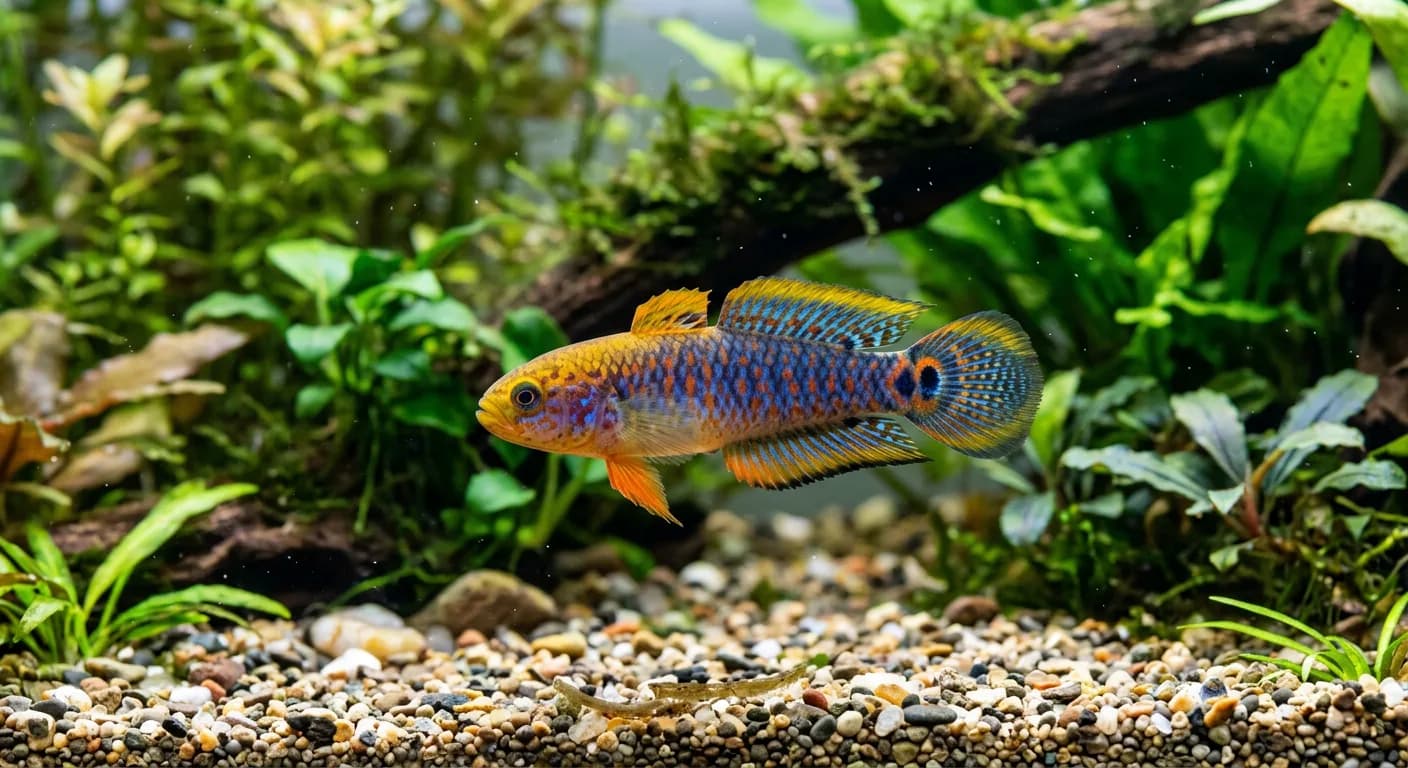
Peacock Gudgeon
Tateurndina ocellicauda
Overview
Peacock gudgeons are one of the most beautiful small fish available in the hobby, with electric blue spots covering their yellow-orange bodies and stunning iridescent fins. Males develop more intense coloration and longer fin extensions, especially during breeding displays. These are not schooling fish but do well in pairs or small groups in larger tanks. A mated pair in a 20-gallon setup often provides the most interesting behavior and color displays. They spend most of their time near the bottom, perching on driftwood, rocks, or broad plant leaves like small, colorful sentries. Despite their gudgeon name, they are actually more closely related to gobies and share many behavioral traits. Peacock gudgeons are not beginner fish, requiring stable water conditions and can be picky eaters. They are peaceful but may be too timid for tanks with very active or aggressive tankmates. Their small size and bottom-dwelling nature make them perfect for nano community setups, but they do best with other calm, peaceful species.
Tank Setup
A 15-gallon tank can house a pair of peacock gudgeons, though 20-30 gallons provides more territory and allows for additional tankmates. They prefer a well-planted tank with plenty of hiding spots and perching areas. Driftwood, rocks, and broad-leafed plants like anubias provide the elevated surfaces they love to rest on. Sand or fine gravel substrate works well, as they occasionally sift through it looking for food. Water flow should be gentle to moderate. They come from slow-moving streams and do not appreciate strong currents. A quality sponge filter or small canister filter provides adequate filtration without creating excessive flow. Lighting can be moderate to low. Bright lights tend to wash out their colors and make them skittish. Plants like java fern, cryptocoryne, and anubias do well in lower light and provide the subdued environment these fish prefer. Tank mates should be chosen carefully as peacock gudgeons can be outcompeted for food by more aggressive feeders.
Water Parameters
Peacock gudgeons prefer soft, slightly acidic water similar to their native Papua New Guinea habitat. pH between 6.0 and 7.5 works, with 6.5-7.0 being ideal. They do best in soft to moderately hard water. Temperature should stay between 74 and 79 degrees with 77 as the sweet spot. They are sensitive to parameter fluctuations, especially sudden changes. Ammonia and nitrite must be zero, and nitrates should stay under 15 ppm. Weekly water changes of 25-30% help maintain stable conditions. They can be sensitive to medications, especially copper-based treatments. Always test medications in a separate container if treatment becomes necessary. Aged, stable water is preferable to freshly treated tap water. If using tap water, age it for 24-48 hours before water changes to allow chlorine to dissipate and pH to stabilize.
Diet & Feeding
Peacock gudgeons can be picky eaters, especially when first introduced to a tank. They prefer small, meaty foods and may initially refuse flakes or pellets. Start with frozen or live foods like bloodworms, brine shrimp, or daphnia to get them feeding. Once established, gradually introduce high-quality micro pellets or small granules. Fluval Bug Bites Micro, Hikari Micro Pellets, or New Life Spectrum Small Fish Formula work well. They have small mouths and prefer food sized appropriately. Feed small amounts twice daily rather than one large feeding. They are deliberate, careful feeders that may take time to notice and consume food. This can be a problem in community tanks with faster-feeding species. Target feeding with a pipette or feeding tube helps ensure they get adequate nutrition. Live foods like microworms or grindal worms provide excellent nutrition and trigger natural hunting behaviors.
Behavior & Temperament
Peacock gudgeons are peaceful, somewhat shy fish that spend most of their time near the bottom of the tank. They perch on decorations, rocks, or broad plant leaves, rarely venturing into open water. Males are territorial during breeding season but rarely cause injury to rivals. They communicate through subtle color changes and fin displays rather than aggressive behavior. Pairs often stay close together, with the male following and displaying to the female. They have a curious nature and will investigate new additions to the tank, though they may hide initially when startled. These fish are most active during dawn and dusk, becoming more secretive during bright daylight hours. They use their large pectoral fins to hover and position themselves precisely on perches. A well-established pair will often develop a routine, occupying specific areas of the tank at different times of day.
Compatible Tankmates
Peacock gudgeons do best with small, peaceful species that occupy the middle and upper water column. Tiny tetras like neons, cardinals, and embers make good companions, as do celestial pearl danios and small rasboras. Avoid fast-swimming or aggressive species that might outcompete them for food or stress them with constant activity. Other bottom-dwellers should be chosen carefully. Pygmy corydoras work well in larger tanks, but avoid larger cory species that might accidentally harass the gudgeons. Small shrimp like cherry shrimp or amanos are usually safe, though large gudgeons might eat very small shrimplets. Snails make excellent cleanup crew members. Avoid any cichlids except the smallest, most peaceful varieties. Gouramis should be limited to honey gouramis or sparkling gouramis in larger tanks. Bettas and angelfish are too aggressive or territorial for peaceful coexistence.
Common Health Issues
Peacock gudgeons are generally hardy once established but can be sensitive during the initial acclimation period. Stress from transport or water parameter changes can lead to loss of appetite and secondary bacterial infections. Take acclimation slowly, using drip acclimation over several hours. The most common problem is difficulty feeding, which can lead to starvation if not addressed quickly. Always have frozen or live foods available to entice new arrivals to eat. Ich can be an issue, especially with newly imported fish. Use heat treatment (slowly raising temperature to 84-86F) rather than medications when possible, as they can be sensitive to copper and some antibiotics. Internal parasites occasionally affect wild-caught specimens, showing up as weight loss despite normal appetite. Medicated foods with praziquantel or metronidazole are usually effective. Maintain excellent water quality to prevent stress-related illnesses.
Breeding
Peacock gudgeons are cave spawners that can be bred in the home aquarium with proper setup. Condition a pair with frequent feedings of live or frozen foods for 2-3 weeks. Males develop more intense coloration and longer fins when ready to breed. Set up a breeding tank with numerous small caves, PVC tubes, or coconut shell halves. The male will choose and defend a cave, displaying to attract the female. Spawning occurs in the cave with the female depositing 30-80 eggs on the cave ceiling or walls. The male guards the eggs and fry while the female should be removed to prevent aggression. Eggs hatch in 5-7 days depending on temperature. The male continues guarding the fry for another week until they are free-swimming. Fry are tiny and need infusoria or liquid fry food for the first few days, then transition to newly hatched brine shrimp. Growth is slow, taking 3-4 months to reach sellable size. Breeding pairs often spawn repeatedly if conditions remain stable.
Frequently Asked Questions
Quick Stats
What You Need for Peacock Gudgeon
Gear that works well for this species, based on what experienced keepers actually use.
Provides gentle, biological filtration without creating strong currents that stress peacock gudgeons. Sponge media supports beneficial bacteria while the gentle flow suits their calm water preferences.
Maintains stable temperatures in the 74-79F range peacock gudgeons require. Temperature stability is crucial for these somewhat sensitive fish, and the adjustable controller provides precise control.
Small pellets that peacock gudgeons can easily consume, made with insect protein they naturally prefer. The slow-sinking formula gives careful feeders like gudgeons time to notice and eat the food.
Essential for monitoring the stable water conditions peacock gudgeons require. Regular testing helps catch parameter swings before they stress these sensitive fish.