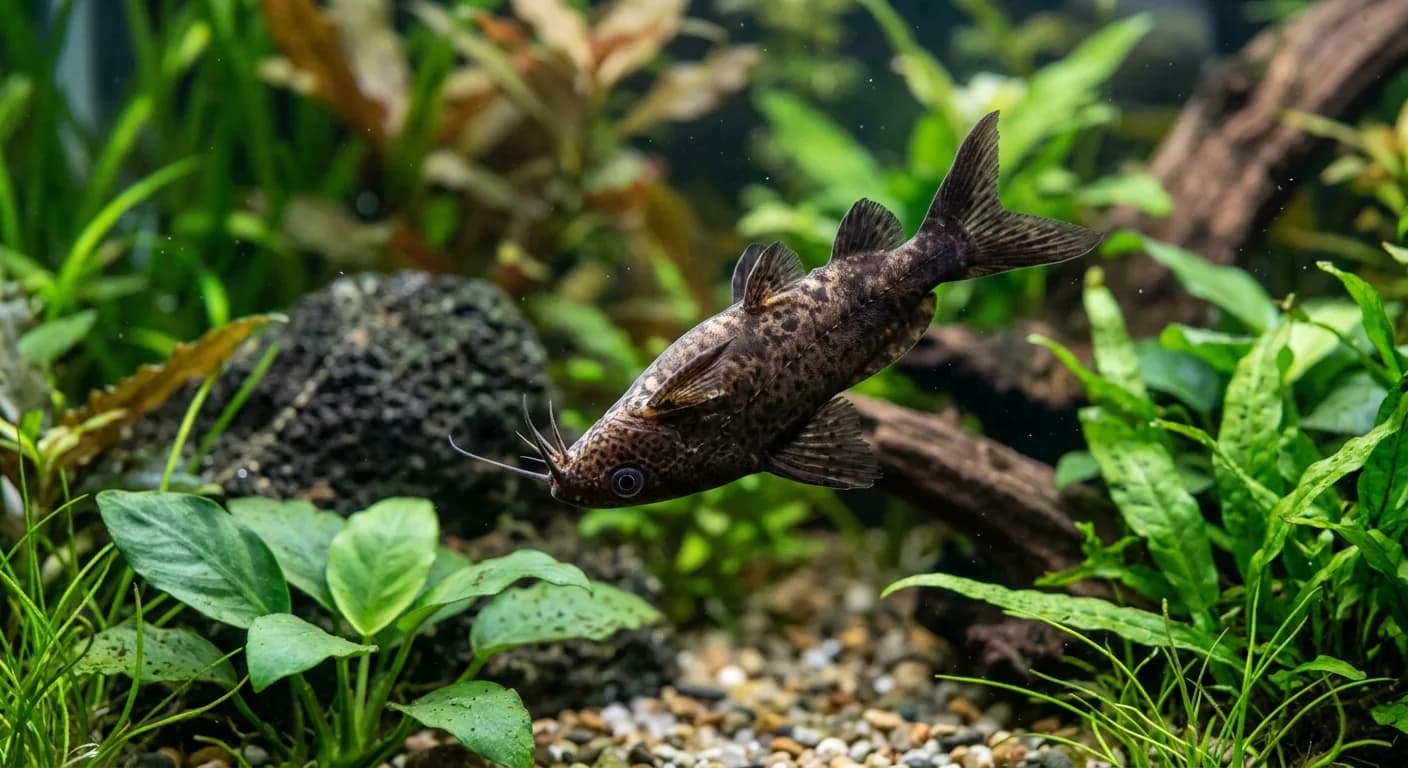
Upside Down Catfish
Synodontis nigriventris
Overview
Upside down catfish are exactly what the name suggests. These small African catfish spend most of their time swimming belly-up, using the underside of driftwood, rocks, or tank decorations as their ceiling. It looks wrong until you realize this is normal behavior for Synodontis nigriventris. They have a dark belly and lighter back, the reverse of most fish, which makes perfect sense when you see them cruising upside down. A single upside down catfish will hide constantly and rarely show this signature behavior. You need at least 3, preferably 4-5 in a 30-gallon tank. In a group, they become bold and active, swimming upside down in the open water and foraging together along the substrate. These are not beginner fish despite their small size. They are nocturnal and secretive even in groups, doing most of their activity after lights-out. Tank setup matters more than with typical community fish. They need hiding spots, caves, and overhangs to feel secure. Without proper shelter, they stress easily and may not eat well.
Tank Setup
A 20-gallon tank can house a small group of 3, but 30 gallons gives them more swimming room and better water stability. Focus on creating hiding spots and overhangs. Driftwood arranged to form caves, rock formations with gaps underneath, or PVC pipes work well. They spend daylight hours hiding in these spots and emerge after dark. Sand or fine gravel substrate allows them to sift and forage naturally. Strong filtration is important because they produce a moderate bioload for their size and are sensitive to poor water quality. A good canister filter or quality hang-on-back with biological media handles the load. Keep the tank dimly lit or provide shaded areas. Bright lighting makes them skittish and reduces activity. Live plants like java fern and anubias do well in lower light and provide additional cover. Water movement should be gentle. They do not appreciate strong currents and prefer calm areas near the bottom.
Water Parameters
Upside down catfish need stable, clean water with neutral to slightly acidic pH between 6.0 and 7.5. Temperature should stay between 72 and 78 degrees with 75 as the sweet spot. They are not as tolerant of temperature swings as some other catfish. Ammonia and nitrite must be zero, and nitrates should stay under 15 ppm. Weekly water changes of 25-30% keep parameters stable. They come from the Congo River basin where water is soft to moderately hard. Most municipal water works fine, but avoid extremes in either direction. These fish are sensitive to medications, particularly copper-based treatments and some antibiotics. Always dose carefully and remove carbon filtration when medicating. They handle aquarium salt well for ich treatment but avoid long-term salt use.
Diet & Feeding
Upside down catfish are omnivores that accept most foods but need variety to thrive. Sinking pellets designed for catfish form the staple diet. Hikari Sinking Wafers, Fluval Bug Bites Bottom Feeder formula, or New Life Spectrum Catfish pellets all work well. Supplement with frozen bloodworms, brine shrimp, or daphnia 2-3 times per week. They also graze on algae and biofilm, though not enough to replace dedicated algae eaters. Feed once daily in the evening when they become active. Drop food near their hiding spots rather than in open water. They are not aggressive feeders and may not compete well with fast-swimming tankmates for food. Watch that they actually eat during feeding time. Uneaten food sinking into their caves can foul water quality quickly. Live foods like blackworms or tubifex worms trigger natural foraging behavior, though frozen foods are safer and more convenient.
Behavior & Temperament
The upside down swimming behavior is most pronounced when they feel secure and comfortable. Stressed or newly introduced fish may swim normally for days or weeks before displaying the inverted behavior. They are peaceful with other species but can be somewhat territorial with their own kind, especially around preferred hiding spots. This is normal and rarely leads to injury. Males may become more territorial during breeding season. They are primarily nocturnal, doing most of their swimming and foraging after lights-out. During the day, they hide in caves or under decorations, often in groups. A red-light LED allows you to observe their evening activity without stressing them. They communicate with subtle body movements and positioning rather than aggressive displays. Tank-bred specimens are generally bolder than wild-caught fish and adapt to aquarium life more readily.
Compatible Tankmates
Upside down catfish do well with most peaceful community fish that share their water requirements. Middle-water schooling fish like tetras, rasboras, and barbs make good companions because they occupy different areas of the tank. Other bottom-dwellers like corydoras and kuhli loaches can work if the tank is large enough to provide separate territories. Avoid aggressive or overly active fish that might stress them during their vulnerable daytime hiding periods. Small cichlids like rams and kribensis are acceptable if the tank has enough hiding spots for everyone. Livebearers work well because they prefer similar water parameters. Peaceful gouramis add color to the middle and upper water column. Avoid keeping them with other Synodontis species unless the tank is quite large, as they may compete for the same resources and hiding spots. Shrimp and snails are generally safe though large upside down catfish may occasionally eat very small shrimp.
Common Health Issues
Upside down catfish are generally hardy once established but sensitive to poor water quality. The most common problem is stress-related illness from inadequate hiding spots or incompatible tankmates. Stressed fish lose their appetite, hide constantly, and become susceptible to bacterial infections. Ich is occasionally an issue, especially with new arrivals. Treat with gradual temperature increase to 80-82 degrees rather than medications when possible. They are sensitive to copper and some antibiotics. Internal parasites can be a problem with wild-caught specimens, showing up as weight loss despite normal appetite. Medicated food with praziquantel or metronidazole handles most internal parasites safely. Overfeeding and poor water quality can lead to bacterial fin rot or fungal infections. These respond well to improved water quality and gentle antibiotics like kanamycin. Always remove carbon filtration when medicating and dose conservatively.
Breeding
Breeding upside down catfish in home aquariums is rare and challenging. They are egg scatterers that spawn in caves or crevices in the wild. Very few hobbyists have successfully bred them, and most attempts fail. If breeding is attempted, condition a group of 4-5 adults with frequent feedings of live foods for several weeks. Set up a large breeding tank with numerous caves and hiding spots. Males develop more pronounced territorial behavior during breeding season and may develop breeding tubercles on their fins. Spawning typically occurs at night in a secluded cave with the female depositing eggs on the cave ceiling while swimming upside down. The male guards the eggs and fry. Water conditions should be pristine with temperature around 78 degrees and pH around 6.5. Even successful spawns often result in fungused eggs or fry that do not survive. Commercial breeding operations use hormone injections and specialized techniques not practical for home aquarists.
Frequently Asked Questions
Quick Stats
What You Need for Upside Down Catfish
Gear that works well for this species, based on what experienced keepers actually use.
Gentle filtration that provides biological and mechanical cleaning without creating strong currents. Perfect for upside down catfish who prefer calm water and need stable biological filtration for their moderate bioload.
Reliable temperature control for the 72-78F range upside down catfish need. External temperature controller allows precise adjustment without disturbing the fish or their hiding spots.
Sinking granules formulated specifically for bottom-dwelling fish. Black soldier fly larvae provide high-quality protein while the granules sink quickly to the feeding zone where upside down catfish forage.
Fine sand substrate that allows natural sifting and foraging behavior. Pool filter sand is clean, inert, and provides the smooth texture upside down catfish prefer for their bottom-dwelling lifestyle.