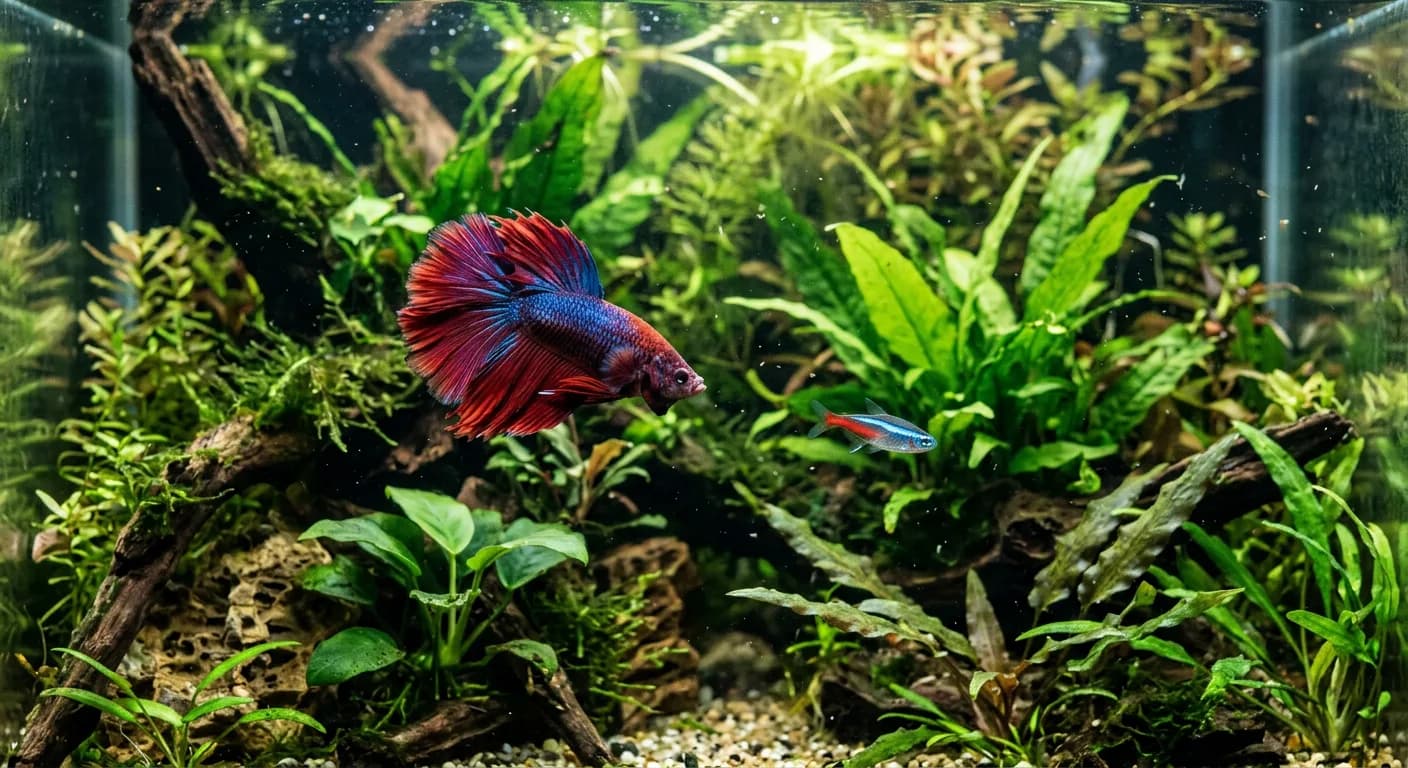
Why Is My Fish Aggressive? Fixing Predation, Stress, and Territorial Behavior
You wake up one morning and there's a neon tetra missing. Or your Betta is flaring at everything: the filter, your finger, its own reflection. Aggression in aquarium fish isn't a personality flaw. It's a signal that something's off in the tank. Wrong tankmates, not enough cover, water quality problems you can't see. Most aggressive behavior is fixable once you know the cause. This guide walks through the three most common scenarios, what triggers each, and what to do about them.
01
Quick Diagnostic Checklist
Before getting into specific scenarios, run through this checklist. The cause of aggression usually falls into one of a few categories:
Is it hunger? Try feeding a small amount. If aggression stops, you're dealing with mealtime competition, usually from underfeeding or feeding in one spot.
Is it territory? Watch where the aggression happens. If it's concentrated near a specific spot (a hideout, plant corner, the heater), it's territorial. More common in cichlids, Bettas, and Gouramis.
Is it stress? Look for glass surfing (swimming up and down the glass), clamped fins, constant hiding, or flaring at equipment. Stress-driven aggression almost always points to water quality, overstocking, or bullying.
Once you've narrowed it down, the scenarios below will help you pinpoint and fix the specific problem.
02
Scenario 1: Predation
You added small fish to your tank and now they're disappearing. The classic version: Betta with neon tetras. You wake up and find fins missing, or the tetra is just gone. Your Betta isn't being mean. It's doing what its instincts say to do.
Why it happens: Size mismatch. Your Betta's mouth is bigger than a neon tetra. Even a peaceful Betta sees a 1-inch fish as food, especially in a tank with no visual barriers. Bright colors make it worse by triggering the hunting response.
The fix depends on how bad it is:
*Immediate separation:* If a fish is injured or missing, separate them now. Use a breeder box or a separate tank. Don't wait to see if it stops.
*Add visual barriers:* Dense plants (Java fern, Anubias, hornwort) break sightlines. If the predator can't see potential prey, and the prey has places to hide, that alone resolves many cases.
*Bigger tank:* Cramped tanks make predation worse. A 20-gallon minimum gives everyone room to stay out of each other's way.
*Reconsider the combination:* Some fish can't coexist. Full-grown Betta with adult neon tetras is often a bad match. Corydoras, otocinclus, or snails tend to work better as Betta companions.
03
Scenario 2: Confusion and Misidentification
Your fish keeps charging its own reflection, reacting to your movements through the glass, or harassing a mate nonstop. It looks aggressive, but the fish might just be confused.
Why it happens: Fish don't see well. They mistake reflections for rival males, your movement for a predator, or potential mates for threats. Male Bettas and Gouramis are especially prone to this.
*Mirror stress:* A Betta sees its reflection and thinks another Betta has invaded. It flares, charges, and stresses itself out on repeat. The fix is simple: remove reflective surfaces. Add a background to the back and sides of the tank. Use plants or decor to break up reflections.
*Reacting to humans:* If your fish charges the glass when you walk by, it's not attacking you. It could be territorial, expecting food, or startled by its own reflection against your clothing.
*Hormonal aggression:* Males ready to breed sometimes chase females relentlessly, nipping constantly. If the female has nowhere to escape, this can turn fatal. Breeding setups need dividers and visual barriers.
The fix: Add background decor, rearrange the tank layout, create visual breaks. If hormones are the issue, separate the male from the female after spawning.
04
Scenario 3: Stress and Defensive Aggression
Your fish was fine yesterday. Now it's glass surfing, flaring at the filter, hiding in the corner, or chasing everything that moves. This is stress showing up as defensive behavior, not genuine aggression.
Common triggers:
*Bad water parameters:* Ammonia, nitrite, or high nitrate irritate fish constantly. They get irritable and lash out. Test your water immediately if behavior changes suddenly.
*Overstocking:* Too many fish in too little space creates constant competition. Even naturally peaceful fish become territorial when crowded.
*No hiding spots:* A bare tank with no plants, caves, or decorations means nowhere to retreat. Stressed fish with no escape route will fight.
*Bullying:* Some fish pick on others relentlessly. Watch who's getting targeted. It's usually the slowest, smallest, or most colorful fish in the tank.
What to do:
*Test water first:* Ammonia and nitrite should always read 0. Nitrate should be under 40 ppm. If anything's high, do a 25-30% water change and test again.
*Add cover:* Plants, caves, PVC pipes, driftwood. Java fern and Anubias attach to hardscape and create dense shelter.
*Reduce stocking:* The "1 inch of fish per gallon" rule is rough but useful. Remember that bioload varies a lot by species.
*Rearrange the tank:* Moving decorations disrupts established territories and can reset aggression patterns. Rearrange hardscape and plants, then watch what happens.
05
Species-Specific Aggression
Some fish are natural bullies. Some are natural targets. Knowing which is which saves you a lot of grief.
Known bullies:
*Bettas (male):* Aggressive toward other males and flashy fish that look like rivals. Can coexist with peaceful bottom-dwellers and small schooling fish if the tank is big enough.
*Tiger Barbs:* Nippy and hyperactive. They harass slow-moving fish with long fins. Best kept in groups of 6+ so aggression stays within the school.
*German Blue Rams:* Beautiful cichlids but very territorial, especially during breeding. Need their own space.
Common targets:
*Neon Tetras:* Popular but vulnerable. Targeted by aggressive fish and easily stressed by bullying.
*Cherry Shrimp:* Defenseless. Most fish will eat them.
*Pygmy Corydoras:* Small and peaceful. Need tankmates that won't see them as a snack.
When planning a community tank, pair bullies with fish that can handle themselves, or keep them in species-only setups.
06
Introducing New Fish Without Starting a War
New fish stress out existing residents. How you introduce them determines whether you get peace or chaos.
The quarantine method: Keep new arrivals in a separate tank for 2-4 weeks. This lets them settle, recover from transport stress, and keeps disease contained. It also lets existing fish get used to the new presence through the glass before they share space.
The barrier method: Use a tank divider to separate new fish from established ones for 1-2 weeks. They can see each other but can't make contact. This reduces territorial aggression when you remove the divider.
The slow reveal method: Float the new fish in a clear plastic bag or breeding box at the surface for 30 minutes to equalize temperature. Then open the bag and let them swim out. Less stressful than netting them directly in.
A few things that help: - Add new fish at night when existing fish are less active - Feed the tank before introducing newcomers to reduce food competition - Add plants or decor to break up sightlines - Watch closely for 48 hours for signs of bullying
07
When Aggression Turns Lethal
Sometimes it goes beyond nipping and stress. Fish can kill each other. Here's how to handle the worst case.
Signs of severe injury: - Torn fins that aren't healing (repeated nipping) - Missing scales or open wounds - Fish hiding constantly, refusing to come out for food - One fish chasing another without any breaks - Visible exhaustion or weight loss in the victim
Immediate steps:
*Remove the aggressor:* Use a fish net. Have a bucket with tank water ready. This is faster than trying to rearrange everything.
*Or remove the victim:* If you can't catch the aggressor, catch the victim and move them to a separate tank or breeder box.
*Use a divider:* If you can't remove either fish, insert a divider immediately to separate them.
When to rehome: Some fish can't coexist no matter what. A male Betta in a community tank might always be a problem. A pair of cichlids might claim the entire tank. In these cases, rehoming the incompatible fish is the kindest option. Local fish stores sometimes accept surrenders, and online fishkeeping groups can help find appropriate homes.
Table of Contents
Related Content
Popular Fish Species
Essential Gear
Best Aquarium Test Kit for Freshwater Tanks
API Freshwater Master Test Kit
Frequently Asked Questions
Not sure what you're treating?
Match what you're seeing on the fish to the most likely cause before reaching for medication.
Open the fish symptom guide →A note on fish health advice
TankMinded shares guidance based on common hobbyist practice and published aquarium literature. We're not veterinarians. Individual cases vary, medications can interact with water chemistry in unpredictable ways, and advanced or persistent illness calls for an aquatic vet — the AAFV directory is a good place to start. Follow any treatment at your own discretion.