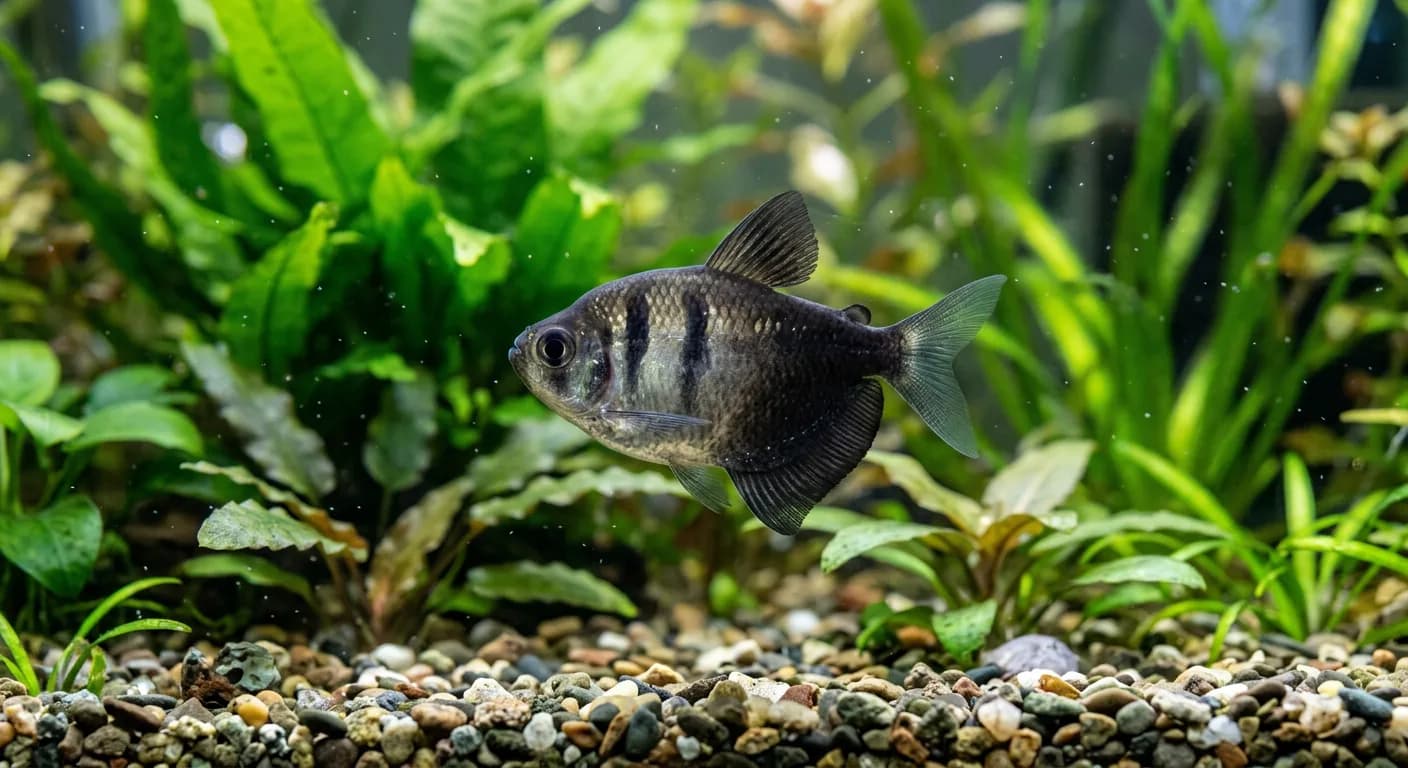
Black Skirt Tetra
Gymnocorymbus ternetzi
Overview
Black skirt tetras are the little black dresses of the aquarium world—elegant, versatile, and always appropriate. Their deep black body with striking black fins creates a beautiful contrast in any community tank. Originally from the Paraguay River basin in South America, these fish have been aquarium staples for decades thanks to their peaceful nature and hardy constitution. They are active swimmers that do best in groups, creating a beautiful synchronized display as they move through the tank together. Black skirts are excellent starter fish for beginners and work well in heavily planted setups where their dark coloration pops against green plants. They are also one of the more affordable tetra species, making them a great choice for stocking a new tank without breaking the bank.
Tank Setup
A 20-gallon tank is the minimum for a school of 6 black skirt tetras, but a 30-gallon is ideal and gives them room to swim actively. These fish come from slow-moving waters in the Paraguay River basin, so they appreciate moderate water flow rather than strong current. A hang-on-back filter works well for most setups, or a sponge filter for a planted tank. Black skirts do best in a planted tank with dark substrate, which brings out their colors. They are not particularly demanding about plants—java fern, anubias, and vallisneria all work well. Leave open swimming space in the center of the tank. These fish are not known jumpers, but a covered tank is still recommended. They tolerate a wide range of water parameters, which makes them forgiving for new fishkeepers. A gentle to moderate filter current is perfect—they are not strong swimmers and can be overwhelmed by strong flow.
Water Parameters
Black skirt tetras are remarkably adaptable, which is why they are considered excellent beginner fish. pH between 6.0 and 7.5 works well, and they tolerate both soft and moderately hard water (2-15 dGH). Temperature can range from 70 to 85 degrees, with 78 being ideal. They are more tolerant of higher temperatures than many tetras, which makes them good companions for warmer tanks. Like all fish, they need zero ammonia and nitrite, with nitrates kept under 20 ppm through weekly water changes of 25-30%. They are fairly hardy and tolerate minor water quality lapses better than more sensitive species, but consistent maintenance still produces the best colors and health. Wild-caught specimens may require softer, more acidic water, but tank-bred fish (the vast majority available) adapt easily to standard community tank parameters.
Diet & Feeding
Black skirt tetras are unfussy omnivores that will eat almost anything. A quality flake or micro pellet is the daily staple—look for formulas specifically designed for tetras or general tropical fish. Fluval Bug Bites, Omega One flakes, or New Spectrum pellets all work well. Supplement with frozen bloodworms, brine shrimp, or daphnia 2-3 times per week for variety and to condition for breeding. They feed primarily at the middle and top of the water column. Feed twice daily, offering only what they consume in 2-3 minutes. Black skirts are not aggressive feeders and can be outcompeted by faster fish at mealtime. If housing with faster eaters, target food specifically toward the black skirts or use a feeding ring. They are not prone to obesity and will self-regulate when fed appropriately. A varied diet helps maintain their best coloration—their dark black body looks most striking when fed quality foods.
Behavior & Temperament
Black skirt tetras are peaceful, active schooling fish that bring life to any community tank. In a group of 6 or more, they display natural schooling behavior, swimming together in a coordinated group. A lone black skirt or a pair will feel stressed and may hide. Males can be slightly territorial with each other, but actual aggression is rare and never harmful. They are active swimmers that appreciate open tank space but also use plants and decorations for cover. These tetras are generally bold and will come out to feed even when the tank is being maintained, making them engaging pets. Their dark coloration makes them stand out in planted tanks and creates nice contrast with colorful tankmates. They are daytime feeders and are most active during lights-on hours. Black skirts are compatible with most peaceful community fish and are unlikely to bother shrimp or snails.
Compatible Tankmates
Black skirt tetras are excellent community fish that get along with a wide variety of peaceful tankmates. Other small tetras like neons, cardinals, rummy-nose, and embers make excellent schooling companions. Corydoras (bronze, sterbai, panda, pygmy) are great bottom-dwellers that share their temperature range. Rasboras, cherry barbs, and zebra danios all work as active mid-water schooling fish. Livebearers like platies, mollies, swordtails, guppies, and endlers share similar water preferences. Peaceful bottom dwellers like kuhli loaches and corydoras make good tankmates. Snails (mystery, nerite) and peaceful shrimp (amano, ghost) are generally left alone. Avoid keeping them with bettas, especially long-finned varieties, as the tetras may nip at flowing fins. Large, aggressive fish like Oscars, Jack Dempseys, or Flowerhorn cichlids will see them as food. Avoid tiger barbs, which are fin nippers, and avoid pairing with slow-moving fish like discus that prefer higher temperatures.
Common Health Issues
Black skirt tetras are hardy fish with few specific health problems when kept in good conditions. Ich is the most common issue, appearing as white spots on the body and fins, typically triggered by stress or temperature fluctuations. Treat by raising water temperature to 86 degrees over 48 hours and adding aquarium salt. Fin rot can occur in poor water quality, appearing as frayed or discolored fins—improve water quality first, then treat with antibiotics if needed. They can be susceptible to fungal infections, which show as cotton-like growths. These are usually secondary to injury or poor water quality, so address the underlying cause. Internal parasites may cause bloating or weight loss—medicated food with praziquantel handles most cases. The single best thing you can do for black skirt health is maintain consistent water quality and avoid overfeeding. Tank-bred specimens are generally very resilient and recover quickly when issues are caught early. Quarantine new arrivals for 2 weeks before adding to your main tank.
Breeding
Breeding black skirt tetras is achievable in a home aquarium with some preparation. They are egg scatterers and will spawn in dense vegetation. Set up a separate breeding tank (10-20 gallons) with spawning mops or fine-leaved plants like java moss. Use a sponge filter or air-driven filter to keep the water calm. Condition the pair with live and frozen foods for 1-2 weeks. Spawning usually occurs in the morning. The female deposits eggs among the plants, and the male fertilizes them. A single female can produce 100-500 eggs. Remove the adults after spawning, as they will eat the eggs. Eggs hatch in 24-36 hours, and the fry become free-swimming 3-4 days later. Feed infusoria or liquid fry food initially, then graduate to baby brine shrimp. Black skirt fry grow relatively quickly and reach juvenile size within 2-3 months. Sexing adults is straightforward—females are fuller-bodied, especially when gravid, while males are slimmer with more pointed dorsal fins.
Frequently Asked Questions
Quick Stats
What You Need for Black Skirt Tetra
Gear that works well for this species, based on what experienced keepers actually use.
Rated for tanks up to 20 gallons with excellent biological filtration. The adjustable flow rate lets you dial in the moderate current black skirt tetras prefer. Affordable with good media capacity for the bioload of a tetra school.
Insect-based formula with black soldier fly larvae as the first ingredient. High protein content supports health and coloration in black skirt tetras. The small flake size is perfect for their small mouths.
100W adjustable heater suitable for 20-30 gallon tanks. Compact design fits easily in smaller setups. Adjustable temperature dial lets you fine-tune for the 70-85F range black skirts tolerate well.
Essential for monitoring water parameters. Tests for pH, ammonia, nitrite, and nitrate. The liquid test kits are more accurate than strips and last for hundreds of tests. Keep nitrates under 20 ppm for optimal tetra health.