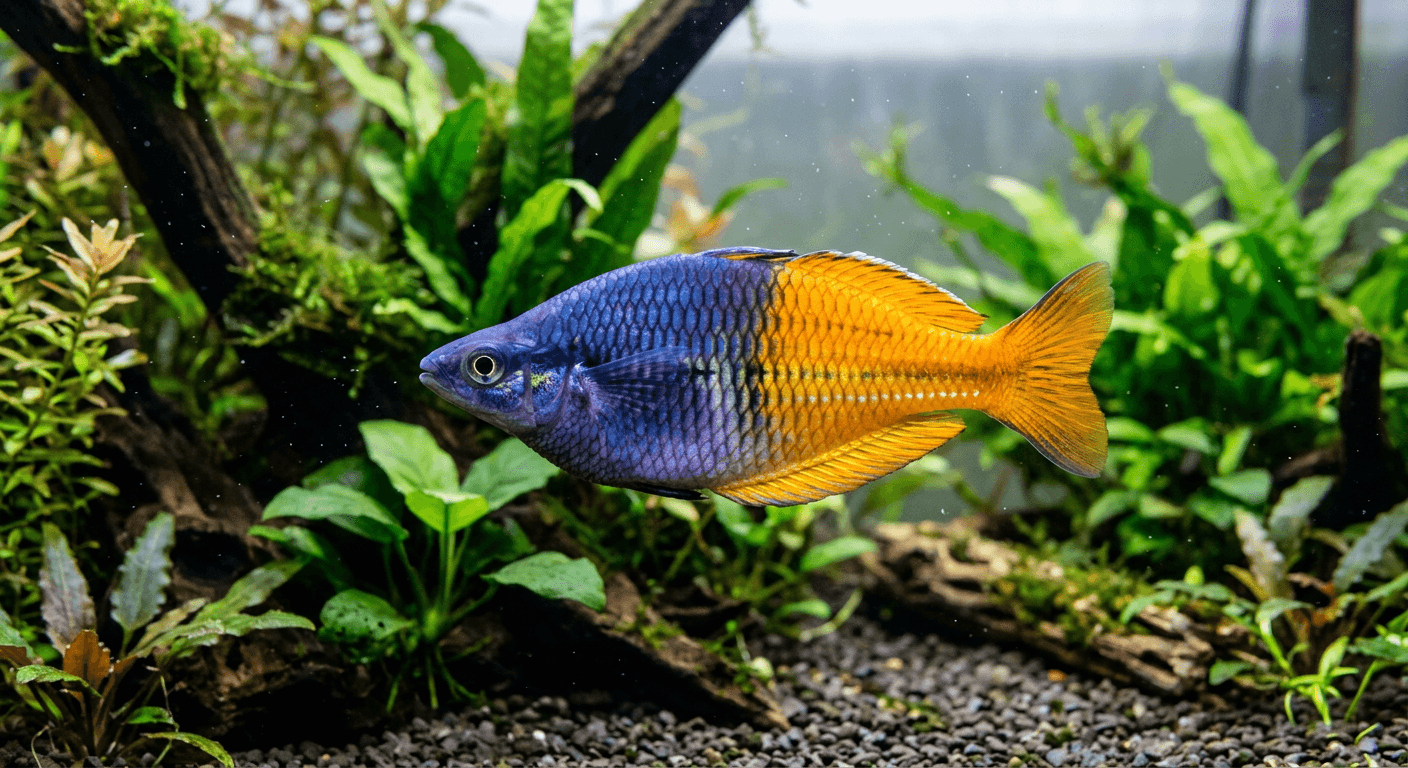
Boesemani Rainbowfish
Melanotaenia boesemani
Overview
Boesemani rainbowfish are one of those species that make people stop and stare at your tank. The front half of the body is a deep blue-gray, and the back half shifts into a bright orange-yellow. Mature males develop the most intense split coloration of any freshwater fish you can buy at a regular fish store. Females are more subdued but still attractive, with a silvery body and hints of yellow in the fins. These fish need to be in groups. A solo Boesemani looks washed out and stressed. Six is the starting number, and honestly, 8-10 in a 55-gallon is where they really shine. Males compete with each other by flashing their colors, and a group with 2-3 males and a few females will give you a constant color show. On tank size: a 30-gallon can technically house a group of 6, but it feels tight. Boesemani are active, fast swimmers that use every inch of horizontal space. If you can swing a 55-gallon, do it. They are a different fish in a bigger tank.
Tank Setup
Start with a 30-gallon minimum, 55-gallon preferred. Boesemani come from Lake Ayamaru in West Papua, Indonesia, where the water is warm, slightly alkaline, and moderately hard. They appreciate a planted tank with open swimming space in the center and plants or driftwood along the sides and back. Vallisneria, java fern, and anubias all do well in the higher pH these fish prefer. Use sand or fine gravel as substrate. Filtration should turn over the tank 4-6 times per hour. A canister filter works best for a 55-gallon setup, while a quality hang-on-back filter handles a 30-gallon. They like some current but not a washing machine. Keep the tank covered with a lid or glass top. Boesemani are jumpers, especially when startled or during breeding displays. Good lighting matters with these fish. Their colors pop under full-spectrum LED lights, and decent lighting also keeps your plants growing, which in turn helps water quality.
Water Parameters
Boesemani are hardwater fish, which is actually good news for most people on municipal water. pH between 7.0 and 8.0 is ideal, and they do well in moderately hard to hard water (8-15 dGH). Temperature should stay between 75 and 82 degrees, with 78 as the sweet spot. They are not as forgiving of poor water quality as some other community fish. Ammonia and nitrite must be zero. Keep nitrates under 20 ppm with weekly 25-30% water changes. Their colors fade fast when water quality drops, so if your Boesemani look dull, test your water before anything else. These fish have been tank-bred for decades now, so they are more adaptable than wild-caught specimens, but they still do best in clean, stable conditions with harder water.
Diet & Feeding
Boesemani are omnivores with big appetites. A quality flake or small pellet is the daily staple. Fluval Bug Bites, Omega One flakes, or New Life Spectrum pellets all work well. Supplement with frozen bloodworms, brine shrimp, or daphnia 2-3 times per week. Live foods like daphnia or baby brine shrimp will trigger the best color displays, especially in males before spawning. They feed at the surface and mid-water, catching food as it enters the tank or drifts down. Feed twice daily, only what they finish in 2-3 minutes. Boesemani are not shy eaters and will outcompete slower feeders at mealtime, so watch that bottom-dwellers and shyer tankmates still get their share. Color-enhancing foods with astaxanthin or spirulina help maintain the intense orange-yellow in the back half of the body. Skip the cheap generic flakes. With these fish, better food produces noticeably better color.
Behavior & Temperament
Boesemani are active, fast-swimming fish that spend most of their time in the middle of the water column. Males constantly display to each other and to females, flashing their colors and flaring their fins. This is normal behavior, not aggression. Actual fighting is rare and almost never results in injury. They are peaceful with other species but can be a bit boisterous. Their speed and constant movement may stress out very timid tankmates like celestial pearl danios or dwarf shrimp. They are not fin nippers, but their activity level is high enough that slow-moving, long-finned fish like bettas are not ideal companions. A group of 6+ will establish a loose hierarchy with the dominant male showing the most intense colors. Keep at least 2 females per male to spread out the attention. Males without females or in too-small groups often stay pale and hide.
Compatible Tankmates
Boesemani do well with a wide range of community fish that can handle slightly alkaline, harder water. Corydoras (bronze, sterbai, panda) are excellent bottom-dwellers to pair with them. Cherry barbs, harlequin rasboras, and rummy-nose tetras all work as mid-water schooling companions. Bristlenose plecos and siamese algae eaters handle cleanup. Larger tetras like cardinals and neons work in a big enough tank, though neons prefer softer water and may not show their best colors in the same parameters Boesemani prefer. Livebearers like platies, mollies, and swordtails share the same hardwater preferences and make natural tankmates. Avoid bettas, which are too slow and will be stressed by the constant movement. Oscars and other large cichlids will eat them. Dwarf puffers are too aggressive and territorial. Tiger barbs will nip their fins relentlessly. Discus need softer, more acidic water and higher temperatures than Boesemani prefer.
Common Health Issues
Boesemani are reasonably hardy once established in a stable tank. The most common problem is ich, typically triggered by temperature drops during water changes or the stress of shipping. Standard heat treatment (raise to 86 degrees over 48 hours) combined with aquarium salt works well. They can be susceptible to columnaris, a bacterial infection that shows up as white patches or fuzzy growths on the body and fins. Columnaris spreads fast in warmer water, so catch it early. Treat with antibiotics like kanamycin or furan-2. Internal parasites are occasionally an issue with imported fish, showing up as weight loss despite normal eating. Medicated food with praziquantel handles most intestinal parasites. The single best preventive measure is consistent water quality. Boesemani that live in clean, stable water with a good diet rarely get sick. Quarantine new additions for at least 2 weeks before adding them to your main tank.
Breeding
Breeding Boesemani rainbowfish is straightforward compared to many tropical fish. Condition a pair or trio (one male, two females) with frequent feedings of live or frozen foods for 1-2 weeks. Set up a separate breeding tank (20 gallons works) with spawning mops or fine-leaved plants like java moss. Keep the water at 78-80 degrees with a pH around 7.5. Males will display intensely in the morning light, driving females into the spawning mops. Boesemani are egg scatterers that deposit a few eggs daily over several days, attaching them to plants or mops with small adhesive threads. Remove the parents or the mops, because adults will eat the eggs given the chance. Eggs hatch in 7-10 days depending on temperature. The fry are tiny and need infusoria or liquid fry food for the first week, then transition to freshly hatched baby brine shrimp. Growth is slow. Expect 3-4 months before fry start showing any real color, and full adult coloration takes about a year. Males develop their split-color pattern as they mature, so do not judge young fish by their drab juvenile appearance.
Frequently Asked Questions
Quick Stats
What You Need for Boesemani Rainbowfish
Gear that works well for this species, based on what experienced keepers actually use.
Rated for 20-45 gallons with strong biological and mechanical filtration. Quiet operation and customizable media baskets. Handles the bioload of a Boesemani school without being oversized for a 30-gallon setup.
Insect-based formula with black soldier fly larvae as the first ingredient. High protein content supports color development in rainbowfish. Flake format floats and drifts through the mid-water column where Boesemani feed.
200W heater rated for tanks up to 65 gallons. LCD display shows real-time temperature so you can verify it without a separate thermometer. Dual temperature sensors provide accurate, consistent heating for the 75-82F range Boesemani need.
Full-spectrum LED that supports plant growth and brings out the blue and orange tones in Boesemani coloration. Programmable sunrise/sunset cycle via Bluetooth app. The 36-inch model fits standard 30 and 55-gallon tanks.