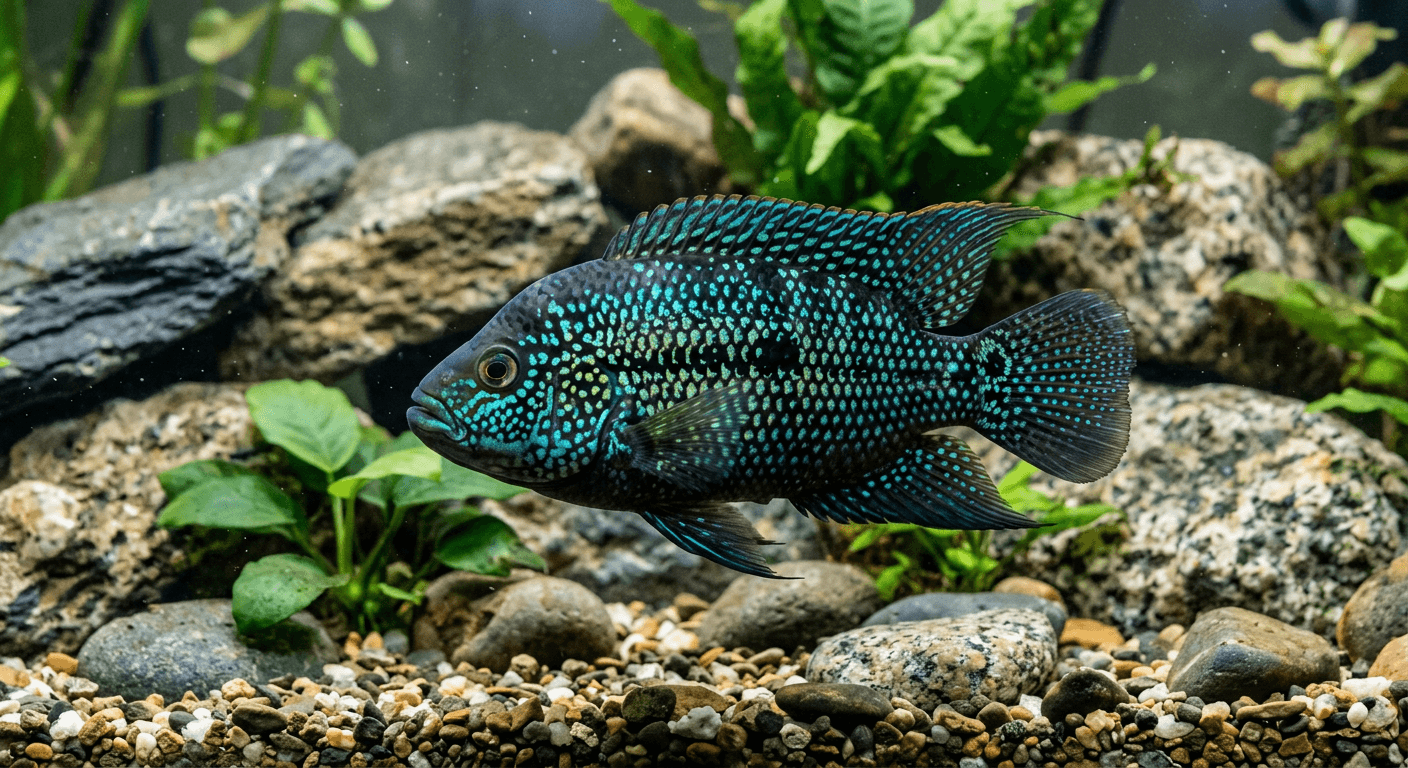
Jack Dempsey
Rocio octofasciata
Overview
Named after the heavyweight boxer William Harrison "Jack" Dempsey for its aggressive fighting style, the Jack Dempsey cichlid has been a staple in the hobby since the 1970s. And the name fits. These are territorial, confrontational fish that will redecorate your tank, pick fights with neighbors, and stare you down through the glass like they own the place. But that personality is exactly why people keep them. A full-grown Jack Dempsey covered in iridescent blue-green spangles is one of the most striking freshwater fish you can own. Under good lighting, the scales shift between gold, teal, and deep blue depending on the angle. They live 10 to 15 years, learn to recognize their keeper, and develop individual quirks that make them feel less like a pet fish and more like a roommate with a short fuse. Just know what you are signing up for. These fish get big, they get mean during breeding, and they need space. If you want a docile community fish, look elsewhere. If you want a fish with attitude and looks, this is the one.
Tank Setup
A 55-gallon tank is the minimum for a single Jack Dempsey, but 75 gallons gives you much more flexibility for tankmates and territory management. These fish produce a lot of waste and need powerful filtration. A canister filter rated for at least 1.5 times your tank volume is the right call. They dig constantly, so use sand or smooth, rounded gravel as substrate. Sharp gravel can injure their mouths and gills while they sift. Forget about a planted aquascape. Jack Dempseys will uproot, shred, and bury just about any plant you put in there. If you want greenery, attach Java fern or Anubias to rocks and driftwood where the fish cannot pull them loose. The real priority is structure. Use rocks, driftwood, and clay pots to create caves and line-of-sight breaks. Jack Dempseys need territories they can claim and defend, and breaking up sightlines reduces aggression between tankmates. Make sure all hardscape is stable and cannot topple, because these fish will push things around. A tight-fitting lid is required. They are not frequent jumpers, but it happens, especially when startled or during territorial disputes.
Water Parameters
Jack Dempseys tolerate a fairly wide range of water conditions, which is part of why they have stayed popular for decades. Temperature should stay between 72 and 82 degrees Fahrenheit, with 78 being the sweet spot. pH can range from 6.5 to 8.0, so most tap water works fine. They are not picky about hardness either. What they will not tolerate is dirty water. Weekly water changes of 25-30% are non-negotiable with a fish that produces this much waste. Ammonia and nitrite must be at zero. Keep nitrates under 20 ppm if you can, and definitely under 40. Poor water quality is directly linked to hole-in-the-head disease, which Jack Dempseys are prone to. A good liquid test kit and a consistent maintenance schedule will save you a lot of trouble.
Diet & Feeding
Jack Dempseys are carnivores that need a protein-heavy diet. High-quality large cichlid pellets should be the foundation, making up about 70% of what they eat. Supplement with frozen bloodworms, brine shrimp, krill, and earthworms a few times per week. Some keepers offer occasional live feeder insects like crickets, which Jack Dempseys will attack with enthusiasm. Avoid feeder fish. They carry parasites and diseases that are not worth the risk. Feed once or twice a day, only what the fish can finish in 2 to 3 minutes. Jack Dempseys are greedy and will overeat if you let them. Obesity shortens their lifespan and contributes to organ problems. Some experienced keepers fast their fish one day per week, which is a reasonable practice for any large cichlid.
Behavior & Temperament
Jack Dempseys earned the boxer's name honestly. They are territorial and will defend their space with real aggression, especially during breeding season. A breeding pair will attack anything that enters their half of the tank, regardless of size. Outside of breeding, aggression is more about posturing and chasing than actual damage, but it can escalate in cramped tanks. Males are generally more aggressive than females and will flare their gills, lock jaws with rivals, and chase relentlessly if they decide another fish is in their territory. The best way to manage aggression is space and structure. In a 75-gallon tank with plenty of caves and sightline breaks, a Jack Dempsey can coexist with appropriately tough tankmates. In a bare 55-gallon, someone is getting bullied. Bonded pairs are fascinating to watch. They work together to defend territory, clean spawning sites, and raise fry. But getting a bonded pair is partly luck. Two Jack Dempseys thrown together may fight instead of bond, especially if they are both males.
Compatible Tankmates
Tankmate selection is limited and size-dependent. Anything small enough to fit in a Jack Dempsey's mouth will end up there. Good options include silver dollars, which are fast, peaceful, and too large to eat. Bala sharks work in tanks of 125 gallons or more but need a school. Bristlenose plecos and rubber-lip plecos generally do well because they stay out of the way, are armored, and occupy the bottom where the Dempsey is less territorial. Clown loaches can work in large tanks with plenty of hiding spots. Avoid small community fish entirely: tetras, rasboras, guppies, livebearers, and shrimp are all food. Do not pair with other aggressive cichlids like oscars. Two territorial centerpiece fish in the same tank usually ends badly unless you have 150+ gallons and serious experience. Mid-sized cichlids like angelfish, rams, and acaras get bullied or killed. When in doubt, keep a Jack Dempsey as a solo centerpiece with a pleco for cleanup.
Common Health Issues
Hole-in-the-head disease (HITH) is the number one health concern with Jack Dempseys. It shows up as small pits or erosions on the head and along the lateral line, and it looks exactly as bad as it sounds. The cause is debated, but poor water quality, lack of dietary variety, and the parasite Hexamita are all linked. Prevention is straightforward: keep the water clean, feed a varied diet, and do not let nitrates creep up. If you catch HITH early, improving water quality and diet can reverse it. Advanced cases may need metronidazole treatment. Ich is another common problem, especially after a move or temperature swing. White spots across the body and fins are the telltale sign. Raise temperature to 82-84 degrees and treat with ich medication. Jack Dempseys can also develop bacterial infections from injuries sustained during fights. Melafix or similar antibacterial treatments help, but separating the injured fish is the real fix.
Breeding
Jack Dempseys are substrate spawners that breed readily in captivity once you have a bonded pair. Sexing them is not always straightforward, but males tend to be larger with more pointed dorsal and anal fins, and adult males often develop a pronounced nuchal hump on the forehead. A bonded pair will claim a flat rock, piece of slate, or cleared area of substrate and clean it obsessively before spawning. The female lays 500 to 800 eggs in rows, and both parents guard the clutch aggressively. Expect the pair to attack anything that comes near, including your hand during water changes. Eggs hatch in about 3 days at 78 degrees, and fry become free-swimming around day 5. The parents herd fry around the tank in a tight group, which is one of the more impressive parenting displays in freshwater fish. Feed fry baby brine shrimp and crushed flake food. If you want to raise the fry, you may need to remove them once they reach about half an inch, because the parents sometimes eat fry from later broods or during stress.
Frequently Asked Questions
Quick Stats
What You Need for Jack Dempsey
Gear that works well for this species, based on what experienced keepers actually use.
Rated for up to 70 gallons with strong mechanical and biological filtration. Handles the heavy waste output of a large cichlid without needing constant maintenance.
Color-enhancing formula with high protein content sized for large cichlid mouths. Floating pellets let you monitor how much your fish actually eats.
Precise thermostat control and shatterproof glass construction. The 300W model handles 55-75 gallon tanks with room to spare, and it can take the occasional bump from a rearranging cichlid.
Smooth, fine-grained sand that will not injure a digging cichlid's mouth. pH neutral and free of dyes. Jack Dempseys sift substrate constantly, so smooth grain matters.