Leopard Danio
Brachydanio frankei
Overview
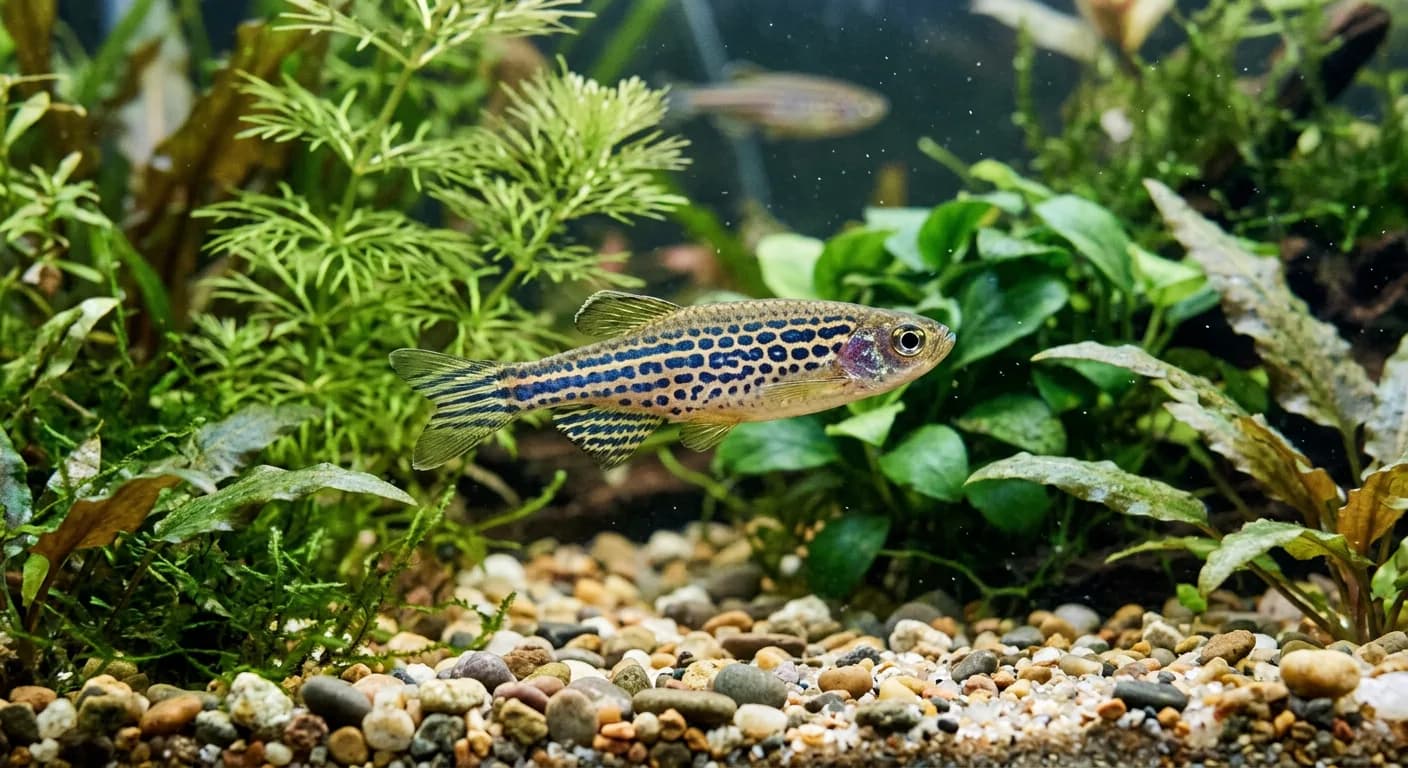
Leopard Danios are the spotted sprinters of the freshwater world. Unlike their striped zebra danio cousins, these fish wear a coat of dark spots against a silvery background that breaks up their outline in the water. They are perpetually in motion, zooming around the tank in coordinated groups like a small school of aquatic bullets. This constant activity is part of their appeal and also their main requirement. A lone Leopard Danio is a stressed Leopard Danio, and stressed danios lose their spots and fade to a dull gray. Keep them in groups of at least 6, and they will entertain you for hours as they patrol the tank together. They are one of the best beginner fish for people who want something more interesting than a basic guppy but not as demanding as a rainbowfish. The spots give them a slightly wilder look than the zebra danio, and in a planted tank, they really stand out against the green.
Tank Setup
A 20-gallon tank is the bare minimum for a school of 6 Leopard Danios, but a 30-gallon gives them room to really stretch their fins. These are active swimmers that use every inch of horizontal space, so longer tanks are better than tall ones. They are not picky about substrate, but dark gravel or sand makes their spots pop visually. Plants are appreciated but not required. Java fern, anubias, and java moss all work well and provide cover where the danios can rest between zoom sessions. Avoid high-flow filters danio-style danio water movement. A hang-on-back filter that creates moderate surface agitation is perfect. Leopard Danios can jump when startled, so a tight-fitting lid is essential. They do not care about lighting and will look good under anything from ambient room light to bright planted tank LEDs. The only non-negotiable is open swimming space in the center of the tank.
Water Parameters
Leopard Danios are forgiving of water parameters in a way that makes them ideal for beginners. pH between 6.5 and 7.5 covers their range, and they handle moderately hard water without issues. Temperature can range from 70 to 79 degrees, with 75 being the sweet spot. They are not as sensitive to ammonia as some species, but like all fish, they do best in cycled tanks with zero ammonia and nitrite. Nitrates should stay under 40 ppm, with weekly 25% water changes being the standard maintenance routine. One thing to note: Leopard Danios are more sensitive to temperature drops than zebra danios. If you do a large water change with cold water, you risk shocking them. Match the temperature or add the new water slowly. They are hardier than they look, but sudden temperature changes will put them into shock.
Diet & Feeding
Leopard Danios are unfussy eaters that will accept almost anything you drop into the tank. A quality flake food forms the base of their diet. Rotate between a couple of different brands to keep them interested. They are omnivores, so supplement with frozen foods a few times per week. Bloodworms, brine shrimp, and daphnia are all enthusiastically received. Live foods trigger the best feeding responses, but frozen is more convenient and just about as good nutritionally. Feed small amounts twice daily. These fish are near the surface most of the time, so they grab food before it sinks. Make sure slower bottom-dwellers in the tank get their share by using sinking pellets or feeding in a way that gives bottom feeders time to find food. They are not aggressive feeders but they are fast, and slower fish can get outcompeted at mealtime.
Behavior & Temperament
Leopard Danios are what you get when you cross a schooling fish with a perpetual motion machine. They swim constantly, exploring the tank in tight formation with their tankmates. Males will occasionally chase each other in mock battles that look aggressive but result in no injuries. This display behavior is normal and actually a sign of a healthy, established group. They are peaceful with other species and make ideal dither fish for shy corydoras or cichlids that appreciate having active tankmates in the upper levels of the tank. Their high energy level can stress very slow or timid fish, so avoid pairing them with species that hide constantly. They are not fin nippers, which makes them safe with long-finned tankmates. A group of 6 or more will establish a loose hierarchy and spend their days patrolling the tank together. The spots help them blend in with each other when schooling, creating a unified group that moves as one.
Compatible Tankmates
Leopard Danios fit well with most peaceful community fish that share their temperature range. Zebra danios are the obvious tankmate since they are the same species essentially. Other fast-moving community fish like harlequin rasboras, cherry barbs, and most tetras make good companions. Bottom dwellers including corydoras of all varieties, kuhli loaches, and bristlenose plecos work well. They are peaceful enough for planted tank communities with dwarf gouramis or honey gouramis. Smaller snails and most freshwater shrimp are safe. The main thing to avoid is pairing them with fish large enough to eat them, like Oscars or other big cichlids, or with aggressive fish that will harass their constant movement. Goldfish are a bad match because of the temperature incompatibility. They do fine with a betta in a large enough tank, provided the betta is not extremely aggressive.
Common Health Issues
Leopard Danios are tough little fish with few specific health problems. Ich is the most common issue, usually triggered by stress from shipping or poor water quality. The white spots are easy to spot against their spotted pattern. Treatment follows the standard protocol of raising temperature to 86 degrees over 48 hours and adding aquarium salt. They handle the heat well since their upper range approaches those temperatures. Fin rot can occur in dirty water or if injured by aggressive tankmates. Clean water usually resolves mild cases. Bacterial infections are rare in healthy danios. The best prevention is keeping them in a proper school, maintaining good water quality, and quarantining new additions for at least two weeks before adding them to the main tank. They are not prone to swim bladder issues or the internal parasites that plague some other small fish.
Breeding
Breeding Leopard Danios at home is straightforward once you understand what triggers them. They are egg scatterers that do not provide parental care. A separate breeding tank of 10 gallons with spawning mops or java moss on the bottom works best. Condition the breeding group with heavy feedings of live or frozen foods for a week. Males will chase females aggressively in the morning, and the female releases eggs which the male fertilizes simultaneously. Hundreds of tiny eggs get scattered across the tank bottom. Remove adults after spawning or they will eat every egg they find. Eggs hatch in 2-3 days depending on temperature. The fry are tiny and need infusoria or liquid fry food for the first week, then graduate to baby brine shrimp. They grow fast and reach adult size in about 3 months. The spotted pattern develops as they mature, with full coloration showing around 4-6 months of age.
Frequently Asked Questions
Quick Stats
What You Need for Leopard Danio
Gear that works well for this species, based on what experienced keepers actually use.
Rated for tanks up to 30 gallons with adjustable flow. The multi-stage filtration handles the bioload of an active danio school without creating excessive current. Reliable and easy to maintain with a lifetime warranty on the motor.
50W heater appropriate for 20-30 gallon tanks. The adjustable dial lets you set the exact temperature in the 70-79F range Leopard Danios need. Compact design hides easily behind decorations or filter intake.
Complete test kit with liquid tests for pH, ammonia, nitrite, and nitrate. The only test kit most hobbyists need. Accurate enough for tracking the weekly water changes that keep danios healthy.
Insect-based formula with black soldier fly larvae as the first ingredient. High protein content supports the active lifestyle of Leopard Danios. Small flake size is appropriate for their small mouths.