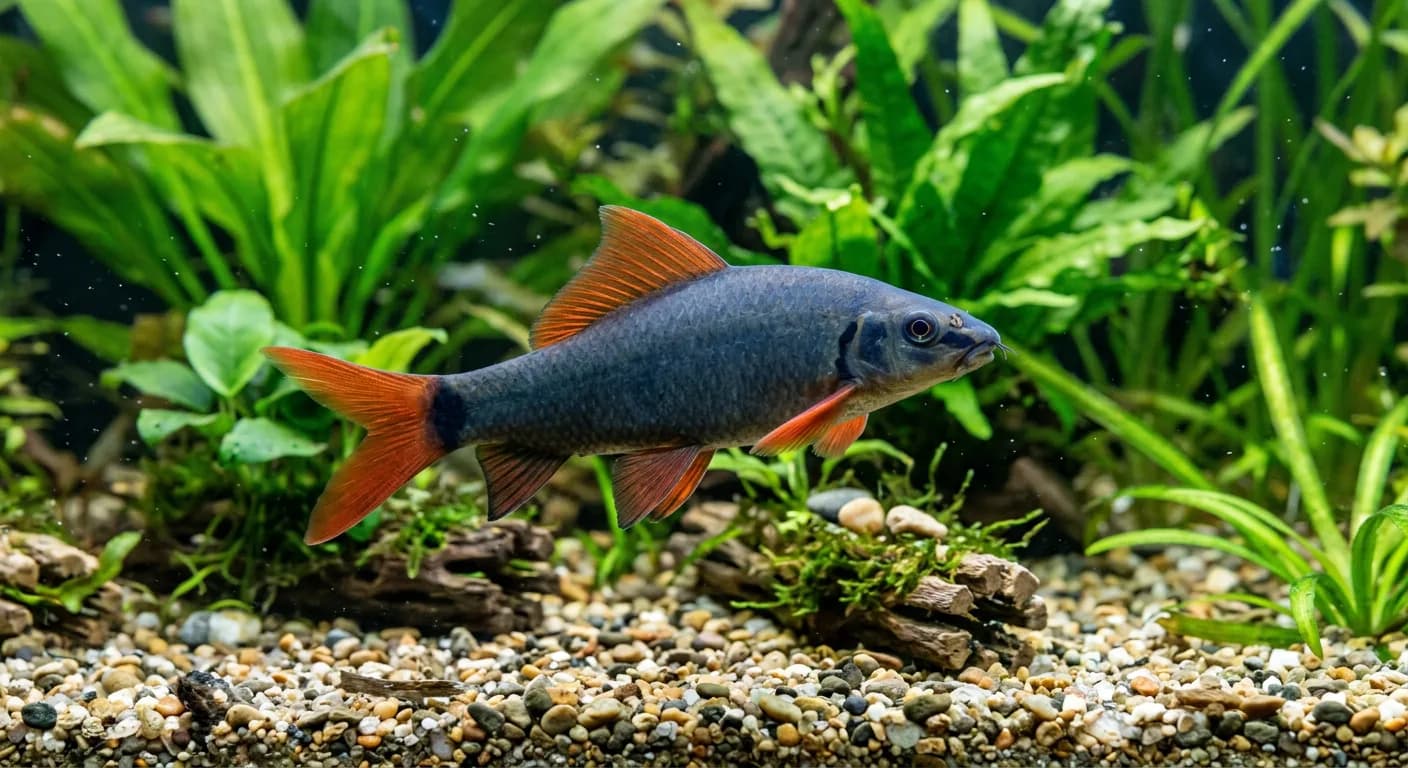
Rainbow Shark
Epalzeorhynchos frenatum
Overview
Rainbow Sharks are often confused with Red-Tailed Sharks, but they are actually more aggressive and territorial. While Red-Tailed Sharks have black bodies with red tails, Rainbow Sharks have dark gray to black bodies with orange-red fins throughout. Young fish show more pronounced coloration that may fade slightly with age, but mature Rainbow Sharks still display beautiful contrasts. These fish are not for beginners or peaceful community tanks. They are more aggressive than their Red-Tailed cousins and will dominate the bottom territory of any tank they occupy. Only one Rainbow Shark should be kept per tank, and that tank needs to be large enough to accommodate their territorial nature and active swimming style. When properly housed with appropriate tankmates, they make striking centerpiece fish that command attention. Their constant activity and bold personality make them interesting to watch, but their aggressive tendencies require careful planning and compatible tankmate selection.
Tank Setup
Rainbow Sharks need a minimum of 55 gallons, with 75-100 gallons being much better for their temperament and the peace of their tankmates. The tank should be heavily decorated with caves, driftwood, large rocks, and dense plant groups to create territorial boundaries and break up sight lines. They are excellent jumpers, so a secure lid is essential. Use sandy or fine gravel substrate since they spend considerable time foraging along the bottom. Filtration needs to be robust due to their bioload and territorial stress they may cause other fish. A canister filter rated for your tank size plus an additional 25-30% capacity handles their needs well. They prefer moderate to strong water movement, which mimics their natural river habitat and helps maintain good oxygen levels. Plants should be robust species that can handle occasional rough treatment - avoid delicate plants that might be damaged during their territorial patrols.
Water Parameters
Rainbow Sharks require stable water conditions with pH between 6.5 and 7.5, leaning toward the neutral range. They do well in soft to moderately hard water and are somewhat sensitive to parameter fluctuations once established. Temperature should remain between 72-79 degrees Fahrenheit, with 76 degrees being optimal. Water quality must be excellent due to their high bioload and stress levels. Maintain ammonia and nitrite at zero, with nitrates kept under 20 ppm through regular water changes. Their aggressive behavior can stress tankmates, making good water quality even more important for overall tank health. Perform weekly water changes of 25-30% to maintain stable conditions. Their sensitivity to water quality changes means any tank maintenance should be done gradually to avoid triggering aggressive behavior or stress responses.
Diet & Feeding
Rainbow Sharks are omnivores with aggressive feeding behaviors that match their temperament. They need a varied diet of high-quality sinking pellets as the staple, supplemented with algae wafers, blanched vegetables, and protein foods like bloodworms and brine shrimp. They are voracious algae grazers and will help control some algae growth, but they should not be relied upon as the primary algae management strategy. Feed once or twice daily, distributing food in multiple locations around the tank to reduce competition with tankmates. Rainbow Sharks are food aggressive and will chase other fish away from feeding areas, so monitor feeding time carefully to ensure all fish get adequate nutrition. They prefer foods that sink to the substrate where they spend most of their time, but they will also dart to the surface to grab floating food before it reaches other fish.
Behavior & Temperament
Rainbow Sharks are more aggressive and territorial than Red-Tailed Sharks, making them challenging community fish. They establish large territories in the bottom portion of the tank and aggressively defend these areas from any perceived intruders. Their aggression extends beyond just territorial defense - they often chase and harass tankmates during feeding time and when establishing dominance. They are particularly aggressive toward other bottom-dwelling fish, anything with similar body shape, and fish that venture into their claimed territory. Unlike some territorial fish that calm down once established, Rainbow Sharks often maintain their aggressive behavior throughout their lives. They are most problematic in smaller tanks where fish cannot escape their attention. Success with Rainbow Sharks requires large tanks, appropriate tankmate selection, and understanding that they will always be the dominant fish in any community setup.
Compatible Tankmates
Rainbow Sharks need tankmates that can handle their aggressive personality and avoid their bottom territory. Fast-swimming, medium-sized fish that inhabit the middle and upper water column work best. Tiger barbs, cherry barbs, and larger tetras can hold their own and avoid prolonged confrontations. Robust cichlids like angelfish may work in larger tanks, though careful observation is needed. Avoid all small, peaceful fish like neon tetras, corydoras, and dwarf gouramis, as they will be constantly harassed. Other bottom-dwellers like other sharks, large plecos, or substrate-dwelling cichlids will create territorial conflicts. Fast livebearers like platies and mollies sometimes work if they stay in the upper water column. The key is choosing fish that are large enough not to be seen as prey, fast enough to escape chasing, and willing to cede the bottom territory to the Rainbow Shark.
Common Health Issues
Rainbow Sharks are relatively hardy once established but can suffer from stress-related illnesses due to their aggressive nature and territorial disputes. Ich is common during introduction to new tanks or when water quality drops. Their constant aggressive behavior can lead to injuries from tank decorations or confrontations with tankmates. Bacterial infections may follow physical injuries, especially around the fins and mouth from aggressive displays. Internal parasites occasionally occur with imported fish, though most are now tank-bred. The most significant health issue is chronic stress, both in the Rainbow Shark and its tankmates. Stressed Rainbow Sharks lose coloration, become even more aggressive, and show increased susceptibility to disease. Maintaining excellent water quality, providing adequate space, and choosing appropriate tankmates prevents most health problems. Watch for signs of excessive stress in both the Rainbow Shark and other tank inhabitants.
Breeding
Breeding Rainbow Sharks in home aquariums is virtually impossible and rarely attempted by hobbyists. Commercial breeding operations use large outdoor ponds, specific seasonal temperature cycles, and hormone treatments to trigger spawning. They are egg scatterers that require precise water conditions and environmental cues that are difficult to replicate in home tanks. Males become even more aggressive during breeding season and may develop slightly brighter fin coloration. Females grow rounder when carrying eggs, but distinguishing sexes outside of breeding condition is very difficult. Even if spawning were to occur, the aggressive parents would immediately eat their eggs and any surviving fry. The tiny fry would require specialized foods and separate raising tanks. Most Rainbow Sharks in the aquarium trade come from commercial farms in Southeast Asia. Focus on providing excellent care for adult fish rather than attempting breeding projects with this challenging species.
Tankmates to Avoid
These species don't mix well with Rainbow Shark. Tap a name for the full breakdown.
Frequently Asked Questions
Quick Stats
Compare
What You Need for Rainbow Shark
Gear that works well for this species, based on what experienced keepers actually use.
Heavy-duty filtration system designed for tanks with higher bioloads and semi-aggressive fish. Bio-wheel technology provides superior biological filtration needed for Rainbow Shark setups.
Maintains stable 72-79°F temperatures that Rainbow Sharks require. External controller prevents fish from damaging the heater during territorial displays.
Sinking pellets that reach bottom-dwelling Rainbow Sharks quickly. High protein content supports their active lifestyle and aggressive behavior patterns.
Smooth sand substrate that will not injure Rainbow Sharks during their constant bottom foraging and territorial displays. Easy to clean and maintain in high-bioload tanks.