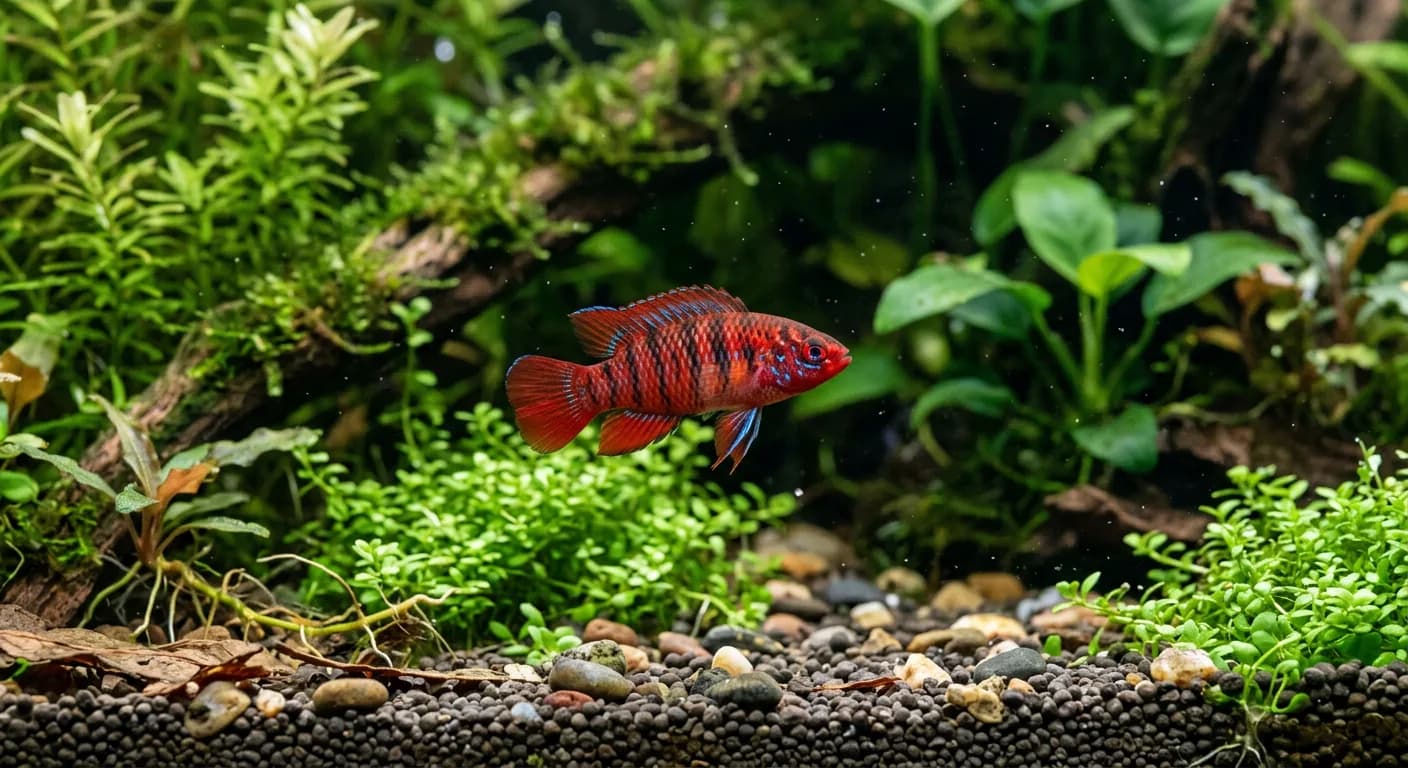
Scarlet Badis
Dario dario
Overview
Scarlet Badis are among the smallest freshwater fish available to aquarists, maxing out at less than an inch in length. Males display stunning red and blue coloration with intricate patterns, while females remain more subdued with brown and tan markings. Despite their tiny size, males are surprisingly territorial and will establish small territories in nano tanks, chasing away other males and displaying intensely to attract females. These Indian natives are specialists that require specific care - they prefer live foods and can be challenging to transition to prepared foods. Scarlet Badis are perfect for nano tanks and species-specific setups where their intricate behaviors and beautiful colors can be properly appreciated. They are not community fish in the traditional sense due to their territorial nature and specialized feeding requirements. However, they can coexist with very small, peaceful tankmates that will not compete for territory or outcompete them for food. Their small size and beautiful coloration make them perfect jewels for experienced nano tank enthusiasts.
Tank Setup
Scarlet Badis can be kept in tanks as small as 10 gallons, with 20 gallons being ideal for a small group or pair. The tank should be heavily planted with fine-leaved plants like java moss, hornwort, and cryptocoryne species that provide hiding spots and territorial boundaries. Males need visual barriers to establish territories without constant conflict. Use a soft substrate like fine sand or smooth gravel since they spend time near the bottom investigating crevices. The tank should have gentle filtration - avoid strong currents that might stress these delicate fish. A sponge filter or small hang-on-back filter with adjustable flow works well. Lighting should support plant growth since plants are essential for their security and territorial behavior. The tank should be mature and well-established before adding Scarlet Badis, as they are sensitive to parameter fluctuations in new setups. Multiple hiding spots and caves allow males to establish separate territories and reduce conflicts.
Water Parameters
Scarlet Badis require stable, high-quality water conditions and are sensitive to parameter fluctuations. pH should stay between 6.0 and 7.5, with 6.5-7.0 being ideal. They prefer soft to moderately soft water and are sensitive to parameter swings. Temperature must remain stable between 72-79 degrees Fahrenheit, with 76 being optimal. Water quality must be excellent: ammonia and nitrite at zero, nitrates under 10 ppm through frequent small water changes. They are extremely sensitive to medications and chemicals, requiring careful treatment approaches. Perform frequent small water changes (15-20% twice weekly) rather than larger weekly changes to maintain stability. Use aged, dechlorinated water at the same temperature as the tank. Their small size and specialized nature makes them vulnerable to any water quality issues. Test parameters regularly and maintain consistent conditions - any fluctuations can stress these delicate fish quickly. Well-aged tanks with established biological filtration work much better than newly cycled setups.
Diet & Feeding
Scarlet Badis are specialized carnivores that strongly prefer live foods and can be very difficult to transition to prepared foods. In the wild, they feed primarily on tiny invertebrates and insect larvae. Live foods like baby brine shrimp, daphnia, cyclops, and microworms are ideal. Frozen foods like bloodworms (chopped into tiny pieces), brine shrimp, and daphnia are acceptable alternatives. Some individuals can be trained to accept high-quality micro pellets or powdered foods, but this requires patience and persistence. Feed small amounts 2-3 times daily since their stomachs are tiny and they cannot eat large meals. They are slow, methodical feeders that may not compete well with faster-moving tankmates. Watch carefully to ensure all fish are eating - their small size makes it easy to miss feeding problems until it's too late. Live food cultures or regular access to live foods is almost essential for long-term success with this species. Their specialized diet is one of the main challenges in keeping them successfully.
Behavior & Temperament
Scarlet Badis display fascinating territorial behavior despite their tiny size. Males establish small territories (often just a few square inches) and defend them vigorously against other males. They display to rivals with spread fins, intense coloration, and aggressive posturing that belies their diminutive size. Males also court females with elaborate displays, showing off their best colors and patterns. They are curious fish that investigate every corner of their territory, often perching on plants or decorations to survey their domain. Unlike schooling fish, they prefer to be alone or in male-female pairs. Multiple males can be kept in larger tanks with plenty of visual barriers, but territorial disputes are common. They are peaceful toward other species that do not intrude on their bottom territory. Their behaviors are best observed in species-specific setups where their intricate social dynamics can be properly appreciated. They are intelligent fish that recognize their owners and can become quite interactive in well-designed nano setups.
Compatible Tankmates
Scarlet Badis work best in species-only setups or with very small, peaceful fish that occupy different water levels. Suitable companions include small tetras like neons or embers, celestial pearl danios, and pygmy corydoras that stay out of their territorial zones. Small livebearers like endlers or female guppies can work in larger tanks. Peaceful invertebrates like cherry shrimp and small snails are usually ignored. Avoid any fish large enough to eat them or aggressive enough to harass them. Also avoid bottom-dwelling fish that might compete for territory or fast-swimming fish that might stress them during feeding time. The key is choosing tankmates that will not outcompete them for food, stress them with aggressive behavior, or intrude on their bottom territories. Many aquarists prefer species-only setups where their natural behaviors can be observed without the complications of community tank management. Their specialized needs make them better suited for dedicated nano setups rather than general community tanks.
Common Health Issues
Scarlet Badis are delicate fish prone to stress-related illnesses and require careful attention to water quality and diet. Poor nutrition from inadequate live food access is their most common health issue, leading to weakness, color loss, and susceptibility to disease. Ich can be problematic since they are extremely sensitive to most medications - use quarter-strength treatments or natural methods like increased temperature and salt. Bacterial infections may occur following stress or poor water quality, often appearing as white patches or fin rot. Parasites can be an issue, particularly with newly imported fish that may have been weakened during shipping. Their small size makes them vulnerable to rapid health decline - problems that would be minor in larger fish can be fatal quickly. Fungal infections can occur in poor water conditions or following injuries from territorial disputes. Prevention through excellent water quality, proper diet, and stable conditions is much more important than treatment. Quarantine new fish for 3-4 weeks and ensure they are eating before introduction to the main tank. Any signs of stress or illness require immediate attention due to their delicate nature.
Breeding
Scarlet Badis can be bred in home aquariums with proper setup and conditioning, though success requires attention to detail. Set up a breeding tank with plenty of fine-leaved plants, caves, or spawning sites like coconut shells or small flower pots. Condition adults with live foods for 2-3 weeks until females become noticeably rounder with eggs. Males will establish territories around potential spawning sites and court females with intense displays. Spawning occurs when the female enters the male's territory and deposits eggs in a hidden location like a cave or plant thicket. The male fertilizes and guards the eggs, becoming extremely territorial during this period. Remove the female after spawning since the male may become aggressive toward her. Eggs hatch in 2-3 days, and the fry become free-swimming after about a week. The male guards fry initially but should be removed once they are free-swimming to prevent predation. Fry are tiny and need infusoria or liquid fry food for the first week before graduating to baby brine shrimp. Growth is slow, taking 6-8 months to reach adult size. Breeding success requires excellent water quality and abundant live foods for both adults and fry.
Frequently Asked Questions
Quick Stats
What You Need for Scarlet Badis
Gear that works well for this species, based on what experienced keepers actually use.
Gentle sponge filtration perfect for nano tanks with delicate fish. Provides excellent biological filtration without creating currents that could stress tiny Scarlet Badis. Easy to adjust flow for small tank requirements.
Maintains stable 72-79°F temperatures critical for temperature-sensitive Scarlet Badis. Small size works well in nano tanks while providing reliable, consistent heating for delicate fish.
High-quality micro pellets that some Scarlet Badis can be trained to accept as supplement to live foods. Natural insect protein closely mimics their wild diet when live foods are unavailable.
Nutrient-rich substrate that supports heavy plant growth essential for Scarlet Badis territories and security. Fine texture is safe for tiny fish while promoting the lush planted environment they need.