How to Treat Ich in a Fish Tank (Step-by-Step)
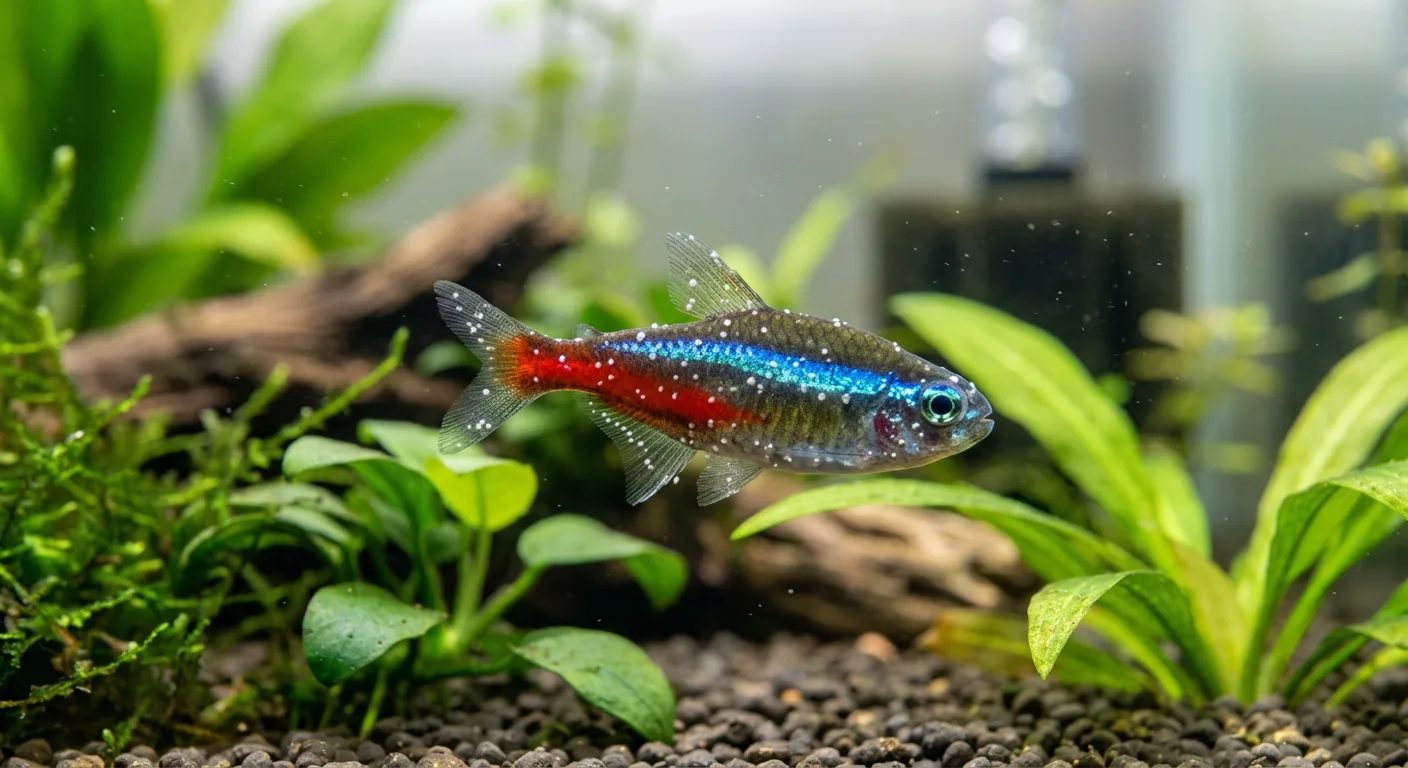
White spots on your fish? You're likely dealing with ich, the most common freshwater fish disease. This guide covers everything you need to eliminate ich from your tank and prevent it from returning. Time matters when treating ich, so let's get your fish healthy again.
01
Is It Ich?
Before treating, confirm you're dealing with ich and not another disease. Ich appears as tiny white spots that look like salt grains sprinkled on your fish's body, fins, and gills. These spots are perfectly round and raised, not fuzzy or cotton-like.
Watch for behavioral changes. Fish with ich will flash or scratch against decorations, rocks, and gravel because the parasites cause intense itching. You'll see rapid gill movement as the parasites irritate breathing. Fish often lose appetite and become lethargic.
Don't confuse ich with other white spot diseases. Columnaris creates fuzzy white patches, not distinct dots. Lymphocystis causes larger, cauliflower-like growths. Stress spots on some fish species appear and disappear quickly, while ich spots persist and multiply.
Count the spots over 24 hours. Ich spots increase in number daily during an outbreak. If spots remain the same or decrease without treatment, you might be dealing with stress marks or another condition.
Check all fish in the tank, not just the obviously affected ones. Ich spreads to every fish in the system, though some show symptoms before others. Healthy fish with strong immune systems may resist showing spots initially but still carry the parasite.
02
The Ich Lifecycle
Understanding ich's lifecycle is critical for successful treatment. Ich has three stages, but only one responds to medication.
Stage 1 is the feeding stage where parasites attach to fish skin and gills. These create the visible white spots. Medications cannot penetrate the protective cyst around feeding parasites. This stage lasts 3-7 days depending on temperature.
Stage 2 happens when mature parasites drop off fish and attach to surfaces in your tank. They form reproductive cysts and multiply rapidly. Warmer water speeds this process. This stage lasts 6-18 hours.
Stage 3 is when hundreds of free-swimming parasites emerge from each cyst, searching for fish to infect. This is the only stage vulnerable to medications. Free-swimmers must find a host within 48-72 hours or die.
Temperature controls the lifecycle speed. At 75°F, the complete cycle takes 7-10 days. At 86°F, it compresses to 3-4 days. This is why heat treatment works and why you must treat for specific durations.
The cycle never stops during an outbreak. While you see spots on fish (stage 1), more parasites are reproducing in your substrate and decorations (stage 2), and others are swimming free looking for hosts (stage 3). Every fish in your tank will be exposed repeatedly.
Treatment must last long enough to catch every parasite during its vulnerable stage 3 period. Miss this window, and the outbreak continues.
03
Heat Treatment Method
Heat treatment eliminates ich without medications by accelerating the lifecycle and creating lethal temperatures for free-swimming parasites.
Raise temperature gradually to 86°F over 48 hours. Increase by 2 degrees every 12 hours to avoid shocking your fish. Use an adjustable heater and monitor with a reliable thermometer.
Maintain 86°F for exactly 14 days. This ensures you catch every parasite cycle. Mark your calendar because early termination allows survivors to restart the outbreak.
Add extra aeration immediately when raising temperature. Hot water holds less dissolved oxygen. Install an air stone or increase filter flow to prevent fish from gasping at the surface.
This method works well for most community fish including tetras, barbs, danios, and gouramis. Avoid heat treatment for cold-water fish like goldfish, which suffer stress above 78°F.
Monitor fish behavior closely during treatment. Some species become more aggressive in warm water. Feed lightly since fish metabolism increases and waste production rises.
Do not combine heat treatment with medications unless specifically needed for resistant strains. The combination can stress fish beyond their tolerance.
After 14 days, reduce temperature gradually over 48 hours back to normal levels. Sudden cooling can shock fish as much as sudden heating.
Disadvantages include higher electricity costs, potential equipment failure with sustained high temps, and stress on sensitive fish species. Some ich strains resist heat treatment and require medication.
04
Medication Treatment
Medication treatment targets free-swimming ich parasites with copper-based or formalin-based products. Always remove activated carbon from filters before medicating as carbon absorbs medications.
Seachem ParaGuard is a gentler aldehyde-based treatment safe for most fish and invertebrates. Dose 5ml per 40 gallons daily for 14 days. This extended treatment catches multiple parasite cycles without harsh chemicals.
API Super Ick Cure contains malachite green and formalin. Dose according to package directions every 48 hours for 6 treatments total. More aggressive than ParaGuard but effective against resistant strains.
Hikari ICH-X combines formalin and malachite green in precise ratios. Dose 5ml per 10 gallons daily for 7 days minimum. Popular among fishkeepers for reliable results.
Never overdose medications thinking faster treatment is better. Overdosing kills beneficial bacteria, crashes your nitrogen cycle, and can poison fish.
Perform 25% water changes before each re-dose to remove metabolic waste and maintain water quality. Replace the exact medication amount removed during water changes.
Treat the entire tank, not just affected fish. Ich infects every surface and all fish carry parasites whether showing symptoms or not. Hospital tank treatment often fails because you cannot treat the main tank where parasites reproduce.
Continue treatment for full duration even after spots disappear. Visible spots represent only attached parasites. Free-swimming stages remain in your tank for days after fish appear clean.
Watch for medication side effects including gasping, erratic swimming, or color changes. Reduce dosage by 50% if fish show stress signs but continue treatment duration.
Hikari Ich-X
Treats ich without harming scaleless fish at correct doses. Works in 3-5 days when paired with heat.
Seachem ParaGuard
Broad-spectrum parasite treatment. Good fallback when you are not sure if it is ich or velvet.
05
Treating the Whole Tank vs Hospital Tank
Always treat the main tank, not individual fish in a hospital tank. This is the biggest mistake new fishkeepers make when fighting ich.
Ich parasites reproduce throughout your main tank in the gravel, decorations, filter media, and glass surfaces. Moving sick fish to a hospital tank leaves the source of infection untreated. Parasites continue multiplying and will reinfect fish when they return.
Treat every fish in the main system because ich spreads to all inhabitants within 24-48 hours of introduction. Fish showing symptoms first have weaker immune systems, but healthy-looking fish already carry parasites in early stages.
Temporary housing is only appropriate when main tank medications would harm invertebrates, live plants, or biological filtration. In these cases, remove sensitive organisms to a separate container, not the infected fish.
If you must use a hospital tank, treat both the main tank and hospital tank simultaneously. Sterilize the main tank completely before returning any fish. This process is more complex and stressful than treating everything together.
Do not move fish multiple times during treatment. Each transfer adds stress that weakens immune systems and makes recovery harder. Set up treatment conditions and leave fish undisturbed.
New additions to treated tanks can reintroduce ich if not properly quarantined. One infected fish restarts the entire outbreak cycle regardless of previous successful treatments.
Filter media harbors parasites in their reproductive stage. Do not transfer filter media between tanks during outbreaks. Clean equipment with diluted bleach solution before reuse in healthy tanks.
06
Ich-Safe Fish and Problem Cases
Scaleless fish like corydoras catfish, kuhli loaches, and some plecos react severely to standard ich medications. Their exposed skin absorbs more chemicals, leading to poisoning.
For scaleless fish, use half-strength medications or choose gentler alternatives. SeaChem ParaGuard works well at reduced doses. Start with 2.5ml per 40 gallons instead of the standard 5ml dose.
Elephant nose fish, discus, and other sensitive species cannot tolerate malachite green or copper-based treatments. Use heat treatment instead, raising temperature gradually to 84°F rather than 86°F for these delicate fish.
Fry and juvenile fish under 2 inches long are extremely sensitive to medications. Heat treatment combined with salt (1 tablespoon per 5 gallons) often works better than chemical treatments for young fish.
Bettas tolerate most ich treatments well but watch for fin damage during treatment. Their long fins can develop tears if water quality drops during medication periods.
Goldfish and other cold-water species should not receive heat treatment above 78°F. Use medication treatment with increased aeration to handle their cold-water needs.
Shrimp, snails, and other invertebrates die from most ich medications. Remove them to a separate container during treatment or choose invertebrate-safe options like increased temperature alone.
Monitor ammonia and nitrite levels closely during treatment with sensitive species. Their reduced tolerance means water quality problems compound treatment stress rapidly.
Some cichlid species become extremely aggressive during treatment stress. Provide extra hiding spots and monitor for excessive bullying that could kill weakened fish.
07
After Treatment: Preventing Ich From Coming Back
Prevention centers on quarantine protocols and tank stability. Most ich outbreaks start with new fish introductions that bypass quarantine.
Set up a permanent quarantine tank for all new arrivals. A 10-20 gallon tank with sponge filter, heater, and basic decorations works perfectly. Quarantine every new fish for 4 weeks minimum before adding to your main tank.
During quarantine, watch for ich symptoms and treat immediately if spotted. Better to catch ich in a small quarantine tank than fight it in your main system with all your fish at risk.
Maintain stable water temperature in your main tank. Temperature swings of more than 3 degrees stress fish and trigger ich outbreaks in carriers. Use a quality heater with backup if possible.
Avoid overcrowding which creates stress and poor water quality. Both factors weaken fish immunity and increase ich susceptibility. Follow the 1 inch of fish per gallon rule for most species.
Keep water parameters stable through regular testing and maintenance. Weekly 25% water changes prevent parameter drift that stresses fish. Test ammonia, nitrite, and pH monthly.
Feed a varied diet including vitamin-enriched foods to boost fish immunity. Healthy fish with strong immune systems resist ich infections better and recover faster if infected.
Clean new decorations, plants, and equipment before adding to established tanks. Ich can survive on wet surfaces for several hours and transfer between tanks on contaminated items.
Never transfer water, filter media, or equipment from infected tanks to healthy tanks without proper sterilization. Use separate nets and siphons for different tanks if maintaining multiple systems.
Build immunity gradually by maintaining excellent water quality and avoiding sudden changes that shock fish systems.
Table of Contents
Related Content
Popular Fish Species
Essential Gear
Best Aquarium Test Kit for Freshwater Tanks
API Freshwater Master Test Kit
Frequently Asked Questions
Not sure what you're treating?
Match what you're seeing on the fish to the most likely cause before reaching for medication.
Open the fish symptom guide →A note on fish health advice
TankMinded shares guidance based on common hobbyist practice and published aquarium literature. We're not veterinarians. Individual cases vary, medications can interact with water chemistry in unpredictable ways, and advanced or persistent illness calls for an aquatic vet — the AAFV directory is a good place to start. Follow any treatment at your own discretion.
Sources & Further Reading
- Ichthyophthirius multifiliis — Wikipedia
Parasite lifecycle, temperature sensitivity data, transmission pathways, and the trophont/tomont/theront stages described in this guide.
- FishBase — Global Species Database
Species-specific temperature tolerance data used to verify safe heat treatment ranges for different fish cited in this guide.