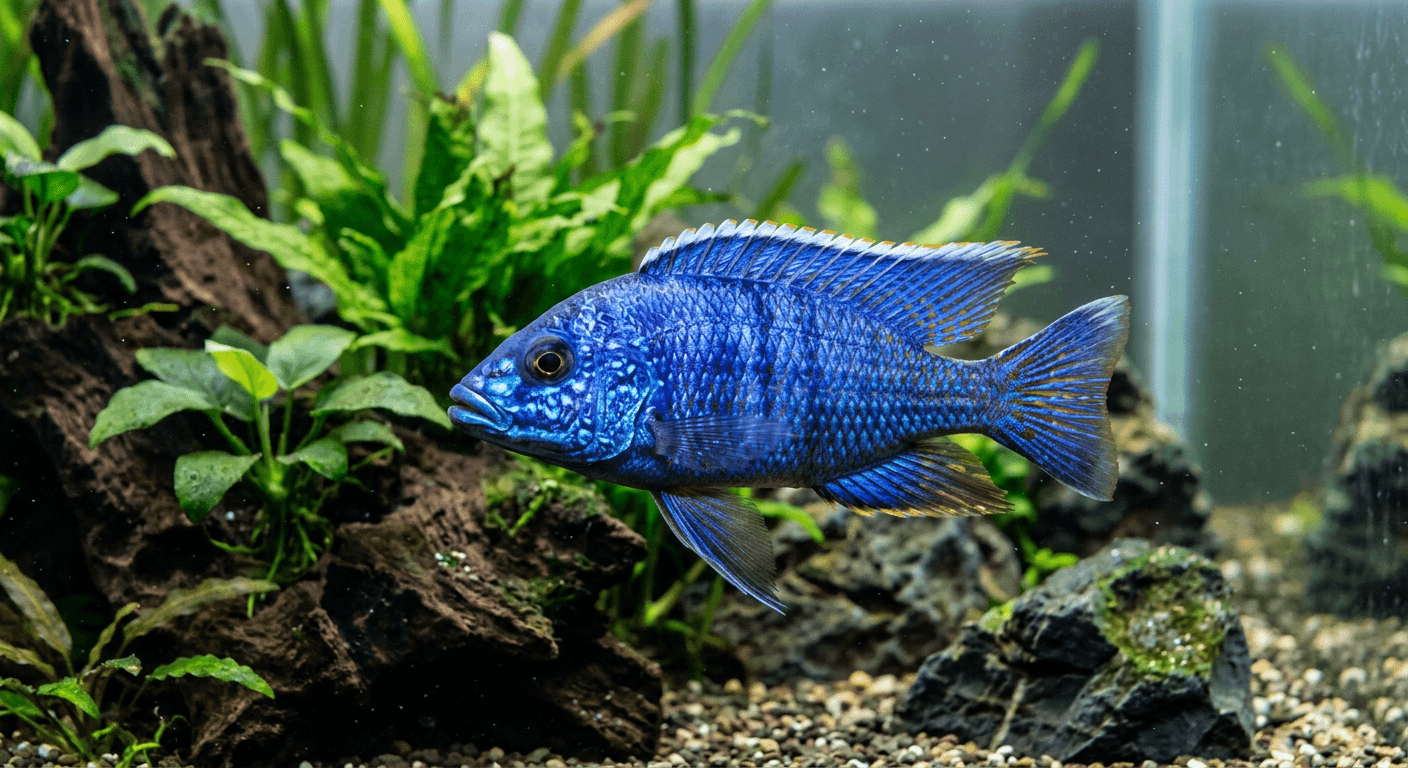
Peacock Cichlid
Aulonocara sp.
Overview
Peacock cichlids are Lake Malawi fish that genuinely look too colorful to be freshwater. Males develop intense blues, yellows, oranges, and reds depending on the species, and there are over 20 recognized Aulonocara species with dozens of locality variants on top of that. They sit in a sweet spot for cichlid keepers: colorful enough to stop people mid-sentence when they see your tank, but nowhere near as aggressive as mbuna or Central American cichlids. That said, they are still cichlids. Males will spar with each other, and they need hard alkaline water that rules out most soft-water tankmates. If you have moderately hard tap water and a 55-gallon or larger tank, peacocks are one of the most rewarding fish in the hobby. If your water comes out of the tap at pH 6.5, you will be fighting an uphill battle to keep them healthy.
Tank Setup
Start with a 55-gallon tank minimum for a small group. A 75-gallon gives you more room to manage aggression and stock 8-12 fish comfortably. Peacocks come from sandy shorelines in Lake Malawi, so use a fine sand substrate or a buffering substrate like crushed coral or aragonite that also keeps your pH elevated. Pile rocks along the back and sides to create caves and hiding spots, but leave plenty of open swimming space in the front and center. Males patrol open water and display there, while subordinate fish need caves to retreat into when things get heated. Skip the driftwood since it leaches tannins that lower pH, exactly the opposite of what you want. Most live plants will not survive the high pH and the digging, but Anubias attached to rocks and Vallisneria can work. Strong filtration is non-negotiable with these fish because they produce a lot of waste. A canister filter rated above your tank volume is the right call. Aim for 8-10x turnover per hour.
Water Parameters
Peacock cichlids need hard, alkaline water. pH should sit between 7.8 and 8.5, with 8.0-8.2 being ideal. General hardness (GH) of 4-6 dGH and carbonate hardness (KH) of 10-12 dKH will keep everything stable. If your tap water is naturally hard and alkaline, you are already most of the way there. If not, a buffering substrate like aragonite or crushed coral mixed into your sand will push pH up and keep it there. You can also add cichlid buffer salts to your water change water, but test weekly to avoid overshooting. Temperature should stay between 76-82 degrees Fahrenheit, with 79 being a good target. These fish tolerate a range but do not handle swings well. Keep nitrates below 20 ppm with weekly 25-30% water changes. In a heavily stocked peacock tank, you may need to bump that to twice per week or increase your water change volume to 40-50%.
Diet & Feeding
In Lake Malawi, peacocks feed on invertebrates they sift out of the sand. In captivity, a high-quality cichlid pellet with color-enhancing ingredients like spirulina and astaxanthin makes the best staple. New Life Spectrum Cichlid Formula and Northfin Cichlid Formula are both well-regarded options. Supplement with frozen foods like bloodworms, brine shrimp, and mysis shrimp 2-3 times a week. These extras help bring out the best coloring, especially in males that are still developing their adult colors. Feed once or twice daily, only what they can finish in about 2 minutes. Overfeeding is the fastest route to bloat, which is a serious and often fatal condition in African cichlids. One thing to watch: peacocks are not herbivores like mbuna. Do not feed them high-spirulina mbuna food as a staple since the fiber content is wrong for their digestive system and can contribute to bloat over time.
Behavior & Temperament
Peacocks are mid-level swimmers that spend their time patrolling the open areas of the tank. Males are territorial and will claim a section of rock or sand as a display site, flaring their fins and intensifying their colors to attract females or warn off rivals. The aggression is real but usually limited to chasing and flaring rather than actual damage. Housing multiple males works best in larger tanks (75+ gallons) with enough rock structure that each male can establish a territory with visual breaks from the others. The standard approach is to keep one male with 3-4 females of the same species, or mix several species with different color patterns to reduce targeted aggression. All-male peacock tanks are popular too, where you keep 10-15 males of different species without any females. This spreads aggression so thin that no single fish gets bullied. It works surprisingly well in 75-gallon and larger setups. Females are plain silver and do not color up, which is why all-male tanks appeal to many hobbyists.
Compatible Tankmates
Tankmate selection for peacocks is limited by their need for hard alkaline water and their size. Bristlenose plecos are the classic companion since they handle the high pH, stay out of the way, and help with algae. Nerite snails and mystery snails both do well in hard water. Rubber lip plecos are another solid bottom-dwelling option. Among other fish, larger rainbowfish, swordtails, and platys can work if the tank is big enough since they tolerate alkaline conditions. Tiger barbs in a school of 10+ can hold their own, though they add to the bioload considerably. Clown loaches pair nicely in very large setups (125+). Avoid any fish small enough to fit in a peacock's mouth. Neon tetras, guppies, endlers, cardinal tetras, and ember tetras will become food. Shrimp of any size will not survive. Do not mix peacocks with oscars, which will harass or eat them. Discus need soft acidic water and are incompatible on every level. German blue rams, bettas, and dwarf gouramis all need different water chemistry and will not thrive in a peacock tank.
Common Health Issues
Malawi bloat is the number one killer of peacock cichlids in captivity. It starts with loss of appetite and slightly swollen abdomen, then progresses to lethargy, stringy white feces, and rapid decline. It is linked to diet (too much protein or wrong type of food), poor water quality, and stress. Catch it early and treat with metronidazole in food. Once the fish stops eating entirely, the prognosis gets bad fast. Prevention comes down to varied diet, clean water, and not overfeeding. Ich shows up occasionally, especially after adding new fish to the tank. Raise temperature to 82-84 degrees and treat with ich medication. Peacocks are also susceptible to hole-in-the-head disease (HITH), which appears as small pits along the lateral line and head. HITH is associated with high nitrates and poor diet variety. Keeping nitrates under 20 ppm and feeding frozen foods regularly reduces the risk significantly.
Breeding
Peacock cichlids are maternal mouthbrooders. The male displays over his chosen spawning site, usually a flat rock or cleared area of sand. When a receptive female approaches, they circle each other and the female lays a small batch of eggs on the substrate, then immediately picks them up in her mouth. The male displays egg spots on his anal fin, and when the female tries to collect those "eggs," she takes in milt, fertilizing the real eggs in her mouth. The female carries 12-50 eggs for about 3 weeks, during which she does not eat. You will notice her jaw bulging and she will hide more than usual. After release, the fry are about 1 cm and can eat crushed flake or baby brine shrimp immediately. Many breeders strip the eggs from the female at the 2-week mark and tumble them artificially to reduce stress on the mother and improve survival rates. There is debate about whether stripping or letting the female hold to term produces stronger fry. Both approaches work. If you want to save fry in a community tank, pull the holding female to a separate 10-gallon tank before she spits.
Frequently Asked Questions
Quick Stats
What You Need for Peacock Cichlid
Gear that works well for this species, based on what experienced keepers actually use.
Rated for 40-70 gallons with 303 GPH flow rate. Peacocks produce heavy waste, and the 307's multi-basket media system handles the bioload of a stocked cichlid tank. Easy to maintain without disrupting the tank.
Buffers pH to the 7.8-8.5 range peacocks need and maintains it for the life of the tank. Contains live bacteria to speed up cycling. No rinsing required, which is a nice bonus for a 55-75 gallon setup.
Whole fish protein with natural color enhancers including spirulina and krill. The 1mm sinking pellet size is right for 4-6 inch peacocks, and the formula is designed for cichlid digestive systems to reduce bloat risk.
200W covers 55-75 gallon tanks comfortably. The Jager's TruTemp dial holds within half a degree, which matters for cichlids that do not handle temperature swings well. Fully submersible and shatterproof glass construction survives digging fish.