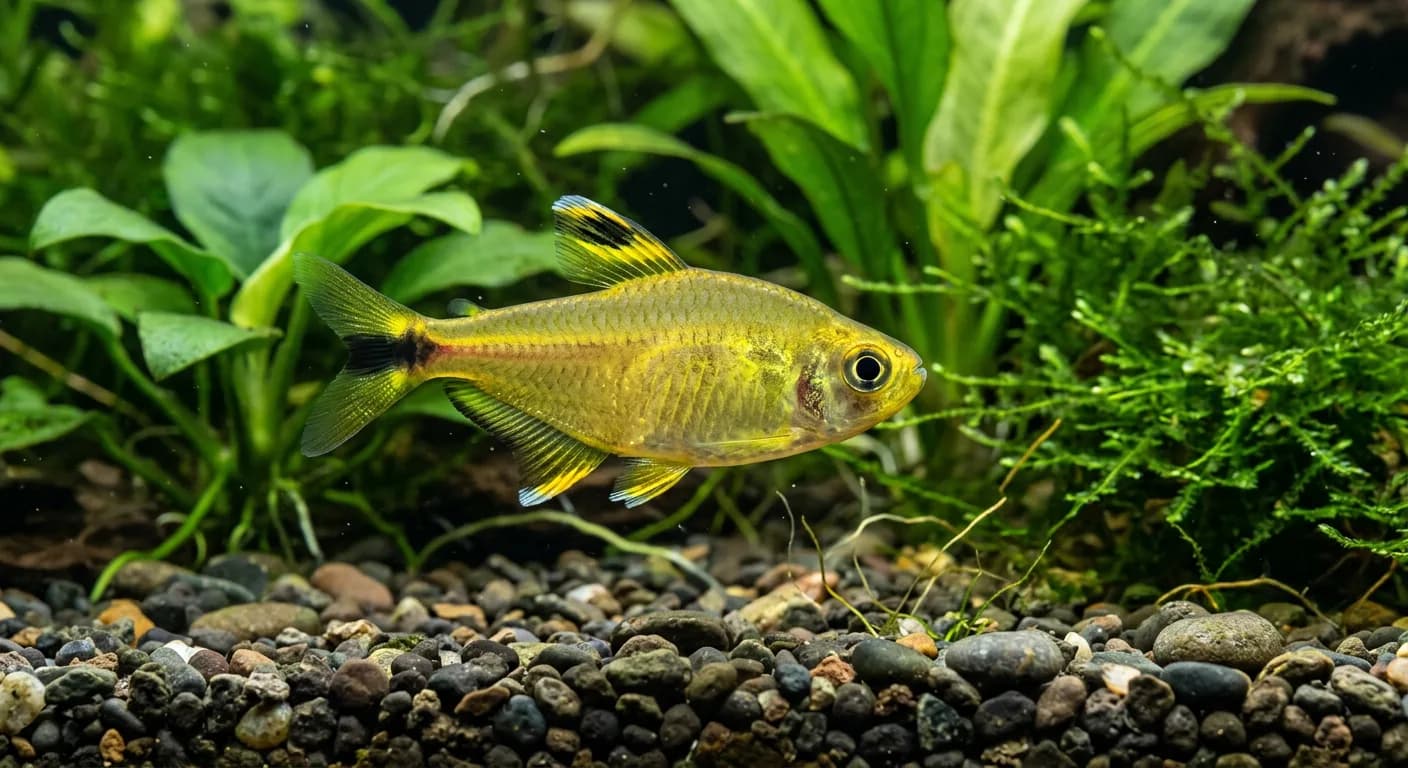
Lemon Tetra
Hyphessobrycon pulchripinnis
Overview
Lemon tetras are the understated gems of the tetra world. Unlike their flashy neon or cardinal cousins, these fish bring a soft, sunny glow to any community tank. The body is a translucent pale yellow that intensifies to a rich lemon yellow in the fins, with distinctive black and white edging on the caudal fin that gives them a striking tail pattern. Males develop slightly more intense coloration and extended dorsal fins as they mature, but females are nearly as colorful. What makes lemon tetras special is their behavior. They are active but not hyper, schooling tightly but not frantically, and they have a curious nature that makes them interesting to watch. A group of 6+ will patrol the middle levels of your tank together, occasionally branching off to explore then rejoining the school. They are peaceful enough for community tanks but bold enough to hold their own. These fish have been popular in the hobby for decades because they are forgiving of beginner mistakes, get along with almost anything, and add a warm, cheerful presence that brightens up a planted tank.
Tank Setup
A 20-gallon is the minimum for a school of 6, but a 30-gallon gives them room to really shine. Lemon tetras come from the slow-moving tributaries of the Amazon basin in Brazil, where the water is soft, acidic, and stained with tannins from decaying leaf litter. While tank-bred specimens are more adaptable than wild-caught fish, they still appreciate water on the softer side and will show their best colors in slightly acidic conditions. A planted tank suits them perfectly. Java fern, anubias, amazon swords, and crypts all work well. Driftwood and dried leaves add to the natural feel and help tint the water. Use sand or fine gravel as substrate. Filtration should be moderate — these are not strong swimmers and prefer gentle current. A hang-on-back filter rated for your tank size works fine, or a sponge filter for a planted tank setup. Avoid strong flow from canister filters or powerheads. Keep the tank covered. Like most tetras, lemon tetras can be jumpy when startled.
Water Parameters
Lemon tetras are forgiving of a wide range of parameters, which makes them great for beginners. pH between 5.5 and 7.5 works well, with slightly acidic water bringing out the best coloration. They adapt to moderately hard water but thrive in softer conditions. Temperature should stay between 73 and 84 degrees, with 78 being ideal. Like all tetras, they need clean water. Ammonia and nitrite must always be zero. Nitrates should stay under 20 ppm with weekly 25% water changes. Their small size means a bio-load is light, but that does not excuse neglect. Poor water quality shows up quickly — colors fade, behavior becomes listless, and disease follows. They are fairly hardy once established, but like all small fish, they are sensitive to sudden parameter changes. Acclimate new arrivals slowly using the drip method.
Diet & Feeding
Lemon tetras are unfussy omnivores that will eat almost anything. A quality flake or micro pellet is the daily staple. They are mid-water feeders that will take food from the surface as it drifts down. Hikari Micro Pellets, Fluval Bug Bites, or New Life Spectrum Small Formula all work well. Supplement with frozen bloodworms, brine shrimp, or daphnia 2-3 times per week. They especially love live or frozen daphnia, which brings out their best color. Feed twice daily, only what they finish in 2-3 minutes. They are not aggressive feeders and may get outcompeted by larger, faster fish. In a community tank, make sure food reaches them. Color-enhancing foods with natural astaxanthin help maintain the bright yellow coloration. Avoid overfeeding — the excess food degrades water quality quickly in a small tank.
Behavior & Temperament
Lemon tetras are the polite houseguests of the tetra world. They school tightly, swim peacefully, and rarely cause problems. A group of 6+ displays the best behavior, with the school moving as a coordinated unit. Males will occasionally display to each other by flaring their fins, but this is cosmetic competition rather than actual aggression. There is no fin nipping, no territorial behavior, no harassment of tankmates. They occupy the middle of the water column and use the full horizontal space of the tank. They are curious but not reckless, exploring plants and decorations without destroying them. Their calm demeanor makes them ideal tankmates for nearly any peaceful community fish. One note: their small size and peaceful nature means they can be intimidated by larger or more boisterous tankmates. Keep them with fish of similar size and temperament for the best results.
Compatible Tankmates
Lemon tetras get along with almost any peaceful community fish. They are small enough to be eaten by large predators, so avoid anything that sees them as food. Other small tetras and rasboras make excellent companions — neons, cardinals, embers, harlequins, and rummy-noses all work well. Corydoras of all varieties are great bottom-dwellers that share their peaceful temperament. Rasboras, barbs (except tiger barbs), and livebearers all work. Smaller gouramis like honey, dwarf, or pearl gouramis are peaceful top-to-mid dwellers. Plecos and otocinclus handle algae cleanup. Avoid large cichlids, Oscars, goldfish (wrong temperature range), aggressive barbs like tiger barbs, and fin nippers. Angelfish can work in larger tanks but may eat very small lemon tetras. Dwarf puffers are too aggressive. Basically, if it is peaceful and roughly the same size, it is a good match.
Common Health Issues
Lemon tetras are hardy little fish with few specific health problems. Ich is the most common issue, typically triggered by stress or temperature drops. Standard ich treatment — raise temperature to 86 degrees over 48 hours and add aquarium salt — works well. They can be susceptible to fungal infections if water quality is poor, showing up as white cottony patches. Improve water quality first, then treat with antifungal medication if needed. Internal parasites occasionally affect newly acquired fish, causing weight loss despite a normal appetite. Medicated food with praziquantel handles most internal parasites. The best prevention is clean, stable water and a varied, nutritious diet. Quarantine new arrivals for 2 weeks before adding them to your main tank. With good care, lemon tetras are long-lived and rarely sick.
Breeding
Breeding lemon tetras is achievable for dedicated hobbyists but requires some setup. They are egg scatterers that do not provide parental care. Set up a separate breeding tank (5-10 gallons) with very soft, slightly acidic water (pH 5.5-6.5) and a temperature around 80 degrees. Use spawning mops or fine-leaved plants like java moss for the eggs. Condition the pair with live and frozen foods for 1-2 weeks. Spawning typically occurs in the morning. The female scatters her eggs among the plants, and the male follows to fertilize. Hundreds of eggs may be laid, but only a fraction will hatch. Remove the adults after spawning — they will eat the eggs. Eggs hatch in 24-36 hours. The fry are tiny and need infusoria or liquid fry food for the first week, then can transition to baby brine shrimp. Growth is relatively fast, with fry reaching adult size in about 6 months. Sexing is difficult until they mature. Males tend to be more colorful with slightly longer dorsal fins.
Frequently Asked Questions
Quick Stats
What You Need for Lemon Tetra
Gear that works well for this species, based on what experienced keepers actually use.
Rated for tanks up to 30 gallons with excellent biological filtration. The multi-stage design handles the bioload of a lemon tetra school without creating excessive current. Quiet operation and easy media customization make it ideal for community tanks.
Insect-based formula with black soldier fly larvae as the first ingredient. High protein content supports health and color in small tetras. The small flake size is perfect for lemon tetras to eat from the mid-water column.
Adjustable 50W heater perfect for 20-30 gallon tanks. Automatic shutoff prevents overheating. Compact design hides easily behind decorations. Accurate temperature control for the 73-84F range lemon tetras need.
Complete liquid test kit measures pH, ammonia, nitrite, and nitrate. Essential for monitoring water quality in community tanks. Long-lasting and accurate. A must-have for any fish keeper.